Biaozhuo WFM-1 In-Situ Load Cell Calibration System for Hopper Scales (No Test Weights Required)

| Brand | Biaozhuo |
|---|---|
| Origin | Shanghai, China |
| Manufacturer Type | Authorized Distributor |
| Country of Origin | China |
| Model | WFM-1 |
| Price | USD 9,200 (FOB Shanghai) |
| Capacity Range | 1–100 t (configurable) |
| Accuracy | ±0.1% FS |
| Measurement Channels | 1–4 (user-selectable) |
| Pressure Stabilization Time | ≥30 s |
| Display | Touchscreen LCD with per-channel and total weight readout |
| Hydraulic System | Imported high-stability compact hydraulic actuation unit |
| Power Supply | Portable dual-mode (AC/DC), battery-operated capability included |
Ask about pricing, availability and specifications.
Overview
The Biaozhuo WFM-1 In-Situ Load Cell Calibration System is an engineered solution for traceable, on-site verification and functional calibration of hopper scales, silo load cells, and other industrial weighing systems where conventional deadweight calibration is impractical. Unlike traditional methods requiring certified test masses—often logistically unfeasible for large-capacity (>10 t), low-profile, or permanently installed installations—the WFM-1 implements a comparative force-transfer methodology grounded in the principle of stacked-load calibration (also known as hydraulic load comparison). It applies a precisely controlled, repeatable mechanical load via a calibrated reference transducer and integrated hydraulic actuator, enabling direct output comparison between the device under test (DUT) and a metrologically traceable standard sensor. This approach satisfies ISO/IEC 17025:2017 requirements for calibration validity when physical weights cannot be deployed, and aligns with ASTM E74-23 Annex A4 (Calibration by Hydraulic Force Comparison) and OIML R60 recommendations for load cell verification in situ.
Key Features
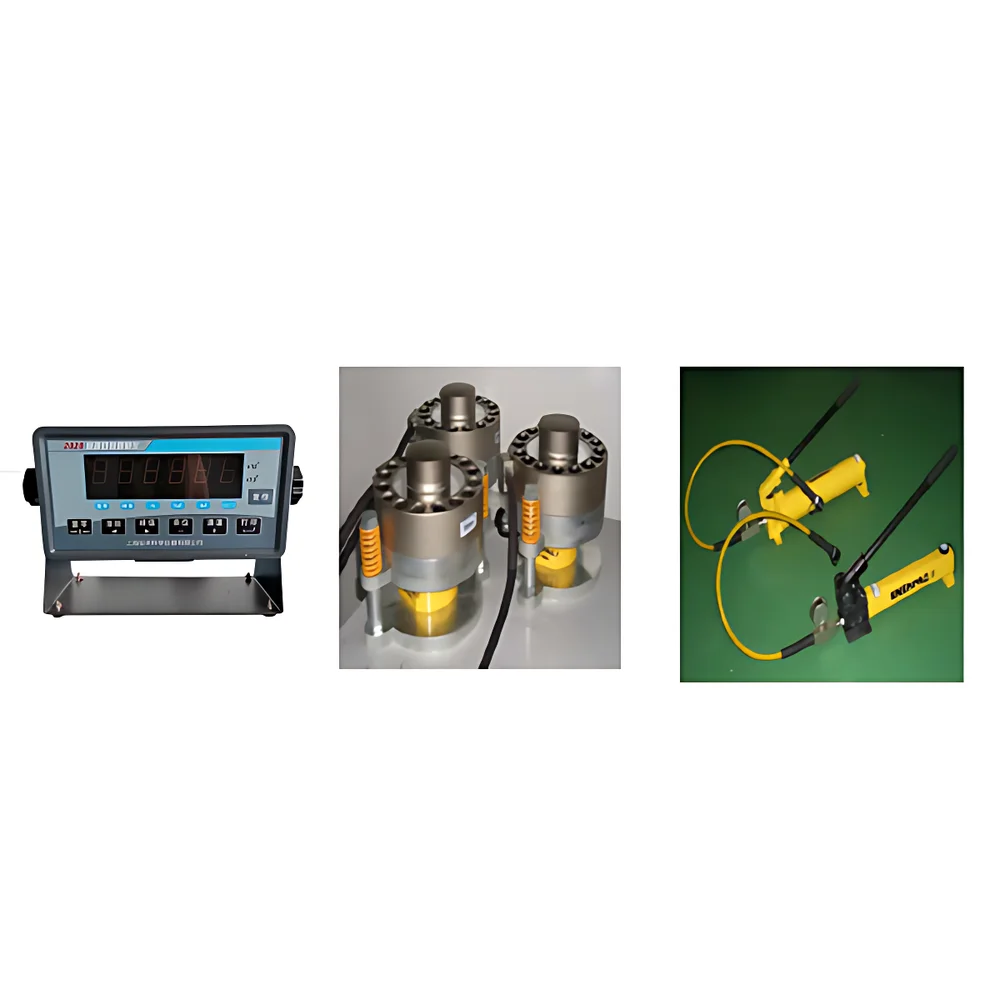
- Modular architecture comprising a Class 0.05 reference load cell, compact high-stability hydraulic actuation unit, and portable touchscreen indicator—all pre-assembled and factory-matched for system-level uncertainty < ±0.1% FS.
- Configurable multi-channel acquisition (1–4 inputs) supporting simultaneous verification of redundant or multi-sensor hopper configurations, with real-time differential output analysis.
- Imported hydraulic control system delivering pressure stability ≤0.05% over ≥30 s dwell time—critical for minimizing dynamic error during static load application per EN 45501:2015.
- Integrated portable power module with Li-ion backup (≥8 h operation) and universal AC/DC input (100–240 V, 50/60 Hz), enabling deployment in remote plant locations without external infrastructure.
- Touchscreen interface with intuitive workflow navigation, automatic zero tracking, tare memory, and export-ready data logging (CSV format) including timestamp, channel ID, applied load, DUT output, deviation, and pass/fail status per user-defined tolerance.
Sample Compatibility & Compliance
The WFM-1 is specifically designed for structural integration with standard industrial hopper scale platforms—including flanged, suspended, and compression-type mounting configurations—without disassembly or process interruption. It accommodates load cell interfaces compliant with IEC 61000-6-2/6-4 (EMC immunity/emission), IP65-rated enclosures, and common analog outputs (mV/V, 4–20 mA) or digital protocols (RS-485 Modbus RTU). Calibration reports generated by the system meet GLP/GMP documentation requirements, including full audit trail (operator ID, date/time stamp, environmental conditions, calibration certificate number), and support 21 CFR Part 11-compliant electronic signatures when paired with validated enterprise software. The reference sensor carries a valid DAkkS-accredited calibration certificate (traceable to NIM, China), with recalibration interval recommended at 12 months or after 500 operational cycles.
Software & Data Management
The embedded firmware supports local data storage (≥10,000 records) and USB mass-storage mode for offline report transfer. Optional PC-based calibration management software (WFM-Control Suite v2.1) provides advanced functionality: automated test sequence scripting, multi-point linearity/hysteresis evaluation per ISO 376, uncertainty budget calculation per GUM (JCGM 100:2008), PDF report generation with digital signature fields, and integration with LIMS via HL7 or CSV API. All data files include embedded metadata (device serial numbers, environmental temperature/humidity logs from integrated sensors, hydraulic pressure history), ensuring full traceability for internal audits or regulatory inspections.
Applications
- Periodic verification of batching hopper scales in cement, fertilizer, and polymer production lines.
- Commissioning validation of newly installed load cell arrays in bulk material handling systems.
- Troubleshooting suspected drift or nonlinearity in existing weigh modules without process shutdown.
- Supporting ISO 9001:2015 Clause 7.1.5 (monitoring and measuring resources) and FDA guidance on scale performance verification in pharmaceutical ingredient dispensing.
- Field calibration of explosion-proof (ATEX/IECEx) rated load cells where hazardous area access prohibits conventional weight handling.
FAQ
Does the WFM-1 replace periodic full-scale deadweight calibration?
No—it serves as an intermediate verification tool between formal accredited calibrations. Per ISO/IEC 17025, it provides evidence of ongoing metrological fitness but does not substitute for initial type approval or annual traceable deadweight calibration.
Can it be used on load cells with different output signals (e.g., 4–20 mA vs. mV/V)?
Yes—the indicator accepts both analog signal types via configurable input modules; scaling factors are programmable per channel.
Is hydraulic oil maintenance required in the field?
The sealed hydraulic unit requires no routine servicing; it is rated for 10,000 cycles or 5 years, whichever occurs first, under normal ambient conditions (−10 °C to +50 °C).
What environmental conditions affect measurement validity?
Calibration should be performed within ±5 °C of the sensor’s rated operating temperature range; built-in thermal compensation corrects for short-term drift up to ±2 °C/min.
How is traceability documented for audit purposes?
Each calibration event generates a timestamped digital record with unique identifier, reference sensor certificate number, operator ID, and deviation values—exportable as tamper-evident PDF or CSV with SHA-256 hash verification.
More from Biaozhuo
View all Biaozhuo products → Biaozhuo SDF-3 Portable pH Meter / Conductivity Meter / Spectrophotometer Calibration System
- Biaozhuo BIO/AB-D-II Multi-Function Standard Disc for Calibration of Antibiotic Potency Assay Instruments
- Fatigue Testing Machine Calibration System FTM-S by BIAOZHUO
- Biaozhuo Standard Calibration Glass Spheres for Rain Gauges (Compliant with JJG524–1988)