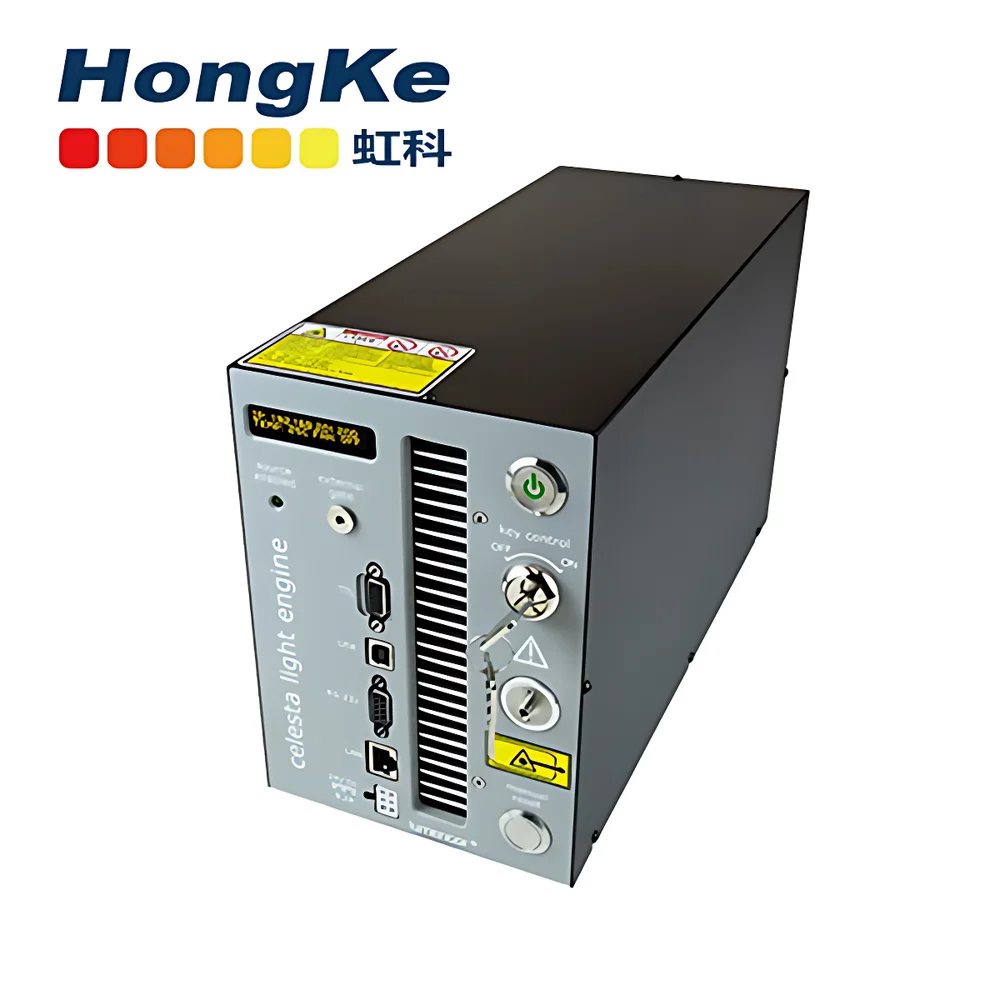
Lumencor CELESTA Solid-State Light Engine for Laser Microscopy

| Origin | USA |
|---|---|
| Manufacturer Type | Authorized Distributor |
| Origin Category | Imported |
| Model | CELESTA |
| Price Range | USD 1,400 – 4,200 (FOB) |
| Light Source Type | Solid-State Hybrid Array (LED + Laser + Lumencor Patented Lightpipe) |
| Illumination Mode | Internal (Through Objective or Side-Arm Coupling) |
| Output Power per Channel | ~1000 mW (via 1.5 mm Core Fiber) |
| Lifetime | >50,000 hours (typical, at rated output) |
| Control Interface | USB 2.0, TTL, Analog Voltage |
| Software | Lumencor LightEngine GUI v3.x (Windows/macOS) |
Ask about pricing, availability and specifications.
Overview
The Lumencor CELESTA is a high-performance, solid-state light engine engineered specifically for demanding fluorescence microscopy applications—including confocal, super-resolution, light-sheet, and optogenetics workflows. Unlike conventional arc-lamp sources (e.g., mercury or xenon), the CELESTA integrates a hybrid array of monochromatic lasers, narrowband LEDs, and Lumencor’s proprietary Lightpipe™ technology—a patented broadband luminescent waveguide delivering high irradiance in the 500–600 nm range. This architecture directly addresses the “green gap” limitation of conventional LEDs while maintaining spectral purity, temporal stability, and spatial coherence required for quantitative imaging. The system delivers up to seven independently controllable spectral channels, each coupled into a 1.5 mm core multimode fiber with nominal output power of ~1000 mW per channel. Designed for internal illumination pathways (objective-based or side-arm coupling), CELESTA eliminates thermal drift, arc instability, and spectral flicker inherent in plasma-based sources—enabling reproducible photon flux delivery critical for time-lapse, FRAP, FRET, and calcium imaging.
Key Features
- Seven-channel solid-state architecture: Combines discrete lasers (e.g., 405, 488, 561, 640 nm), high-output LEDs, and Lightpipe™ broadband emitters (525–575 nm) for full-spectrum coverage without mercury vapor lamps.
- Stable, flicker-free output: <±0.5% RMS intensity noise over 8 hours; no warm-up period required—operational within seconds at ambient temperature.
- Independent digital control: Each channel supports TTL-triggered on/off, analog voltage modulation (0–5 V), and software-defined ramping profiles with microsecond-level timing resolution.
- Integrated photodiode monitoring: Real-time feedback loop maintains power stability across ambient temperature fluctuations and long-term operation.
- Modular scalability: Compatible with CELESTA Quattro configuration (4- or 5-channel variant) for cost-optimized deployment in routine fluorescence screening or teaching labs.
- 15-year design lifetime: Rated for >50,000 hours at full output—eliminating lamp replacement cycles, alignment recalibration, and associated downtime.
Sample Compatibility & Compliance
CELESTA is compatible with all major commercial fluorescence microscope platforms—including Nikon Ti2-E, Olympus IXplore, Zeiss Axio Observer, and Leica DMi8—via standard C-mount, fiber-coupled objective ports, or OEM integration kits. Its emission spectra comply with common fluorophore excitation bands (DAPI, FITC, TRITC, Cy5, etc.) and support multicolor co-localization studies with minimal crosstalk. From a regulatory standpoint, CELESTA meets IEC 61000-6-3 (EMC Emission) and IEC 62471 (Photobiological Safety) Class 1 requirements. While not a medical device, its stable, repeatable output supports GLP-compliant imaging workflows where traceable illumination parameters are essential—particularly in high-content screening (HCS), FISH, and live-cell assay development. Full audit trails (power log, session timestamps, firmware version) are exportable via the LightEngine GUI for internal quality documentation.
Software & Data Management
The CELESTA is operated exclusively through Lumencor’s LightEngine GUI v3.x—a cross-platform application supporting Windows 10/11 and macOS 12+. The interface provides intuitive channel selection, power calibration per wavelength, preset protocol storage (e.g., “Confocal Stack”, “Optogenetic Stimulation”), and synchronized TTL triggering with camera acquisition software (e.g., Micro-Manager, MetaMorph, NIS-Elements). All user actions—including power adjustments, exposure timing, and channel enable/disable—are logged with ISO 8601 timestamps and stored locally in CSV format. The software supports FDA 21 CFR Part 11–compliant user authentication (role-based access control), electronic signatures, and data integrity validation—making it suitable for regulated environments requiring ALCOA+ principles (Attributable, Legible, Contemporaneous, Original, Accurate).
Applications
- Confocal & Spinning-Disk Microscopy: High peak power and low noise enable optimal signal-to-background ratio in thick-tissue imaging and z-stack acquisition.
- Optogenetics: Precise, millisecond-scale laser pulsing (473 nm, 561 nm) enables reliable neuronal activation/inhibition with minimal phototoxicity.
- FISH & Chromosome Imaging: Stable 405/488/561/640 nm excitation ensures uniform probe labeling and quantifiable signal intensity across large fields-of-view.
- High-Content Screening (HCS): Multi-channel programmability supports automated plate-based assays with dynamic illumination scheduling per well.
- Microfluidic Cell Culture Imaging: Compact footprint and fiber-coupled output integrate seamlessly into enclosed chip-based systems requiring localized, heat-free illumination.
- Endomicroscopy & Miniaturized Probes: 1.5 mm fiber output enables direct coupling to GRIN lenses or custom distal optics for in vivo applications.
FAQ
Does CELESTA require alignment or periodic recalibration?
No—solid-state emitters and factory-aligned optical paths eliminate mechanical drift. Photodiode feedback ensures automatic power stabilization; no user intervention is needed beyond initial setup.
Can CELESTA replace mercury/xenon lamps in existing microscopes?
Yes—fiber-coupled output allows drop-in replacement via standard microscope light ports or OEM adapter kits. No modification to the host microscope is required.
Is LightEngine GUI compatible with third-party acquisition software?
Yes—TTL and analog voltage interfaces enable hardware synchronization with Micro-Manager, ThorCam, Andor SDK, and Hamamatsu HCImage via external trigger lines.
What maintenance does CELESTA require over its 15-year service life?
None beyond routine dust removal from fiber connectors and ventilation grilles. No consumables, no lamp replacements, no optical realignment.
How is spectral crosstalk managed between adjacent channels?
Each channel employs bandpass filtering matched to emitter FWHM and optimized for common fluorophore excitation profiles. Spectral overlap is minimized via optical isolation and software-enforced interlock logic.