
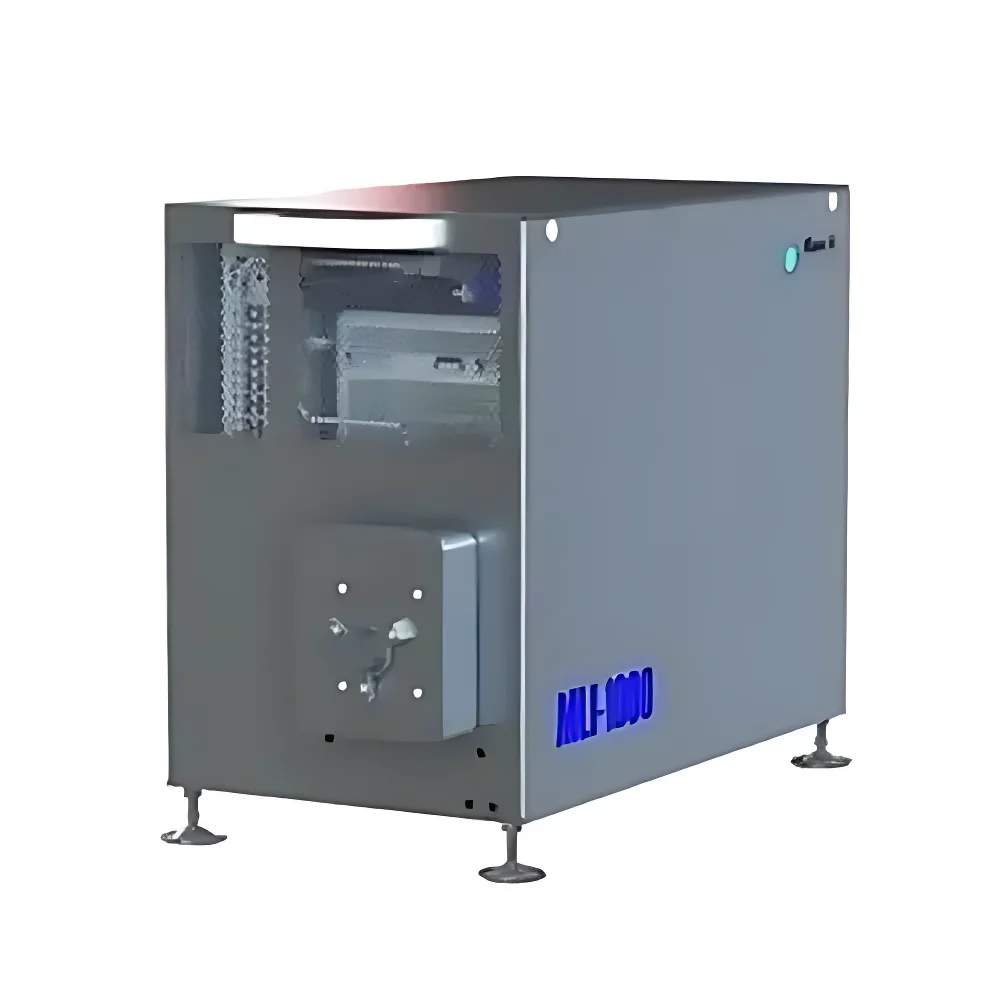
MLase AG ML-ARF 1000LC Excimer Laser System

| Brand | MLase AG |
|---|---|
| Origin | Germany |
| Model | ML-ARF 1000LC |
| Wavelength | 193 nm (ArF) |
| Pulse Repetition Rate | Up to 1 kHz |
| Beam Homogeneity | >90% Top-Hat Profile |
| Energy Stability | ≤±2% RMS over 8 hours |
| Cooling | Active Water Cooling (LC variant) |
| Compliance | CE, RoHS, IEC 60825-1:2014 Class 4 Laser Product |
| Interface | USB 2.0, RS-232, Analog TTL Trigger |
| OEM Integration | Standardized electrical & mechanical interfaces |
Ask about pricing, availability and specifications.
Overview
The MLase AG ML-ARF 1000LC is a high-reliability, industrial-grade excimer laser system engineered for precision ultraviolet photoprocessing in semiconductor manufacturing, optical component fabrication, and advanced materials research. Operating at the deep-ultraviolet wavelength of 193 nm (ArF excimer), it leverages the fundamental photochemical ablation mechanism—where photon energy exceeds the bond dissociation energy of target materials—to enable non-thermal, sub-micron resolution material removal with minimal thermal damage zone. Its design adheres to the physical constraints of excimer gas discharge physics: stable plasma formation in Ar/F₂ gas mixture, optimized electrode geometry for uniform gain distribution, and thermally managed resonator architecture enabling sustained pulse-to-pulse consistency. Unlike solid-state UV lasers, the ML-ARF 1000LC delivers inherently short pulse durations (~10–20 ns FWHM) and high peak power (>100 MW), making it uniquely suited for applications demanding deterministic photon–matter interaction—such as photolithography mask repair, thin-film patterning, and surface conditioning of SiC, GaN, and fused silica substrates.
Key Features
- Active water-cooled (LC) architecture supporting continuous operation at 100% duty cycle without thermal drift—enabling uninterrupted wafer-level processing or long-duration metrology calibration sequences.
- High spatial beam uniformity (>90% top-hat profile) and energy stability (≤±2% RMS over 8 h), critical for reproducible ablation thresholds in lithographic resist development and DLC film etching.
- Integrated control electronics with USB 2.0 and RS-232 interfaces, compliant with SEMI E54.12 (Equipment Communications Standard) for seamless integration into factory automation environments.
- Modular gas handling system with sealed, pre-filled gas cartridges and automatic pressure regulation—reducing maintenance downtime and eliminating manual gas mixing procedures.
- OEM-ready mechanical footprint and standardized I/O pinout (24 V DC logic, TTL sync signals), facilitating drop-in integration into custom vacuum chambers, mask aligners, or laser-induced forward transfer (LIFT) platforms.
Sample Compatibility & Compliance
The ML-ARF 1000LC is compatible with a broad spectrum of optically opaque and transparent materials common in semiconductor front-end and back-end processes—including silicon wafers, sapphire substrates, low-k dielectrics (e.g., SiCOH), photoresists (DUV chemically amplified resists), and hard masks (TiN, TaN). Its 193 nm output exhibits strong absorption in organic polymers (α > 10⁵ cm⁻¹) and wide-bandgap semiconductors (Eg > 6.2 eV), ensuring efficient ablation with minimal subsurface damage. The system conforms to ISO 13406-2 for laser safety interlock integrity, meets IEC 61000-6-4 electromagnetic emission limits for industrial environments, and supports GLP-compliant audit trails when paired with optional time-stamped logging firmware. All optical path components are certified to ASTM F2739 for UV-transmission stability under prolonged irradiation.
Software & Data Management
Control is executed via MLase’s proprietary LaserControl Suite v3.2—a Windows-based application supporting real-time pulse energy monitoring, shot counter logging, and user-defined parameter sets (pulse rate, voltage, gas pressure). The software exports ASCII-formatted logs compliant with ASTM E1482-22 for raw data traceability and integrates with third-party SCADA systems via OPC UA (IEC 62541) profiles. Optional FDA 21 CFR Part 11 compliance packages include electronic signature enforcement, role-based access control, and immutable audit trail generation for regulated semiconductor fabs operating under ISO 9001:2015 and IATF 16949 quality management frameworks.
Applications
- Semiconductor photomask repair and defect mitigation on reticles used in 193i immersion lithography nodes (≤28 nm HP).
- Precision micromachining of MEMS packaging substrates (AlN, LTCC) with <±0.5 µm feature placement accuracy.
- Laser-assisted chemical vapor deposition (LA-CVD) initiation for selective growth of graphene on Cu/Ni foils.
- Surface activation of polyimide flex circuits prior to electroless Cu plating—enhancing adhesion strength per IPC-4552B.
- Calibration source for UV spectroradiometers used in cleanroom photolithography tool qualification (per SEMI F20-0212).
FAQ
What gas mixture is required for 193 nm operation?
The ML-ARF 1000LC uses a premixed Ar/F₂ gas blend (typically 0.1–0.3% F₂ in Ar) supplied in certified, leak-tested cylinders. Gas lifetime is rated for ≥1 × 10⁹ pulses under standard operating conditions.
Is external chiller mandatory for LC cooling?
No—tap water (10–25°C, flow rate ≥3 L/min) suffices for most lab and pilot-line applications. For production environments requiring temperature stability ±0.1°C, an external heat exchanger is recommended.
Can the system be integrated into a Class 10 cleanroom environment?
Yes—the laser head and power supply are rated IP54; optional stainless-steel enclosures and HEPA-filtered purge ports are available for ISO 4 (Class 10) compatibility.
Does MLase provide application-specific beam delivery optics?
Yes—customizable homogenizers, telecentric scan lenses, and reflective beam expanders optimized for 193 nm transmission are offered under separate part numbers (e.g., MLO-HOMO-193, MLO-SCAN-193-10x).
What is the typical warm-up time to achieve specified energy stability?
Less than 15 minutes from cold start, verified per ISO 13695:2021 stability test protocol using calibrated pyroelectric sensor and oscilloscope trigger synchronization.