
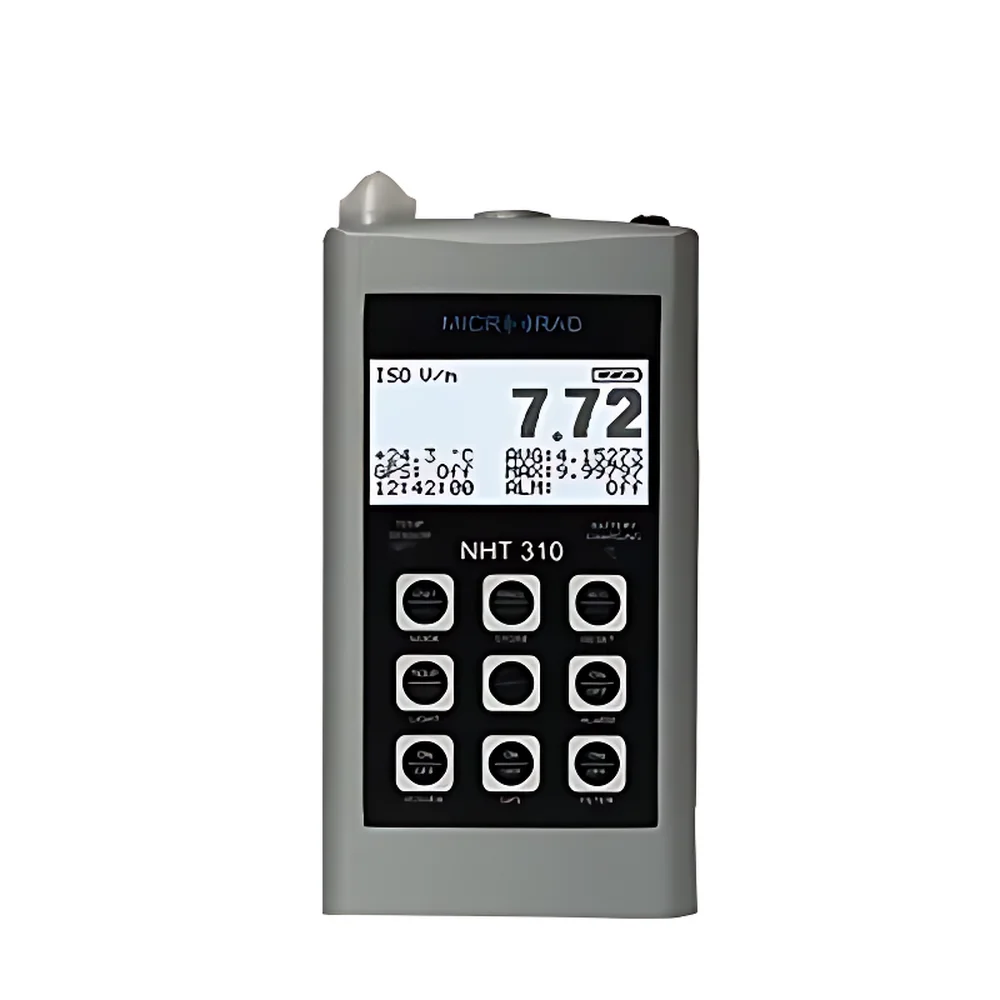
MicroRad NHT-310 Portable Broadband Electromagnetic Field Analyzer

| Brand | MicroRad |
|---|---|
| Origin | Italy |
| Model | NHT-310 |
| Frequency Range | DC–40 GHz |
| Display | 7 cm monochrome backlit LCD (128 × 64 px) |
| Battery Life | >70 h (backlight off) |
| Data Storage | 21,504 samples |
| Interface | Fiber-optic (full-duplex serial), USB, 3× SMA analog outputs (X/Y/Z) |
| Probe Interface | Plug-and-play LEMO™ with auto-recognition |
| Built-in Sensors | Temperature, GPS (optional) |
| Housing | Magnesium-aluminum alloy |
| Operating Temperature | –10 °C to +50 °C |
| Dimensions (host) | 160 × 98 × 30 mm |
| Weight (host) | 500 g |
| Compliance | EN 50499, IEC 62232, ICNIRP guidelines, EU Directive 2013/35/EU (replacing 2004/40/EC) |
Ask about pricing, availability and specifications.
Overview
The MicroRad NHT-310 is a portable, broadband electromagnetic field (EMF) analyzer engineered for traceable, high-fidelity assessment of human exposure to electromagnetic fields across an exceptionally wide frequency spectrum—from static (DC) fields up to 40 GHz. Designed in accordance with the requirements of EU Directive 2013/35/EU (Occupational Exposure), EN 50499 (Assessment of EMF exposure), and aligned with ICNIRP 2020 and IEEE C95.1 safety reference levels, the NHT-310 implements a calibrated, probe-based measurement architecture rooted in standardized field metrology. Its core principle relies on real-time sampling of electric (E) and magnetic (H) field components using interchangeable, factory-calibrated isotropic probes—each characterized by defined frequency response, linearity, and uncertainty budgets traceable to national metrology institutes. Unlike single-band survey meters, the NHT-310 integrates hardware-level signal conditioning, synchronous multi-axis digitization, and on-board vector summation to deliver true RMS, peak, and time-weighted exposure metrics compliant with occupational and public health evaluation protocols.
Key Features
- Ultra-wideband coverage from DC to 40 GHz—enabling unified assessment of static fields (e.g., MRI fringe fields), power-frequency harmonics (50/60 Hz and up to 400 kHz), RF sources (mobile base stations, Wi-Fi, LTE), and millimeter-wave emissions (5G FR2, radar).
- Modular probe architecture with automatic LEMO™ plug-and-play recognition—supports E-field probes (e.g., PROBE-11E: 5 Hz–400 kHz; PROBE-01E: 100 kHz–6.5 GHz) and H-field probes (e.g., PROBE-10B: 5 Hz–400 kHz), each supplied with individual calibration certificates valid for 24 months.
- Rugged magnesium-aluminum housing rated for field deployment—IP54 ingress protection, integrated temperature sensor for thermal drift compensation, and optional embedded GPS for georeferenced logging.
- High-capacity battery system delivering >70 hours of continuous operation (backlight disabled) and full recharge in ≤4 hours—optimized for extended site surveys without external power dependency.
- On-device data management: 21,504-sample memory buffer, configurable logging intervals (down to 1 s), multi-threaded acquisition supporting simultaneous E/H-field monitoring, MAX/AVG/median/actual value computation, and time-stamped exposure duration tracking.
- Dual-interface connectivity: fiber-optic serial link (full-duplex, EMI-immune) for real-time streaming and USB 2.0 for local data transfer—complemented by three isolated SMA analog outputs (X/Y/Z axes) for integration with external DAQ systems or oscilloscopes.
Sample Compatibility & Compliance
The NHT-310 supports measurement of electromagnetic field parameters in diverse physical configurations—including near-field reactive zones (e.g., induction heaters, welding equipment), far-field radiating environments (e.g., broadcast towers, cellular infrastructure), and mixed-mode exposure scenarios (e.g., hospital MRI suites with concurrent RF and low-frequency gradients). All probes are isotropic (±0.5 dB deviation at reference frequencies), linear (±0.5 dB over specified dynamic ranges), and validated per IEC 61786-1 and IEC 62110. The system meets the technical requirements for compliance verification under EN 50499 Annex A (for occupational assessment) and EN 50499 Annex B (for general public exposure), and supports audit-ready reporting aligned with GLP principles. Calibration is traceable to INRIM (Istituto Nazionale di Ricerca Metrologica), Italy, and documented per ISO/IEC 17025.
Software & Data Management
MicroLink software (Windows XP–11 compatible) provides full instrument control, real-time spectral visualization, exposure limit overlay (ICNIRP, IEEE, national variants), and automated report generation per EN 50499 templates. It enforces secure data integrity through encrypted project files, user-access logging, and immutable metadata stamping (timestamp, GPS coordinates, probe ID, calibration expiry). For regulated environments, MicroLink supports 21 CFR Part 11-compliant configuration—enabling electronic signatures, audit trails, and role-based permissions when deployed in GxP-aligned occupational hygiene programs.
Applications
- Ongoing compliance monitoring for industrial facilities operating induction furnaces, dielectric heaters, arc welders, and RF sealers—per EN 62233 and EU Directive 2013/35/EU.
- Pre-commissioning and periodic safety audits of MRI systems, including static field (B₀), gradient switching (dB/dt), and RF transmit chain emissions.
- Site surveys around high-voltage substations, traction power lines (railway electrification), and renewable energy inverters—covering ELF to VLF harmonics.
- Radiofrequency exposure assessment for telecom infrastructure: macrocell sites, small cells, DAS, satellite earth stations, and broadcast AM/FM/DTV transmitters.
- Public space evaluation in sensitive locations—schools, hospitals, residential zones—against national reference levels derived from ICNIRP.
- Research-grade characterization of novel wireless technologies (e.g., 5G NR FR2, UWB, IoT gateways) where broadband capture of transient and modulated signals is essential.
FAQ
What standards does the NHT-310 support for occupational exposure assessment?
The NHT-310 complies with EN 50499, EU Directive 2013/35/EU, ICNIRP 2020, and IEEE C95.1, and is routinely deployed for assessments referenced in national legislation across the EU, UK, Australia, and Canada.
Can the NHT-310 measure both electric and magnetic fields simultaneously?
Yes—when equipped with dual-axis or triaxial E- and H-field probes (e.g., PROBE-11E + PROBE-10B), the NHT-310 acquires synchronized X/Y/Z components and computes resultant field vectors and exposure ratios in real time.
Is GPS data embedded in measurement records?
GPS is optional but factory-integrated; when enabled, position, altitude, and UTC timestamp are automatically appended to every logged sample and exported via MicroLink.
How is calibration traceability maintained?
Each probe ships with a certificate indicating calibration date, uncertainty budget, frequency points tested, and traceability to INRIM. Recalibration is recommended every 24 months or after mechanical shock or environmental stress.
Does the NHT-310 support real-time spectral analysis?
No—the NHT-310 is a broadband field strength meter, not a spectrum analyzer. It delivers broadband RMS, peak, and time-weighted exposure values per standardized metrics—not frequency-domain decomposition.
