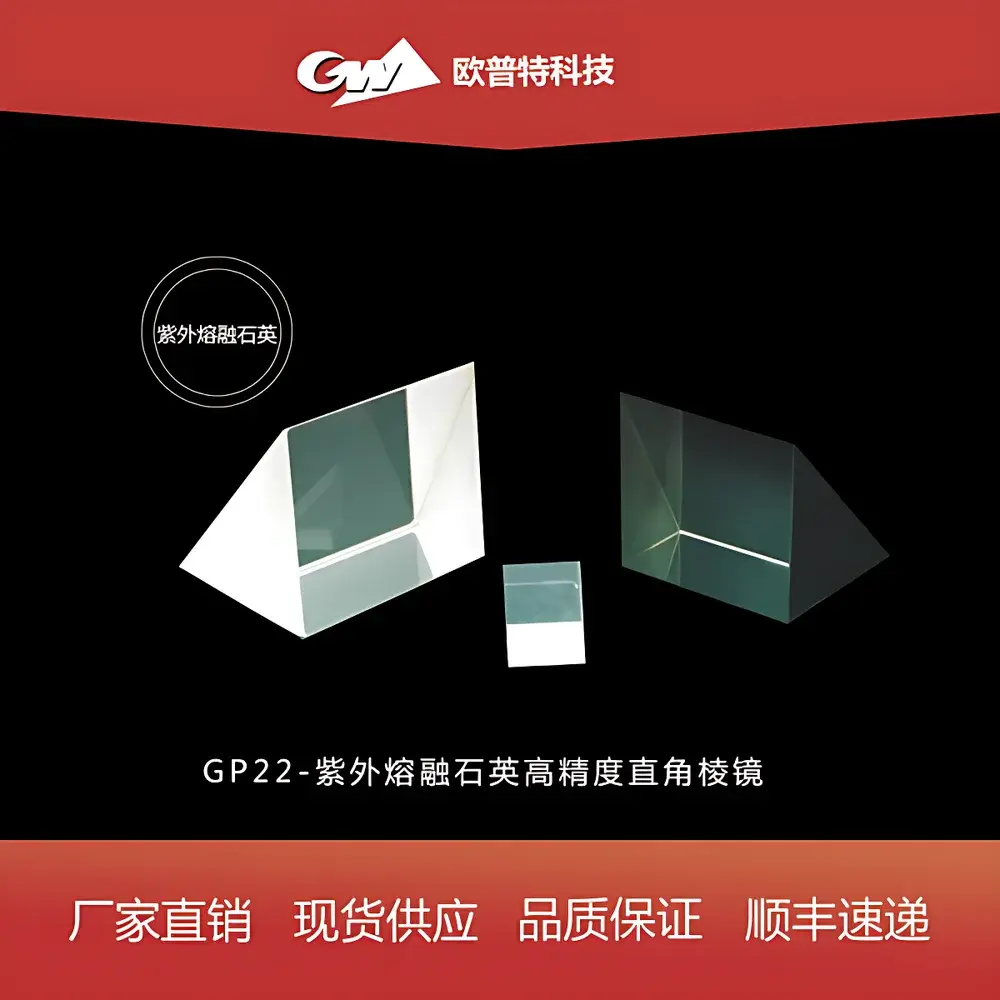
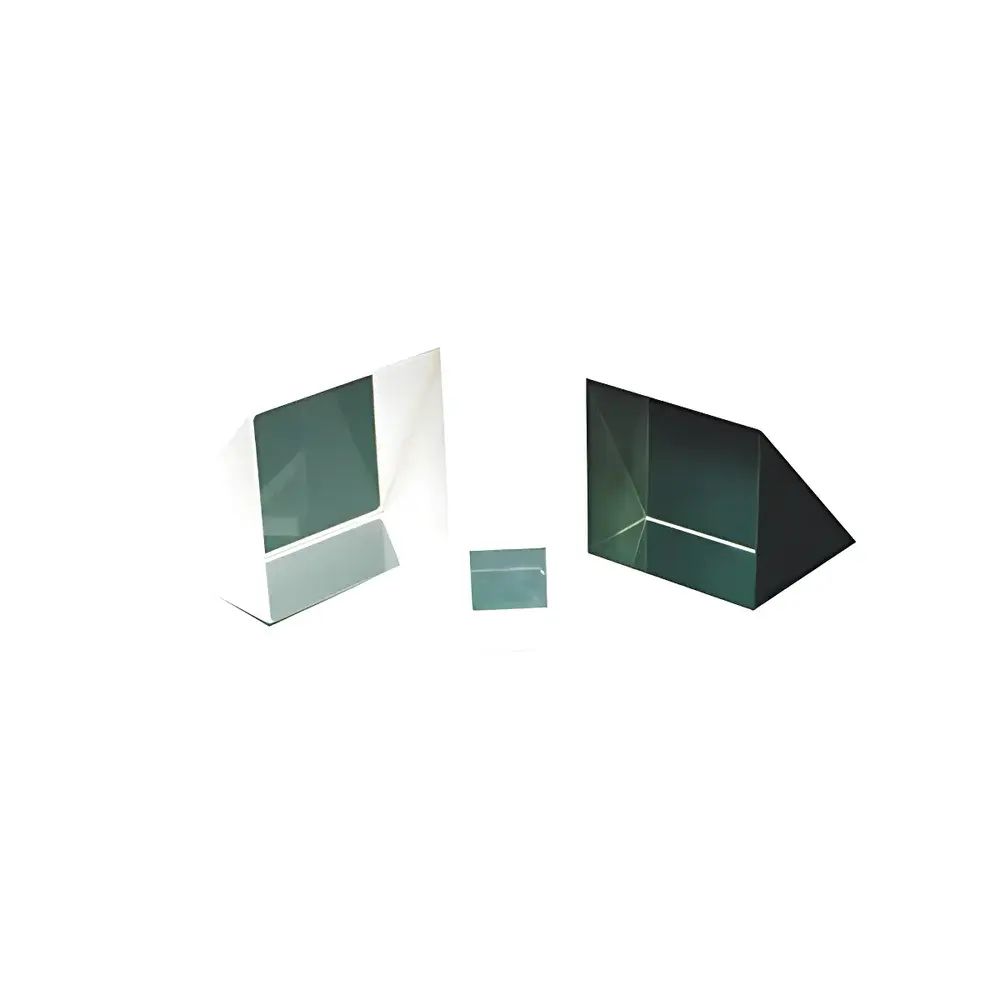
GP22 Ultra-Violet Grade Fused Silica Precision Right-Angle Prism

| Material | UV-grade fused silica |
|---|---|
| Dimensions tolerance | +0.0 / −0.1 mm |
| Surface flatness | λ/10 @ 632.8 nm |
| Surface quality | 10–5 scratch-dig (MIL-PRF-13830B) |
| Angular accuracy | ±15 arcseconds |
| Beam deviation (tower error) | < 5 arcminutes |
| Edge deletion | 0.25 mm × 45° chamfer |
| Coating options | Uncoated, UV-enhanced AR (250–400 nm), or Al + protected dielectric on hypotenuse |
| Available sizes (A=B=C) | 5.0 mm, 6.3 mm, 10.0 mm, 12.5 mm, 15.0 mm |
Ask about pricing, availability and specifications.
Overview
The GP22 Ultra-Violet Grade Fused Silica Precision Right-Angle Prism is a high-stability optical component engineered for demanding applications in UV spectroscopy, laser beam steering, interferometry, and alignment-critical optical systems. Fabricated from synthetic UV-grade fused silica (SiO₂), this prism exhibits exceptional transmission from 180 nm to 2.1 µm, low thermal expansion (α ≈ 0.55 × 10⁻⁶ /°C), and superior resistance to solarization under prolonged UV exposure. Its right-angle geometry (90° ±15″) enables reliable 90° beam deviation via total internal reflection (TIR) at the hypotenuse face when used uncoated — or enhanced broadband performance when configured with optimized coatings. The prism adheres to ISO 10110-3 surface specification standards and is manufactured under controlled cleanroom conditions to ensure sub-micron dimensional repeatability and wavefront fidelity.
Key Features
- UV-grade fused silica substrate with certified OH content < 1 ppm and refractive index homogeneity Δn < 5 × 10⁻⁶
- Angular precision of ±15 arcseconds across all three orthogonal edges, verified by autocollimation interferometry
- Surface flatness maintained at λ/10 @ 632.8 nm (RMS), measured via phase-shifting Fizeau interferometry
- Surface quality rated to 10–5 scratch-dig per MIL-PRF-13830B, confirmed by automated dark-field inspection
- Controlled edge treatment: 0.25 mm × 45° protective chamfer applied to all edges to mitigate chipping and coating delamination
- Multiple coating configurations available: uncoated (for TIR operation), UV-enhanced anti-reflection (250–400 nm, R92% from 250–700 nm)
Sample Compatibility & Compliance
The GP22 prism is compatible with standard optomechanical mounts including kinematic bases, cage systems (e.g., Thorlabs 30 mm and 60 mm), and lens tubes. It meets RoHS Directive 2011/65/EU compliance and is free of restricted substances including lead, cadmium, and hexavalent chromium. All manufacturing processes follow ISO 9001:2015 quality management protocols. For regulated environments—such as pharmaceutical analytical labs or aerospace test facilities—the prism’s traceable calibration documentation supports GLP and GMP audit requirements. While not an active measurement device, its geometric and surface specifications are validated per ISO 10110-7 (surface imperfections) and ISO 10110-8 (surface irregularity), ensuring interoperability with metrology-grade optical assemblies.
Software & Data Management
As a passive optical component, the GP22 prism does not incorporate embedded firmware or digital interfaces. However, it is fully supported within industry-standard optical design platforms including Zemax OpticStudio (ZOS), CODE V, and FRED. Pre-characterized material dispersion data (Schott N-SF11-equivalent Sellmeier coefficients for UV fused silica) and measured surface error maps (available upon request for batch-certified units) can be imported directly into ray-tracing simulations. Each shipped unit includes a certificate of conformance listing serial number, dimensional verification results, surface quality assessment, and coating spectral reflectance/transmittance curves (where applicable). Digital copies of certificates are provided in PDF/A-1b format for long-term archival compliance.
Applications
- Laser cavity folding and beam path redirection in excimer (193 nm, 248 nm) and frequency-tripled Nd:YAG (355 nm) systems
- Reference elements in UV-visible spectrophotometer optical benches requiring high polarization stability
- Alignment fiducials in semiconductor lithography tool calibration subassemblies
- Beam combiners and image rotators in multi-channel fluorescence microscopes
- Input/output coupling optics for vacuum ultraviolet (VUV) monochromators operating down to 120 nm
- Interferometric reference arms where thermal drift compensation and wavefront preservation are critical
FAQ
What is the maximum permissible incident angle for total internal reflection (TIR) in the uncoated GP22 prism?
For UV-grade fused silica (n ≈ 1.56 at 254 nm), the critical angle for TIR at the hypotenuse interface is approximately 39.7°. Operation is recommended within ±2° of normal incidence on the entrance face to maintain minimal wavefront distortion.
Can the GP22 prism be used in ultra-high-vacuum (UHV) environments?
Yes — the bulk material outgassing rate is < 1.0 × 10⁻¹² Pa·m³/s·cm² (per ASTM E595), and the absence of organic adhesives or polymer-based coatings ensures compatibility with UHV bake-out cycles up to 150°C.
Is batch certification available for volume orders?
Yes — statistical process control (SPC) reports, including Cpk analysis for angular tolerance and surface flatness, are provided for orders exceeding 25 units per size.
How is coating durability tested for UV-enhanced AR layers?
Coated prisms undergo 100-cycle abrasion testing per ISO 9211-4 and humidity exposure per MIL-C-48497A, with post-test verification of spectral performance and adhesion integrity using tape peel and laser damage threshold (LDT) assessment at 266 nm (10 ns pulse, 10 Hz).