GP14-K9 Dove Prism

| Material | K9 optical glass (precision annealed) |
|---|---|
| Dimensions tolerance | +0.0 / −0.2 mm |
| Surface figure | λ/10 @ 632.8 nm |
| Surface quality | 3–4 scratch-dig |
| Angular accuracy | ±3 arcmin |
| Twist error | <5 arcmin |
| Edge bevel | <0.25 mm × 45° |
| Coating | Optional VIS broadband AR (Ravg < 0.5% @ 400–700 nm) |
| Available sizes | GP14-005 (5 mm), GP14-010 (10 mm), GP14-015 (15 mm), GP14-020 (20 mm) |
Ask about pricing, availability and specifications.
Overview
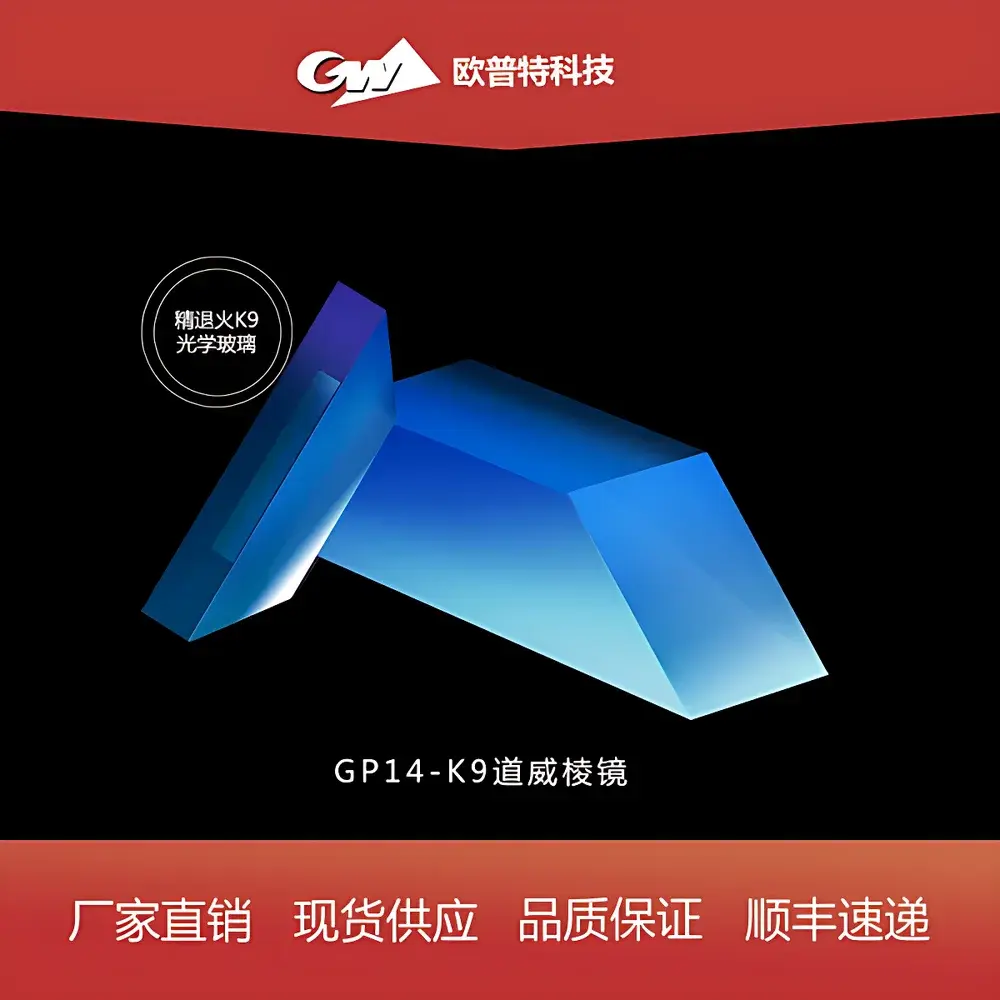
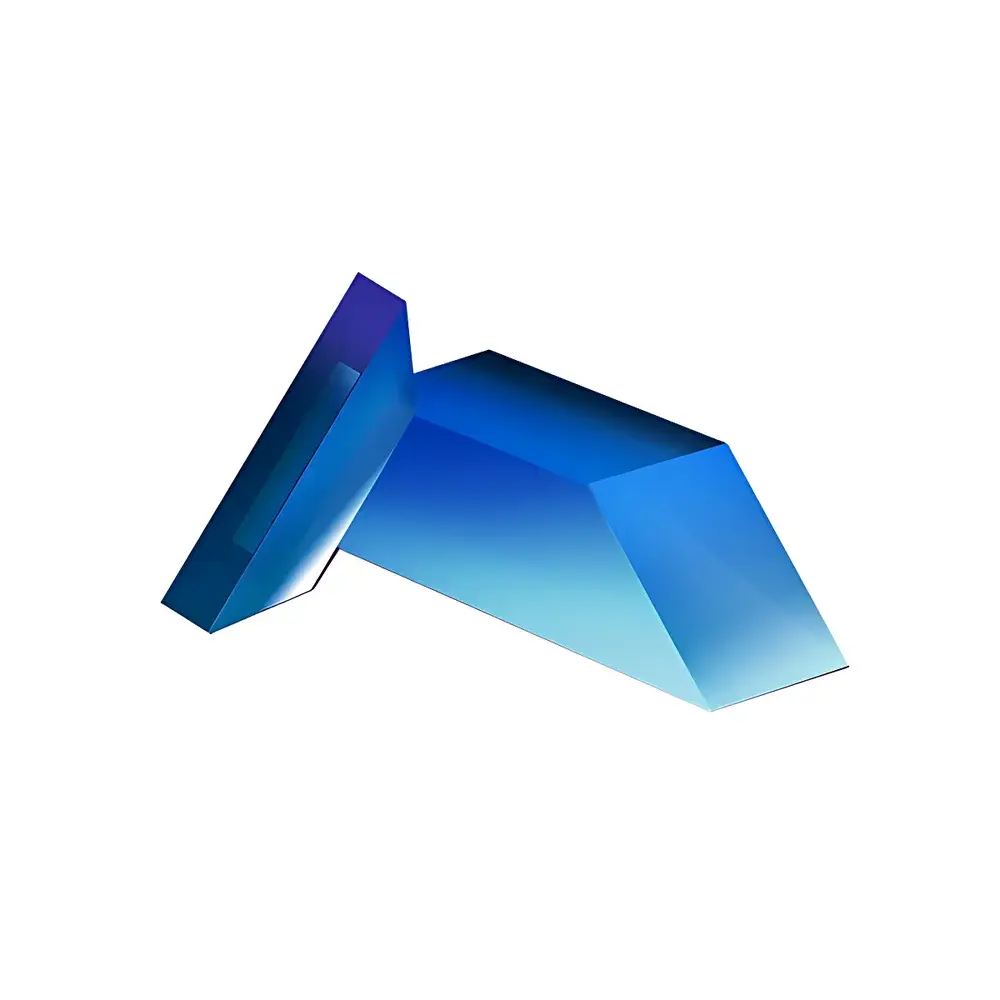
The GP14-K9 Dove Prism is a precision optical component engineered for image rotation and inversion in collimated beam paths. Based on the principle of total internal reflection (TIR) within a trapezoidal prism geometry, it functions as a non-deviating image rotator: when rotated about its longitudinal optical axis, the output image rotates at twice the angular velocity of the prism—enabling precise, contactless angular encoding and beam steering applications. Unlike conventional mirrors or roof prisms, the Dove prism introduces no lateral displacement or beam deviation, preserving optical alignment integrity across dynamic setups. Constructed from high-homogeneity, precision-annealed K9 borosilicate crown glass, it exhibits low birefringence, excellent transmission stability over time, and minimal wavefront distortion—critical for interferometric, alignment, and laser cavity applications.
Key Features
- Optical substrate: Grade A K9 optical glass, fully stress-relieved via precision annealing to meet MIL-PRF-174B and ISO 10110-2 standards for homogeneity and striae control
- Surface figure accuracy: λ/10 @ 632.8 nm (measured with Zygo Verifire Interferometer), ensuring sub-microradian wavefront fidelity in high-resolution imaging systems
- Tight angular tolerance: ±3 arcminutes on critical apex angles, verified via autocollimation and digital theodolite metrology per ISO 10110-3
- Low twist error (<5 arcmin) minimizes image shear and preserves rotational symmetry—essential for polarization-sensitive and phase-critical optical trains
- Standard edge finish: Protective 0.25 mm × 45° bevel compliant with ISO 10110-7, reducing chipping risk during mounting and handling
- Optional broadband anti-reflection coating: VIS-grade MgF₂/TiO₂/SiO₂ multilayer stack with Ravg < 0.5% across 400–700 nm; coating adhesion validated per MIL-C-48497A
Sample Compatibility & Compliance
The GP14 series is compatible with standard kinematic mounts (e.g., Thorlabs KM100, Newport UMB1) and custom-designed prism holders utilizing elastomeric or spring-loaded clamping. Its thermal expansion coefficient (α ≈ 7.1 × 10⁻⁶/K) ensures stable performance across ambient lab environments (15–30 °C). All units are supplied with individual calibration certificates traceable to NIM (National Institute of Metrology, China) for surface figure and angular parameters. The K9 material complies with RoHS Directive 2011/65/EU and REACH Annex XVII restrictions on heavy metals. No hazardous substances are introduced during polishing or coating processes.
Software & Data Management
While the GP14-K9 Dove Prism is a passive optical element requiring no firmware or driver integration, its metrological data—including measured surface figure Zernike coefficients, angle deviations, and coating spectral reflectance curves—is delivered in standardized ASCII format (.txt) and CSV-compatible reports. These files support direct import into optical design platforms such as Zemax OpticStudio, CODE V, and FRED for tolerance analysis and system-level stray light modeling. For GMP/GLP-regulated environments, batch-specific documentation includes full traceability to raw material lot numbers, annealing furnace logs, and interferometric measurement timestamps—facilitating audit readiness per ISO 9001:2015 Clause 8.5.2 and FDA 21 CFR Part 11 compliance when integrated into validated instrumentation.
Applications
- Laser beam rotation and polarization-state manipulation in ultrafast amplifier seeding and regenerative cavity alignment
- Optomechanical encoders in industrial vision systems where 2× angular magnification improves resolution without gear reduction
- Image inversion modules in endoscopic relay optics and compact stereo imaging rigs
- Reference elements in null-test configurations for aspheric mirror fabrication
- Replacement for corner-cube retroreflectors in vibration-insensitive interferometry when metallic-coated variants are specified
- Education and research labs for demonstrating rotational symmetry, TIR path dependence, and geometric phase effects
FAQ
What is the maximum incident beam diameter supported by the GP14-020 variant?
The clear aperture of the GP14-020 is 20 mm × 20 mm (rectangular projection); usable beam diameter is limited to ≤18 mm to maintain full TIR across all ray angles and avoid vignetting at extreme field points.
Can the GP14-K9 be used with UV or NIR wavelengths?
Standard K9 transmits from ~350 nm to 2.0 µm; however, UV applications (<350 nm) require fused silica variants due to increased absorption and solarization risk. NIR use up to 2.2 µm is feasible but requires verification of coating performance beyond 700 nm.
Is there a version with protected aluminum or enhanced silver coating?
Yes—metal-coated variants (e.g., GP14-010-MET) are available upon request, featuring dielectric-overcoated Al or Ag layers optimized for >95% reflectivity from 450–1000 nm and environmental durability per MIL-C-675C.
How does temperature cycling affect angular accuracy?
Thermal drift in apex angle is <0.05 arcsec/°C over −10°C to +50°C, derived from finite-element analysis and confirmed via thermal vacuum chamber testing per ECSS-E-ST-20-07C.
Do you provide mounting fixtures or kinematic adapters?
Standard uncoated GP14 prisms ship bare; optional anodized aluminum mounts (e.g., PRM-GP14-S) with adjustable tilt and azimuth are available separately, compatible with M4 and 8-32 threaded interfaces.