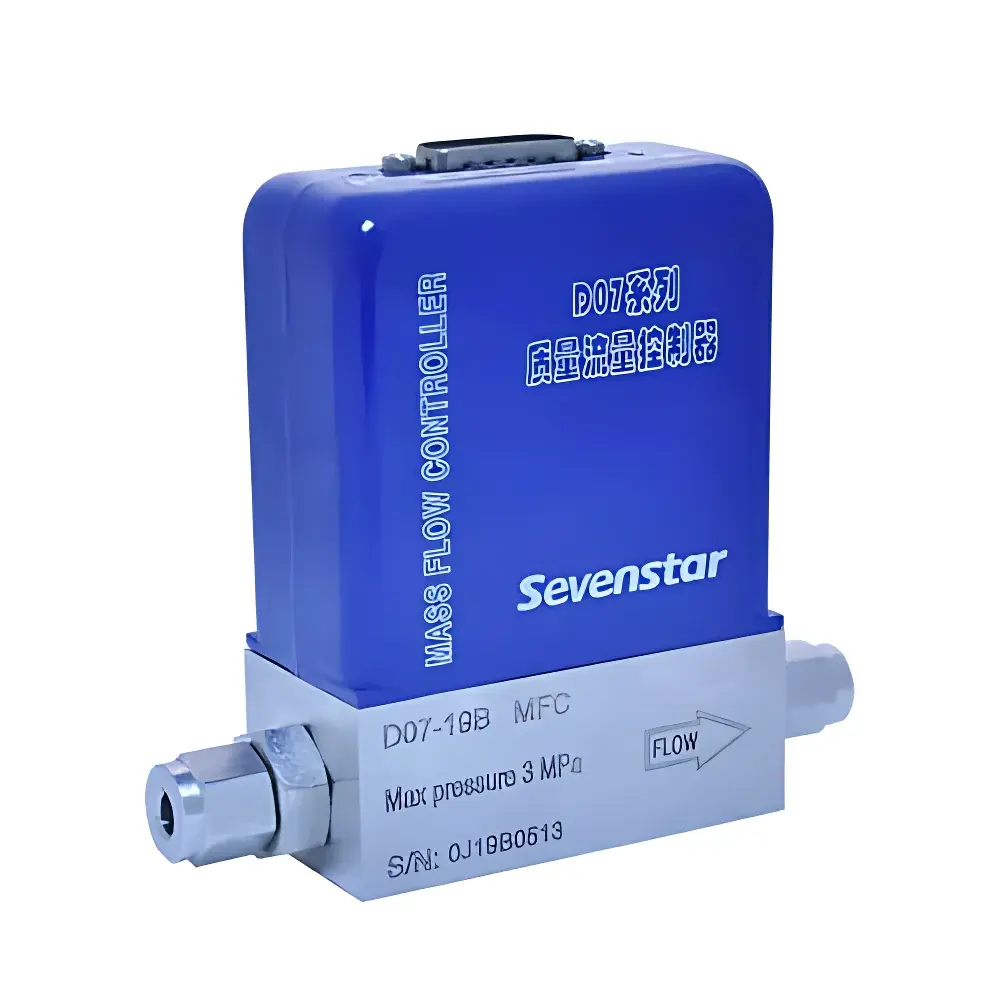
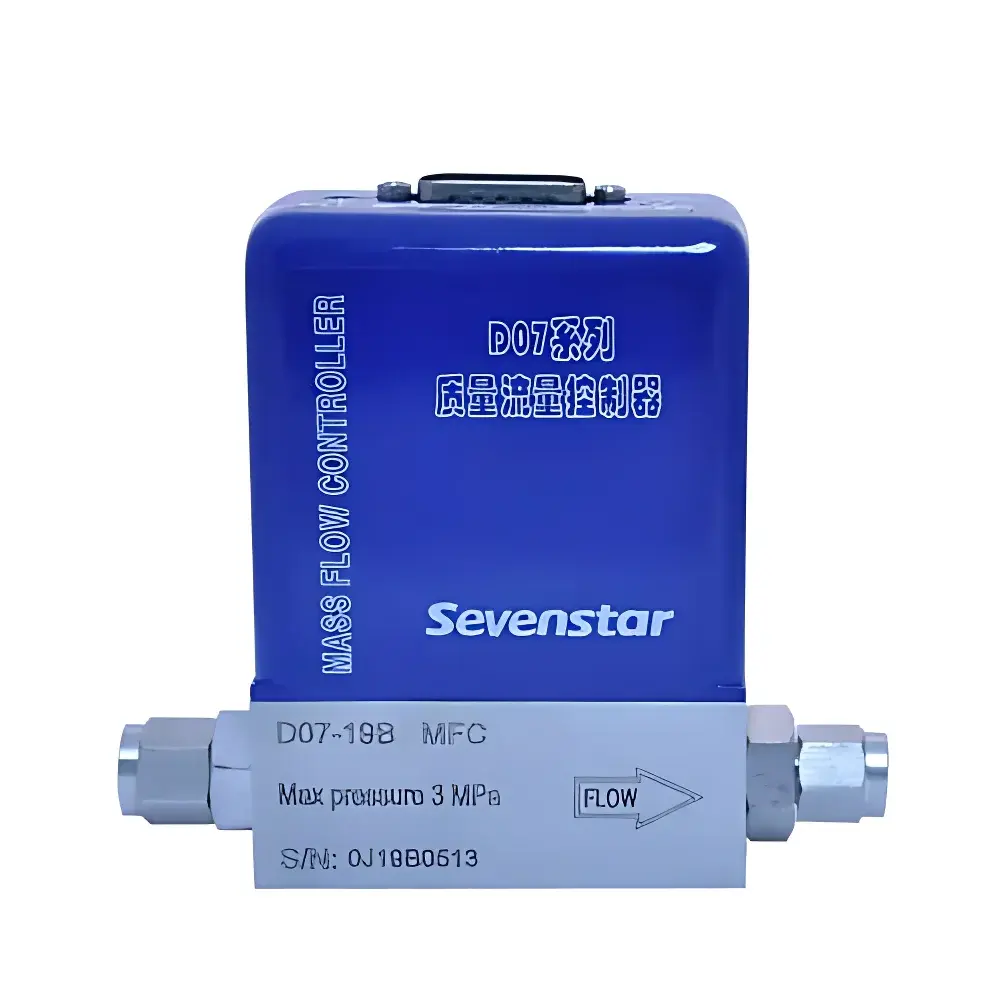
SevenStar D07-19B Mass Flow Controller
| Brand | SevenStar |
|---|---|
| Origin | Beijing, China |
| Model | D07-19B |
| Flow Type | Thermal Mass Flow (N₂-calibrated) |
| Full-Scale Range | 5 SCCM – 30 SLM |
| Control Range | 2–100% F.S. |
| Accuracy | ±1% F.S. (≤10 SLM), ±2% F.S. (>10 SLM) |
| Linearity | ±0.5–1% F.S. (≤10 SLM), ±2% F.S. (>10 SLM) |
| Repeatability | ±0.2% F.S. |
| Response Time | ≤2 s |
| Operating Temperature | 5–45 °C |
| Pressure Drop | 0.1–0.5 MPa (≤10 SLM), 0.1–0.3 MPa (>10 SLM) |
| Burst Pressure | 3 MPa |
| Helium Leak Rate | ≤1×10⁻⁹ SCCS |
| Sealing Materials | Viton®, PTFE, Neoprene |
| Electrical Interface | DB15 male connector |
| Mechanical Interfaces | VCR 1/4", φ4 mm / φ6 mm hose, Swagelok 1/8" / 1/4", or φ3 mm / φ6 mm tubing |
| EMC Compliance | CE |
| Weight | 0.95 kg |
Overview
The SevenStar D07-19B Mass Flow Controller (MFC) is a thermally based, analog-input/output gas flow control instrument engineered for high-reproducibility mass flow regulation in industrial and laboratory process environments. It operates on the principle of thermal dispersion—measuring heat transfer between a heated sensor element and the flowing gas stream—to deliver real-time, temperature- and pressure-compensated mass flow data referenced to standard conditions (0 °C, 101.325 kPa). Unlike volumetric flowmeters, the D07-19B provides true mass flow output independent of gas composition changes—provided calibration is performed with nitrogen (N₂) as the reference gas per ISO 14111 and ASTM D6327 conventions. Its robust architecture supports stable operation across dynamic pressure differentials and ambient temperature fluctuations typical in semiconductor tool integration, vacuum thin-film deposition systems, catalytic reaction monitoring, and controlled-atmosphere furnaces.
Key Features
- Thermal mass flow sensing with N₂ traceable calibration—certified to ISO/IEC 17025-accredited standards upon request
- Electromagnetically actuated normally-closed control valve enabling fail-safe shutoff during power loss
- Analog I/O interface: 0–5.00 V DC input for setpoint command and 0–5.00 V DC output for real-time flow feedback—compatible with PLCs, DAQ systems, and legacy process controllers
- Wide full-scale range coverage (5 SCCM to 30 SLM) with consistent repeatability (±0.2% F.S.) and fast step response (≤2 s to 90% of target)
- Multi-material wetted path incorporating Viton® elastomers, PTFE seating, and Neoprene O-rings—validated for compatibility with inert, corrosive, and mildly reactive gases including N₂, Ar, He, O₂, CO₂, and NH₃
- CE-marked electromagnetic compatibility (EMC) performance—designed to operate without signal degradation in electrically noisy cleanroom or factory-floor settings
- Modular mechanical interface options: VCR 1/4″ for ultra-high-purity (UHP) applications, Swagelok® 1/8″ and 1/4″ for general industrial use, and metric tube fittings (φ3/φ6 mm) for OEM integration
Sample Compatibility & Compliance
The D07-19B is qualified for use with non-aggressive, non-particulate, and dry gas streams. While calibrated using nitrogen, its thermal transfer characteristics allow reasonable cross-gas estimation when used with other diatomic and monatomic gases—subject to correction factors derived from specific heat capacity (Cp) and thermal conductivity (λ) ratios. For regulated industries, the device meets mechanical and electrical safety requirements under IEC 61000-6-2 (immunity) and IEC 61000-6-4 (emissions). Though not intrinsically safe or ATEX-certified, it may be deployed in Zone 2 classified areas when installed within appropriately rated enclosures. Documentation packages—including calibration certificates, material declarations (RoHS/REACH), and CE DoC—are available for GMP/GLP audit support and FDA 21 CFR Part 11-aligned validation protocols.
Software & Data Management
As an analog-native MFC, the D07-19B does not embed firmware or require proprietary software for basic operation. However, its 0–5 V signals integrate seamlessly into SCADA, LabVIEW™, Python-based control suites (e.g., PyVISA + NI-DAQmx), and distributed I/O networks. When paired with a compliant data acquisition system, the controller supports ALCOA+ data integrity principles: attributable (timestamped setpoint/feedback logs), legible (ASCII or CSV export), contemporaneous (real-time sampling at ≥10 Hz), original (raw voltage-to-flow conversion traceable to NIST-traceable calibration), accurate (validated linearity and hysteresis curves), complete (full measurement history with operator ID and event tagging), consistent (audit trail of configuration changes), enduring (archival storage with checksum verification), and available (controlled access per role-based permissions). Optional analog-to-digital signal conditioning modules enable direct RS-485 Modbus RTU or EtherNet/IP integration for Industry 4.0-ready architectures.
Applications
- Semiconductor fabrication: Precise dopant gas delivery in CVD, PECVD, and etch tools
- Vacuum coating systems: Reactive gas metering (O₂, N₂, CH₄) for sputtering and evaporation processes
- Pharmaceutical manufacturing: Controlled purge gas flow in lyophilizers and isolators
- Gas blending & calibration gas generation: Dynamic mixing of certified reference standards (CRM) for GC and FTIR analyzers
- Research reactors & fuel cell test stations: Stoichiometric air/fuel ratio management under variable backpressure
- Fiber optic preform consolidation: Inert carrier gas control during MCVD and OVD processes
FAQ
Is the D07-19B suitable for use with hydrogen or silane?
The unit is not recommended for H₂ or SiH₄ without prior compatibility testing and third-party certification due to potential permeation through elastomeric seals and flammability hazards.
Can the device be recalibrated for gases other than nitrogen?
Yes—custom calibration against user-specified gases (e.g., Ar, CO₂, O₂) is available through SevenStar’s accredited calibration lab; however, accuracy specifications apply only to N₂ unless otherwise validated.
What is the maximum allowable upstream pressure?
The wetted body is rated for 3 MPa burst pressure, but optimal control performance is maintained at differential pressures within the specified operating range (0.1–0.5 MPa for ≤10 SLM, 0.1–0.3 MPa for >10 SLM).
Does the D07-19B support digital communication protocols?
No native digital interface is included; however, analog-to-digital gateways supporting Modbus RTU, Profibus DP, or EtherNet/IP are commercially available and field-installable.
How often should routine calibration be performed?
Annual calibration is recommended for GLP/GMP environments; more frequent verification (e.g., quarterly) is advised when used in critical process steps or after exposure to particulates, condensation, or thermal shock.