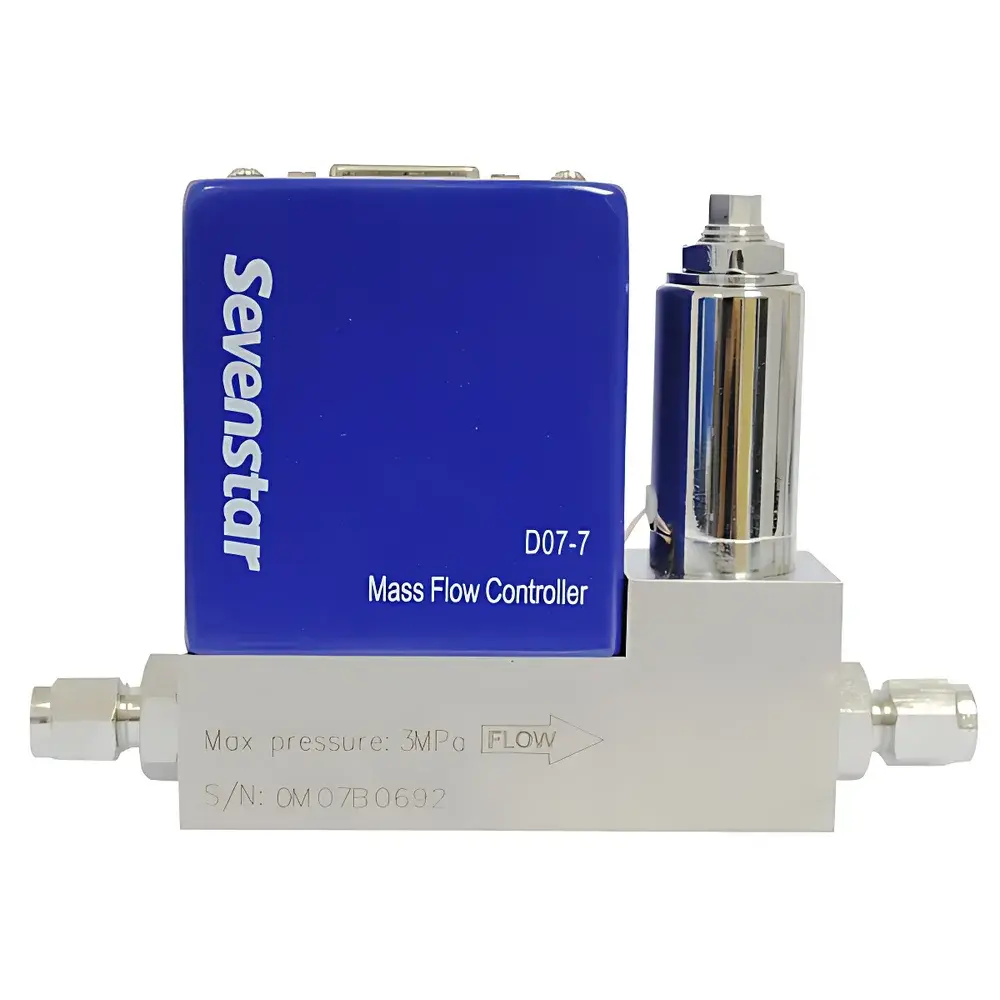
SevenStar D07-7B Mass Flow Controller (MFC)
| Brand | SevenStar |
|---|---|
| Origin | Beijing, China |
| Model | D07-7B |
| Type | Thermal Mass Flow Controller |
| Flow Ranges | 5–10,000 sccm (selectable per unit) |
| Accuracy | ±1.5% FS |
| Repeatability | ±0.2% FS |
| Linearity | ±1.0% FS |
| Response Time (Electrical) | ≤10 s |
| Response Time (Gas) | ≤4 s |
| Operating Temperature | 5–45 °C |
| Maximum Working Pressure | 3 MPa |
| Pressure Drop Range | 0.1–0.5 MPa |
| Seal Materials | Viton (FKM), Neoprene |
| Input/Output Signal | 0–5 V DC (Input Impedance >100 kΩ |
| Power Supply | +15 V / 50 mA, −15 V / 200 mA |
| Electrical Interface | D-Sub 15-pin Female |
| Leak Rate | ≤1×10⁻⁸ atm·cm³/s He (≤1×10⁻⁹ Pa·m³/s He) |
| Standard Fittings | Dual Ferrule (Φ3/Φ6/Φ8 mm, 1/8″/1/4″), VCR 1/4″, φ4×1 & φ6×1 Flexible Tube Ports |
| Weight | 1.1 kg |
Overview
The SevenStar D07-7B Mass Flow Controller is a thermally-based, analog-output gas flow control instrument engineered for stable, repeatable mass flow regulation in low-to-medium range applications. Unlike volumetric flow devices, the D07-7B employs constant-temperature anemometry (CTA) principles—measuring heat transfer from a heated sensor element to the flowing gas—to directly infer mass flow rate independent of pressure and temperature fluctuations. This enables true mass-based control essential for process-critical environments such as semiconductor CVD/PVD tooling, optical fiber preform fabrication, laboratory gas blending systems, and analytical instrument carrier gas delivery. Its robust tube-type bypass architecture ensures long-term stability and resistance to particulate-induced drift, distinguishing it from laminar differential-pressure or Coriolis-based alternatives in cost-sensitive industrial deployments.
Key Features
- Thermal mass flow sensing with integrated proportional solenoid valve for closed-loop control
- Wide selectable full-scale ranges—from 5 sccm to 10 slm—configured at time of order to match application-specific gas and flow requirements
- Viton (FKM) and Neoprene sealing options for compatibility with aggressive gases including NH₃, Cl₂, HCl, and inert/combustible process gases
- Dual-ferrule, VCR, and flexible-tube port configurations support seamless integration into stainless-steel vacuum lines (up to 3 MPa working pressure) and benchtop gas panels
- Analog 0–5 V DC input (setpoint) and output (actual flow) signals with high impedance (>100 kΩ) and low output current (<3 mA), ensuring compatibility with PLCs, DAQ systems, and legacy OEM controllers
- Fast dynamic response: ≤4 seconds gas response time and ≤10 seconds electrical settling time under standard operating conditions (5–45 °C ambient, 0.1–0.5 MPa ΔP)
- High metrological consistency: ±1.5% full-scale accuracy, ±0.2% full-scale repeatability, and ±1.0% full-scale linearity across calibrated range
Sample Compatibility & Compliance
The D07-7B is validated for use with common industrial and research-grade gases—including N₂, Ar, He, O₂, H₂, CO₂, NH₃, and synthetic air—when paired with appropriate seal material selection. Its leak integrity meets ultra-high-purity (UHP) standards, with helium leak rate ≤1×10⁻⁸ atm·cm³/s (equivalent to ≤1×10⁻⁹ Pa·m³/s), supporting applications requiring stringent background contamination control (e.g., residual gas analysis, UHV chamber purging). While not certified to ISO/IEC 17025 or ANSI Z540, the device conforms to general industrial electromagnetic compatibility (EMC) and safety practices per IEC 61326-1. It supports GLP- and GMP-aligned workflows through traceable calibration documentation (available upon request) and stable zero-point performance—no active zero-drift compensation circuitry required due to thermal symmetry design.
Software & Data Management
The D07-7B operates as a standalone analog controller and does not require embedded firmware, drivers, or proprietary software. All configuration—including setpoint modulation, gain tuning, and signal scaling—is performed externally via the 0–5 V analog interface. For system-level data logging and auditability, integration with third-party platforms (e.g., LabVIEW, MATLAB, Python-based SCADA) is straightforward using standard ADC modules. When deployed in regulated environments, users may implement 21 CFR Part 11-compliant electronic records by pairing the MFC with validated acquisition hardware and timestamped database logging—though the D07-7B itself contains no onboard memory, user settings, or digital communication protocols (e.g., RS-485, Modbus, or Fieldbus).
Applications
- Precise gas dosing in plasma-enhanced chemical vapor deposition (PECVD) and sputtering systems
- Carrier and dopant gas control in semiconductor diffusion furnaces and epitaxial reactors
- Calibration gas generation for environmental monitoring analyzers (e.g., NOₓ, SO₂, VOC sensors)
- Controlled atmosphere management in metallurgical heat treatment and powder sintering furnaces
- Gas blending for medical gas mixtures (e.g., O₂/N₂, CO₂/O₂) under ISO 8573-1 purity class verification
- Process gas supply to FTIR, GC, and MS instrumentation where stoichiometric reproducibility is critical
FAQ
What gases are compatible with the D07-7B?
The D07-7B supports non-corrosive and mildly corrosive gases. Viton seals accommodate Cl₂, HCl, and NH₃; Neoprene is recommended for ammonia-only service. Avoid use with strong oxidizers (e.g., F₂, O₃) or halogenated solvents without prior compatibility testing.
Is the D07-7B suitable for vacuum applications?
Yes—it maintains specified performance under inlet pressures as low as 0.1 MPa (1 bar absolute) and is routinely used downstream of roughing pumps and turbomolecular pumps in coating and etching tools.
Does the device require periodic recalibration?
Calibration is traceable to national standards (NIM, China) at time of manufacture. Annual recalibration is recommended for GxP environments; field verification using reference flow meters (e.g., bubble flowmeters or calibrated rotameters) is acceptable for routine QC checks.
Can multiple D07-7B units be synchronized?
No native synchronization capability exists. Synchronization must be implemented externally via master controller logic that coordinates analog setpoint signals across units.
What is the maximum allowable pressure drop across the device?
The specified operating pressure drop range is 0.1–0.5 MPa. Exceeding 0.5 MPa may compromise valve actuation reliability and long-term seal integrity.