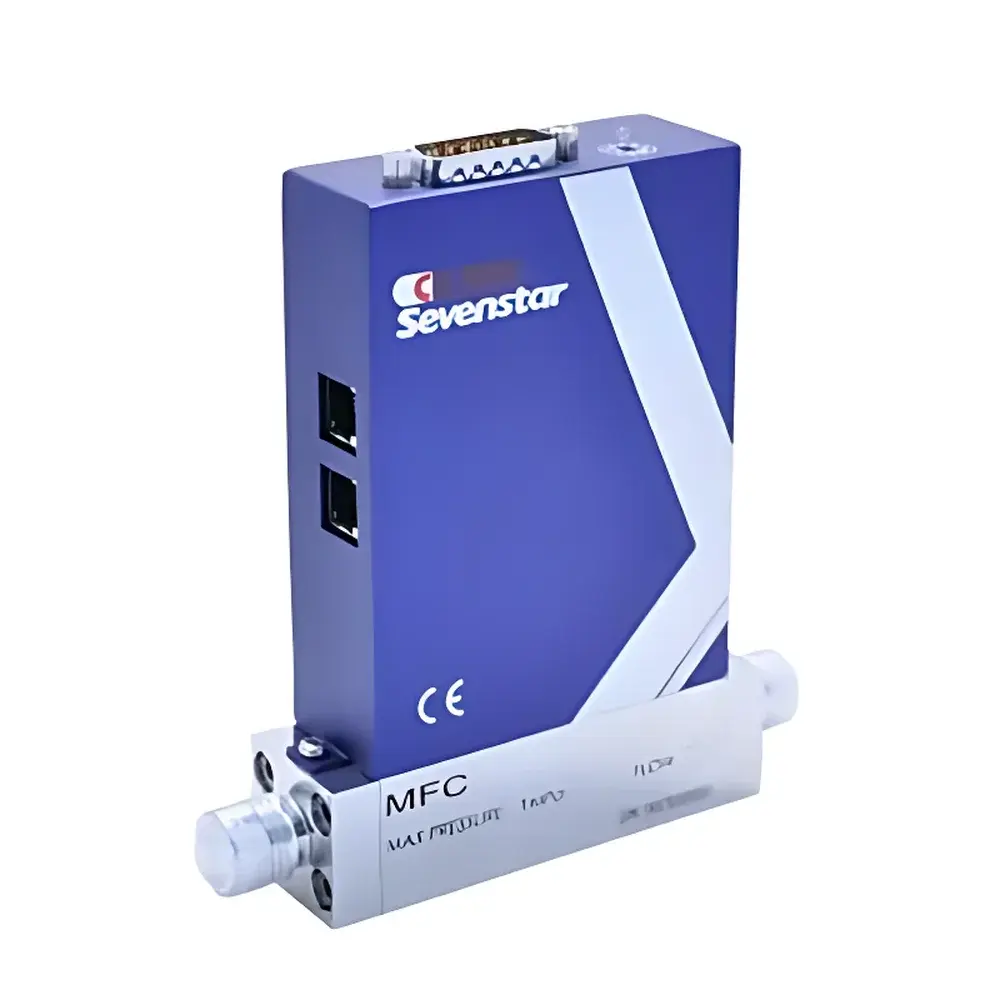
SevenStar CS300 Series Mass Flow Controller
| Brand | SevenStar |
|---|---|
| Origin | Beijing, China |
| Model | CS300 |
| Product Type | Volumetric Mass Flow Controller |
| Accuracy | ±1% S.P. (≥35% F.S.), ±0.35% F.S. (<35% F.S.) |
| Linearity | ±0.5% F.S. |
| Repeatability | ±0.2% F.S. |
| Response Time | ≤0.8 sec (≤0.5 sec optional) |
| Operating Pressure Drop Range | 0.05–0.35 MPa (≤10 SLM), 0.1–0.35 MPa (>10 SLM), <0.02 MPa (for low-pressure variants) |
| Temperature Coefficient | Zero ≤±0.02% F.S./°C |
| Burst Pressure | 3.5 MPa |
| Helium Leak Rate | ≤1×10⁻¹¹ Pa·m³/sec |
| Surface Roughness | Ra ≤5 µin |
| Input/Output | RS485 / DeviceNet / (0–5) VDC |
| Power Supply | ±11–±16 VDC (bipolar) or +11–+28 VDC (unipolar) |
| Operating Ambient Temperature | 0–50 °C |
| Standard Fitting Types | VCR 1/4", 1.125" C/W, 1.5" B/C/W |
| Enclosure Weight | 0.8–1.2 kg |
| Sealing Material | Metal |
Overview
The SevenStar CS300 Series Mass Flow Controller (MFC) is a high-precision, thermally-based volumetric flow control instrument engineered for stable, repeatable gas flow regulation in ultra-high-purity (UHP) and vacuum-integrated process environments. Unlike inferential or differential-pressure-based devices, the CS300 employs constant-temperature anemometry (CTA) — a calibrated thermal dispersion principle — to measure mass flow rate independent of gas composition (when properly configured with gas-specific calibration coefficients). Its design prioritizes metrological integrity in semiconductor fabrication, thin-film deposition (PECVD, ALD), analytical instrumentation (ICP-MS carrier gas control), and research-grade gas delivery systems where trace-level contamination, pressure-induced drift, and long-term zero stability are critical performance constraints.
Key Features
- UHP-Compatible Wetted Path: All gas-contact surfaces undergo electrochemical polishing to Ra ≤5 µin (0.13 µm), minimizing particle entrapment and adsorption hysteresis; Cr/Fe ratio ≥2.0 and CrO oxide layer ≥20 Å ensure passive corrosion resistance against reactive gases (e.g., Cl₂, NH₃, WF₆) and prevent metallic leaching.
- Integrated Pressure Compensation: Onboard absolute pressure sensing enables real-time compensation for upstream/downstream pressure fluctuations, maintaining accuracy across variable backpressure conditions typical in vacuum chamber interfaces.
- Fast Dynamic Response: Standard response time ≤0.8 seconds (T90); optional firmware and heater optimization reduce it to ≤0.5 seconds — essential for pulsed-flow applications and closed-loop reactor control.
- Multi-Protocol Digital Interface: RS485 (Modbus RTU) and DeviceNet support deterministic industrial network integration; analog (0–5) VDC I/O provides backward compatibility with legacy PLCs and data acquisition systems.
- Zero Drift Stability: <0.6% F.S./year without auto-zero function; achieved via matched thermal sensor pairs, symmetric flow channel geometry, and temperature-compensated bridge electronics.
- High Integrity Mechanical Design: All-metal seals (VCR, C-, W-, and B-type fittings) rated to 3.5 MPa burst pressure; helium leak rate ≤1×10⁻¹¹ Pa·m³/sec confirms suitability for Class 1 cleanroom and ISO 14644-1 compliant installations.
Sample Compatibility & Compliance
The CS300 supports calibrated flow ranges from 0–0.5 SCCM up to 0–500 SCCM and 0–30 SLM (N₂-equivalent), with optional gas-specific calibration kits available for Ar, He, O₂, H₂, CO₂, and specialty process gases per ISO 14040 and ASTM E2654 standards. Its metal-sealed construction and electropolished internal path meet SEMI F57-0218 requirements for semiconductor tool gas delivery subsystems. The device complies with CE marking directives (EMC 2014/30/EU, LVD 2014/35/EU), RoHS 2011/65/EU, and carries UL recognition for industrial control equipment (File E492711). For regulated environments, firmware supports audit-trail-capable configuration logging aligned with FDA 21 CFR Part 11 principles when deployed with validated host software.
Software & Data Management
Configuration, calibration, and real-time monitoring are performed via SevenStar’s MFC Control Suite — a Windows-based application supporting multi-device daisy-chaining over RS485 or DeviceNet. The suite enables batch parameter upload/download, flow profile scripting (ramp, step, dwell), and raw data export in CSV/Excel format with timestamped metadata (pressure, temperature, setpoint, actual flow). Firmware v3.2+ includes non-volatile memory for up to 10 user-defined gas calibrations and supports Modbus TCP gateway bridging for SCADA integration. All configuration changes are logged with operator ID, timestamp, and pre/post values — satisfying GLP/GMP documentation requirements for QC laboratories and pilot-scale process validation.
Applications
- Semiconductor front-end process tools: Precise dopant gas injection in diffusion furnaces and etch chambers
- Atomic layer deposition (ALD) reactors: Sub-stoichiometric precursor pulse control with <100 ms repeatability
- Gas chromatography (GC) and ICP-MS auxiliary gas lines: Carrier, make-up, and collision gas regulation with <0.2% F.S. repeatability
- Fuel cell test stations: Anode/cathode stoichiometry management under variable backpressure
- Environmental emission analyzers: Calibration gas dilution systems requiring certified traceability to NIST SRMs
- Research plasma physics setups: Reproducible reactive gas mixing ratios in magnetron sputtering and RF plasma sources
FAQ
What gas calibration options are available for the CS300?
SevenStar offers factory-calibrated versions for N₂, Ar, He, O₂, H₂, CO₂, and SF₆. Custom gas calibrations (including mixtures) can be performed using the MFC Control Suite and certified reference standards traceable to national metrology institutes.
Does the CS300 support automatic zeroing during operation?
Yes — optional auto-zero functionality is available via digital command or scheduled interval; it temporarily isolates the sensor path and performs a baseline correction without interrupting system pressure.
Can the CS300 operate in vacuum environments?
The CS300 is designed for use in positive-pressure gas delivery upstream of vacuum chambers; it is not rated for direct installation in vacuum but functions reliably at inlet pressures as low as 0.05 MPa (50 kPa) absolute when paired with appropriate pressure-regulated supply.
Is firmware upgrade supported in-field?
Yes — firmware updates are delivered via USB-to-RS485 adapter and executed through the MFC Control Suite; all upgrades preserve existing calibration coefficients and configuration parameters.
What is the recommended maintenance interval?
Under continuous UHP service, annual verification against a NIST-traceable master flowmeter is recommended; no routine consumable replacement is required due to all-metal construction and absence of polymer seals or orifices.