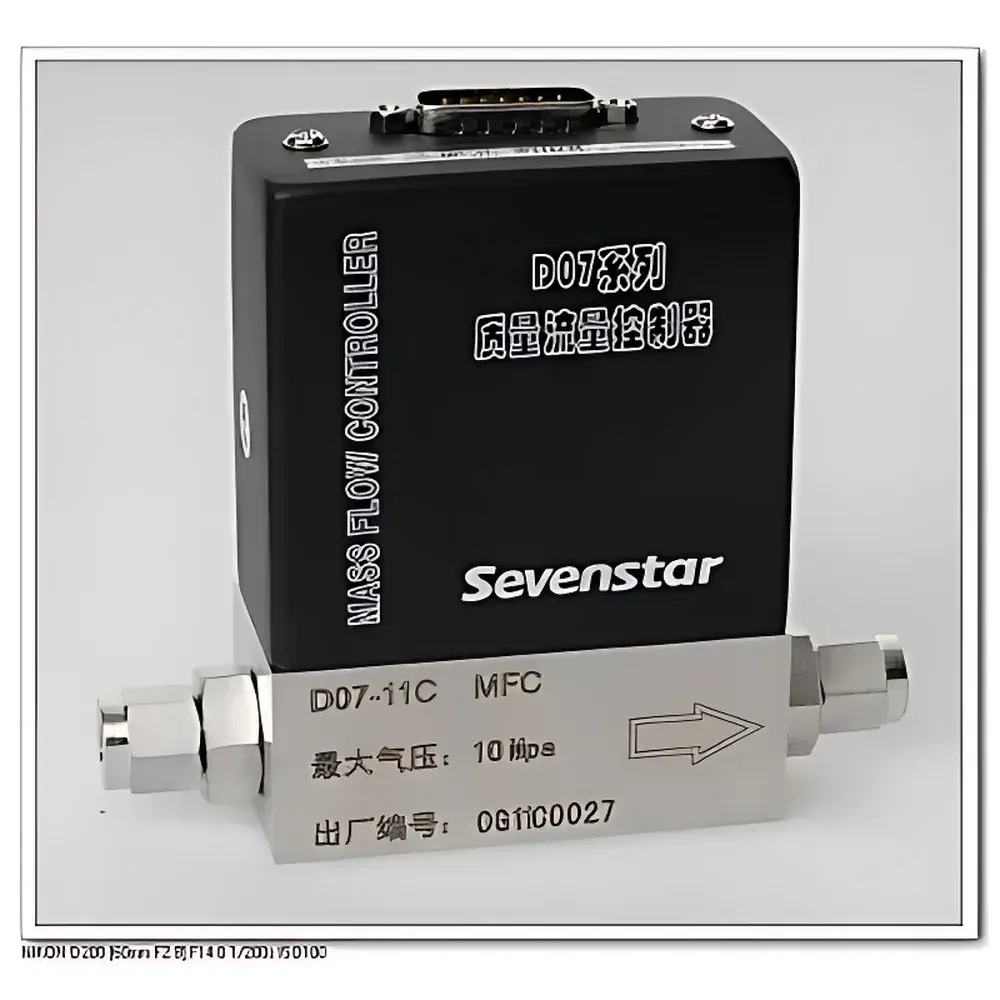
SevenStar D07-11C High-Pressure Mass Flow Controller (MFC)
| Brand | SevenStar |
|---|---|
| Origin | Beijing, China |
| Model | D07-11C |
| Type | Volumetric (Thermal Mass Flow Principle) |
| Flow Range | 5–30 sccm, 50–500 sccm, 1–30 slm |
| Accuracy | ±1% F.S. (±2% F.S. for 20 & 30 slm) |
| Repeatability | ±0.2% F.S. |
| Linearity | ±0.5% F.S. (±2% F.S. for 20 & 30 slm) |
| Response Time | Electrical ≤10 s |
| Operating Temperature | 5–45 °C |
| Max Working Pressure | 10 MPa |
| Sealing Materials | Viton®, Neoprene, PTFE |
| Input/Output Signal | 0–5 V DC (Zin >100 kΩ, Iout ≤3 mA) |
| Power Supply | ±15 V DC |
| Electrical Interface | D-Sub 15-pin Male |
| Pressure Drop Range | 0.2–0.6 MPa (for F.S. >10 slm) |
| Helium Leak Rate | ≤1×10⁻¹⁰ atm·cm³/s (≤1×10⁻¹¹ Pa·m³/s) |
| Standard Fittings | Dual Ferrule 1/8", Φ3 mm, Φ6 mm, Φ8 mm, Φ10 mm, 3/8", 1/4", VCR 1/4" |
| EMI Immunity | CE Certified |
| Weight | 1 kg |
Overview
The SevenStar D07-11C is a high-pressure thermal mass flow controller engineered for precise, stable, and repeatable measurement and control of gas mass flow rates in demanding industrial and laboratory environments. Unlike volumetric flowmeters, the D07-11C employs a calibrated thermal dispersion principle—based on heat transfer between a heated sensor element and the flowing gas—to directly infer mass flow rate independent of pressure and temperature fluctuations (within specified operating ranges). This intrinsic compensation enables traceable, real-time control without requiring external pressure or temperature transducers. Designed for integration into vacuum systems, semiconductor process tools, CVD/PVD chambers, and analytical gas delivery subsystems, the D07-11C operates reliably at up to 10 MPa (1450 psi) working pressure and delivers high immunity to electromagnetic interference—validated by CE certification per EN 61326-1:2013.
Key Features
- High-pressure rated architecture with full-welded stainless-steel body and dual-ferrule or VCR-compatible sealing interfaces for ultra-high-integrity gas handling.
- Thermal sensor design with platinum RTD elements and proprietary calibration algorithms ensuring ±1% full-scale accuracy across 16 standard flow ranges—from 5 sccm to 30 slm—with extended linearity (±0.5% F.S.) over 90% of span.
- Viton®, Neoprene, and PTFE wetted seals enabling compatibility with aggressive gases including NH₃, Cl₂, HCl, O₂, N₂, Ar, He, and specialty process gases.
- D-sub 15-pin male connector compliant with industrial automation signal standards—supporting analog 0–5 V DC input (setpoint) and output (flow feedback), with high-impedance input (>100 kΩ) and low-output current (<3 mA) for noise-resilient signal transmission.
- Rapid dynamic response: ≤4 seconds gas time constant and ≤10 seconds electrical settling time—critical for closed-loop process control in pulsed gas delivery and rapid recipe switching.
- Hermetic helium leak rate <1×10⁻¹⁰ atm·cm³/s, verified per ASTM E499-19, confirming suitability for UHV applications down to 10⁻⁸ Pa base pressure when integrated with appropriate pumping systems.
Sample Compatibility & Compliance
The D07-11C is validated for use with non-corrosive and mildly corrosive gases under clean, dry conditions. Wetted materials—including 316L stainless steel, Viton® (FKM), Neoprene (CR), and PTFE—are selected per ISO 15848-1 for fugitive emission control and long-term chemical resistance. The device complies with CE marking requirements for electromagnetic compatibility (EMC Directive 2014/30/EU) and low-voltage safety (LVD Directive 2014/35/EU). While not inherently 21 CFR Part 11 compliant as a standalone hardware unit, its analog I/O interface supports integration into FDA-regulated systems when paired with audit-trail-capable SCADA or PLC platforms meeting GMP/GLP data integrity requirements (e.g., ISA-88/ISA-95 frameworks).
Software & Data Management
The D07-11C operates as a fully analog, firmware-free device—eliminating embedded software dependencies and maximizing long-term operational stability. Flow setpoints are delivered via externally sourced 0–5 V DC signals from programmable logic controllers (PLCs), motion controllers, or lab automation systems. Real-time flow feedback is provided as a proportional analog voltage, enabling direct acquisition into DAQ systems (e.g., National Instruments, Keysight, or Dewetron platforms) without protocol conversion. For system-level validation, users may perform periodic calibration verification using traceable NIST-certified reference standards (e.g., Brooks 5850E or Mesa Labs DryCal series), with documented procedures aligned with ISO/IEC 17025:2017 clause 6.5 on equipment verification.
Applications
- Semiconductor manufacturing: Precise dopant gas dosing in diffusion furnaces and etch chamber purge sequences.
- Optical fiber preform fabrication: Controlled delivery of SiCl₄, GeCl₄, and O₂ during MCVD and PCVD processes.
- Pharmaceutical lyophilization: Inert gas blanketing and pressure ramp control using N₂ or argon.
- Research-grade gas chromatography: Carrier and make-up gas regulation with sub-sccm resolution.
- Plasma-enhanced chemical vapor deposition (PECVD): Reproducible SiH₄/NH₃ ratio control for thin-film silicon nitride growth.
- Calibration laboratories: Reference flow generation for secondary standard transfer and inter-laboratory comparison studies.
FAQ
Does the D07-11C require digital communication protocols like RS-485 or Modbus?
No—it is an analog-only device. Control and monitoring rely exclusively on 0–5 V DC signals; no firmware, drivers, or communication stacks are embedded.
Can it be used in vacuum environments below 1 mbar?
Yes, provided inlet pressure remains within the specified working pressure range (0.2–0.8 MPa) and downstream conductance supports required flow dynamics. It is commonly installed upstream of vacuum pumps in controlled gas injection manifolds.
Is recalibration required after installation?
Factory calibration is performed at standard temperature and pressure (STP: 0 °C, 101.325 kPa, dry air). Users should verify zero and span post-installation using certified reference gas and pressure conditions matching their process environment.
What is the maximum permissible gas temperature at the inlet?
The specified operating temperature range (5–45 °C) refers to ambient housing temperature—not gas temperature. For sustained exposure to gas >50 °C, consult SevenStar’s thermal derating guidelines and consider optional heat-sink mounting.
Are explosion-proof or ATEX-certified variants available?
The standard D07-11C is not ATEX or IECEx certified. For hazardous area deployment, integrate it within an approved pressurized enclosure or specify custom intrinsically safe barrier configurations through authorized SevenStar engineering support.