
SoilBox Rhizosphere Respiration Measurement and Analysis System
| Origin | USA |
|---|---|
| Manufacturer Type | Authorized Distributor |
| Origin Category | Imported |
| Model | SoilBox Rhizosphere Respiration Measurement and Analysis System |
| Price | USD 1,400 (approx. based on ¥10,000 at 1:7.1 exchange) |
Overview
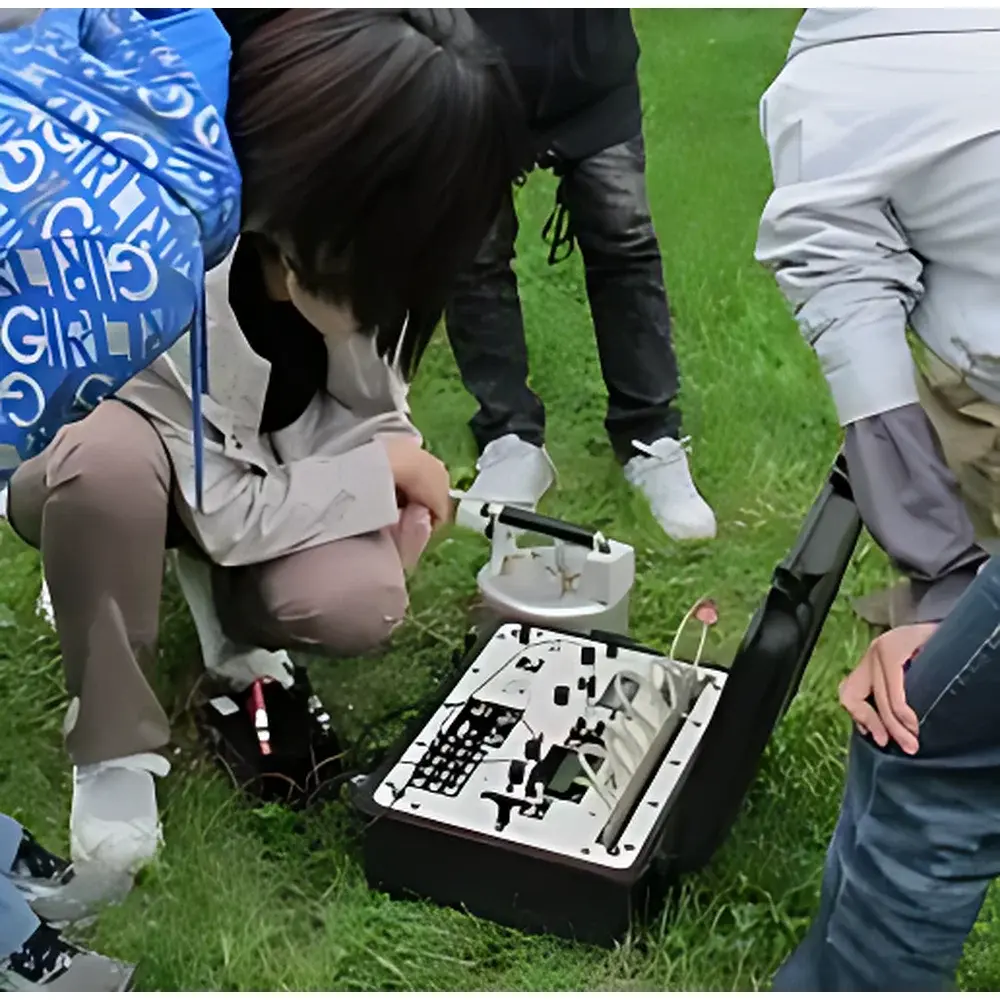
The SoilBox Rhizosphere Respiration Measurement and Analysis System is a field-deployable, high-fidelity gas exchange platform engineered for quantitative partitioning of soil carbon flux components in terrestrial ecosystems. It operates on the principle of closed- or open-path dynamic chamber respirometry, integrating real-time, multi-gas analysis with precise environmental parameter monitoring to resolve rhizosphere respiration (Rrh) from total soil respiration (Rt) and abiotic soil respiration (Rs). The system implements dual-chamber methodology—combining in-situ chambers for undisturbed root–soil interface measurements and ex-situ chambers for isolated root or soil core assays—enabling rigorous application of the mass-balance model: Rrh = Rp − Rl (in-situ) and Rt = Rs + Rr (ex-situ), where Rp is plant-associated soil respiration, Rl is bare-soil respiration from adjacent control plots, Rs is root-free soil respiration, and Rr is root-only respiration. This architecture supports ISO 16635:2017-compliant soil CO2 efflux protocols and aligns with USDA ARS and NSF-funded biogeochemical flux study design standards.
Key Features
- Integrated tri-gas analysis: simultaneous, drift-compensated measurement of CO2, O2, and H2O vapor (FGA variant measures CO2/O2 only)
- Dual-chamber configuration: standardized aluminum in-situ chamber (20 cm ID × 20 cm height) with low-greenhouse-effect design; modular ex-situ chamber for root excision or soil core incubation
- True scientific-grade flow control: microelectronic thermal feedback loop regulating pump output (10–2000 mL/min), eliminating reliance on mechanical rotameters per ASTM D6159-22 best practices
- Baseline compensation module (FMS variant only): dual-channel reference gas path enabling real-time zero-point correction during sequential chamber measurements
- Multi-parameter environmental sensing: integrated thermistor (−5 to 60 °C, ±0.2 °C accuracy), AZS-2 capacitance-based soil moisture probe (0–100 %, ±2 %), and optional PAR/solar radiation sensor
- Expandable architecture: 8-port gas multiplexer compatibility (FMS) for concurrent monitoring across up to eight chambers; optional CH4 analyzer integration via auxiliary gas port
Sample Compatibility & Compliance
The SoilBox system accommodates heterogeneous soil matrices—including mineral, organic, and hydric soils—as well as intact root systems across angiosperm and gymnosperm species. Its chamber geometry and pressure-compensation algorithm minimize diffusion artifacts under variable atmospheric conditions (75–125 kPa range). All gas analyzers comply with IEC 61000-4 electromagnetic immunity standards. Data acquisition meets GLP audit requirements through timestamped, uneditable binary logging. The FMS configuration supports FDA 21 CFR Part 11–compliant electronic signatures when paired with validated software environments. Methodology conforms to ISO 21262:2020 (soil respiration measurement) and US EPA Method TO-15 (trace gas quantification).
Software & Data Management
Acquisition and visualization are performed via proprietary Windows-based software supporting real-time plotting of CO2 concentration (ppm), O2 depletion (%), respiratory quotient (RQ = ΔCO2/ΔO2), and derived fluxes (µmol CO2 m−2 s−1). Raw analog inputs (14 channels, FMS; 2 channels, FGA) are sampled at user-defined intervals (0.1 s to 1 h), with onboard storage of up to 8,000 data points. Export formats include CSV, MATLAB .mat, and NetCDF 4.0 for interoperability with eddy covariance post-processing pipelines (e.g., EddyPro, TK3). Software includes automated baseline subtraction, temperature–moisture normalization routines, and uncertainty propagation for flux calculations per Gaudinski et al. (2001) error framework.
Applications
- Partitioning autotrophic (root-driven) vs. heterotrophic (microbial + faunal) contributions to soil CO2 efflux
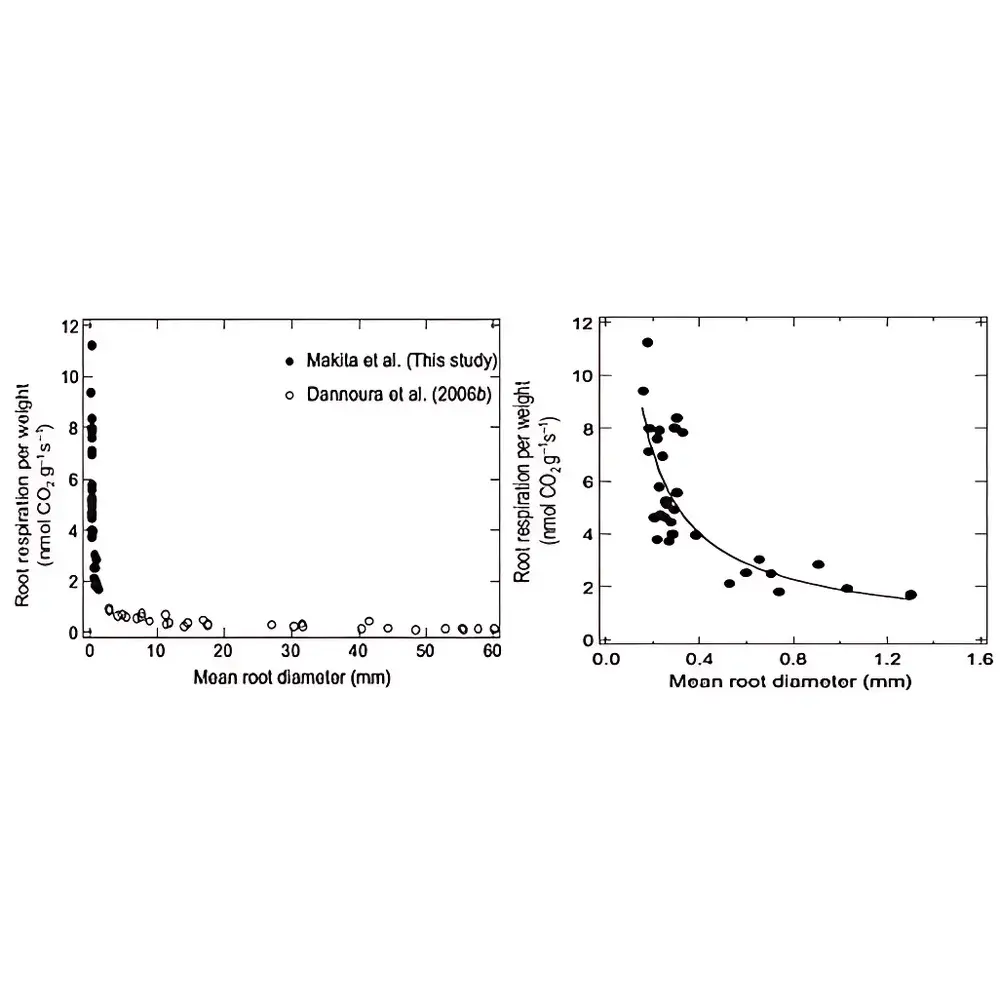
- Evaluating root metabolic activity gradients across fine-root diameter classes (e.g., 2 mm)
- Assessing climate change impacts on rhizosphere carbon use efficiency (CUE) under controlled warming or drought treatments
- Validating ecosystem models (e.g., CLM, ORCHIDEE) with empirical root–soil C flux constraints
- Long-term monitoring of restoration sites, agroforestry systems, and permafrost-affected tundra
- Supporting carbon accounting under Verra VM0042 (Improved Forest Management) and Plan Vivo methodologies
FAQ
What is the difference between FGA and FMS configurations?
The FGA variant provides dual-channel CO2/O2 analysis with basic data logging; the FMS variant adds H2O vapor sensing, 14-channel analog input, baseline correction, and 8-port gas multiplexer support.
Can the system operate autonomously in remote field sites?
Yes—when powered by the optional 40 Ah LiFePO4 battery pack, continuous operation exceeds 5 hours; integration with solar chargers enables multi-day deployments.
Is calibration traceable to NIST standards?
All gas analyzers ship with factory calibration certificates traceable to NIST SRM 1971 (CO2) and NIST SRM 2621 (O2); field recalibration kits (certified span gases, zero air) are available.
Does the software support batch processing of multiple chamber datasets?
Yes—the Batch Analysis Module permits synchronized time-series alignment, flux interpolation, and statistical comparison across treatment groups using ANOVA or mixed-effects modeling frameworks.
Are replacement chambers and sensors available separately?
Yes—standardized chamber bodies, thermistor probes, AZS-2 moisture sensors, and O2/CO2 sensor cartridges are stocked globally with lead times under 10 business days.







