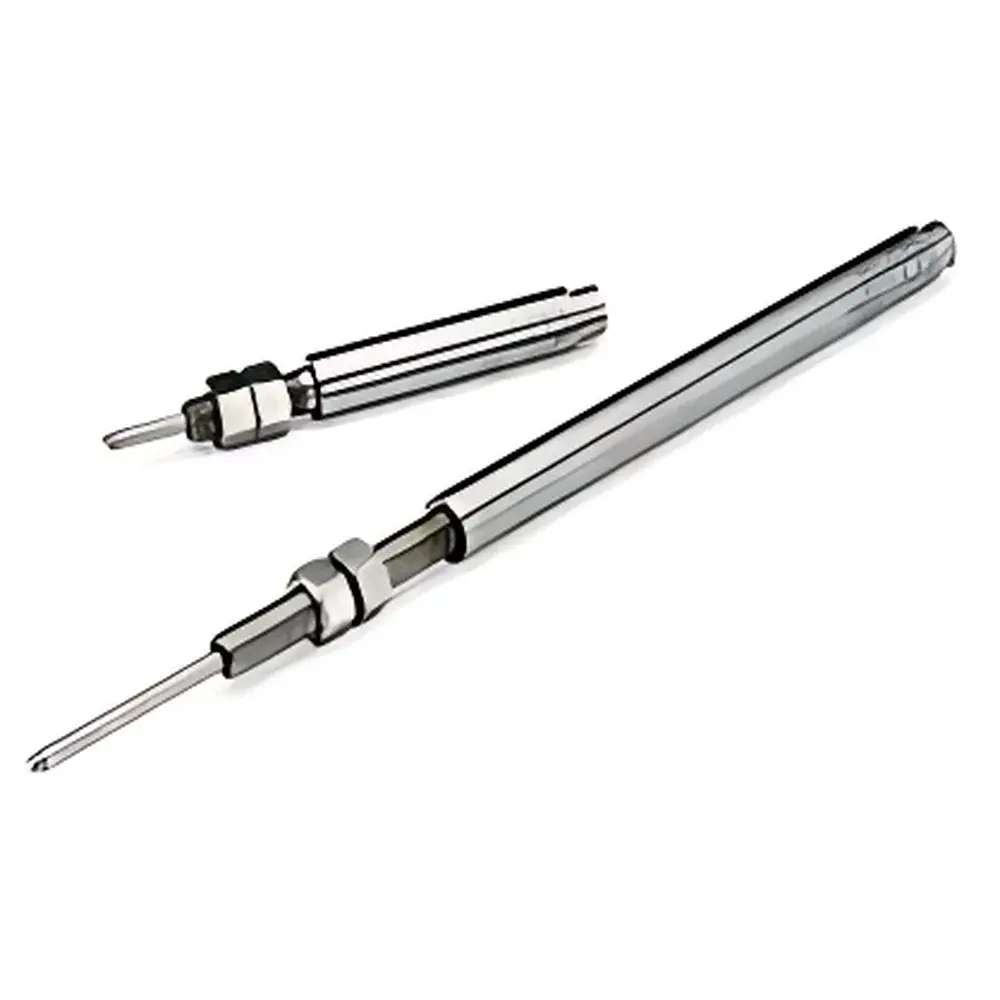
Schaevitz GCA/GCD Series Precision Spring-Loaded Linear Position Sensors
| Brand | Schaevitz |
|---|---|
| Origin | USA |
| Manufacturer Type | Authorized Distributor |
| Origin Category | Imported |
| Model | GCA/GCD Series |
| Price | Upon Request |
| Measurement Range | ±0.050 in to ±2.00 in |
| Compliance | CE (DC models) |
| Construction | Fully Welded Hermetic Seal |
| Connector | MS-Type Circular Connector |
| Electronics Encapsulation | Hermetically Sealed |
| Calibration | NIST-Traceable Certificate Provided per Unit |
| Compatibility | Fully Compatible with All Schaevitz Signal Conditioners |
| Tip Options | Custom Contact Probes Available |
Overview
The Schaevitz GCA/GCD Series precision spring-loaded linear position sensors are engineered for high-reliability displacement measurement in demanding industrial and laboratory environments. Based on the proven principle of resistive potentiometric transduction, these sensors convert mechanical linear motion into a proportional analog voltage or current output via a precision-wound cermet or conductive plastic element. The spring-loaded probe design ensures consistent contact force across the full stroke range—spanning from ±0.050 inches (±1.27 mm) up to ±2.00 inches (±50.8 mm)—enabling accurate, repeatable measurements of surface displacement, part thickness, assembly gap, or mechanical deflection. Unlike non-contact alternatives, this series delivers deterministic, low-noise analog output without requiring external power for basic operation (passive potentiometric mode), while active configurations support 4–20 mA or 0–10 V outputs with integrated signal conditioning.
Key Features
- Fully welded hermetic stainless steel housing provides IP67-rated environmental protection and resistance to moisture, dust, oil mist, and mild chemical exposure.
- MS-type military-spec circular connectors ensure secure, vibration-resistant interconnection in mobile or high-shock applications.
- Hermetically sealed internal electronics eliminate condensation-related drift and extend operational life under thermal cycling conditions.
- Each unit is supplied with an individual NIST-traceable calibration certificate, documenting linearity error (typically ≤±0.25% FS), repeatability (≤±0.05% FS), and temperature coefficient (≤±0.002% FS/°C).
- Interchangeable contact tips—including spherical, conical, flat-faced, and custom geometries—allow optimization for soft materials, curved surfaces, or high-wear scenarios.
- Direct compatibility with Schaevitz’s full family of signal conditioners (e.g., SCM-100, SCM-200, and digital readout modules) enables seamless integration into PLC, DAQ, and SCADA systems.
Sample Compatibility & Compliance
The GCA/GCD series is suitable for static and quasi-static displacement measurement of metallic, polymer, ceramic, and composite components where physical contact is permissible and required for mechanical coupling. Applications include end-of-line gaging in automotive stamping, bearing preload verification in aerospace actuators, and thermal expansion monitoring in power generation equipment. DC-powered variants comply with CE marking requirements for electromagnetic compatibility (EMC Directive 2014/30/EU) and low-voltage safety (LVD Directive 2014/35/EU). While not intrinsically safe, units may be deployed in Zone 2/Class I, Div 2 hazardous locations when used with appropriately rated barriers. Units meet MIL-STD-810G for shock (30 g, 11 ms half-sine) and vibration (10–2000 Hz, 10 g RMS), supporting qualification under customer-specific environmental test protocols.
Software & Data Management
Though inherently analog-output devices, the GCA/GCD series integrates transparently into modern data acquisition ecosystems via Schaevitz’s configurable signal conditioners. These modules support USB, RS-485, and Ethernet interfaces and provide onboard linearization, filtering, zero/span adjustment, and real-time scaling. Firmware supports Modbus RTU/TCP and EtherNet/IP protocols for direct PLC integration. All configuration changes and calibration parameters are logged with timestamped audit trails compliant with FDA 21 CFR Part 11 requirements when used with validated host software. Raw analog outputs may also feed into third-party DAQ systems (e.g., National Instruments, Keysight, or Dewesoft) for synchronized multi-channel analysis under GLP or GMP-aligned workflows.
Applications
- Automotive: Brake pad wear monitoring, suspension travel validation, and engine valve lift measurement.
- Aerospace: Actuator feedback in flight control surfaces, landing gear compression sensing, and composite cure-tool deflection tracking.
- Industrial Automation: Press tonnage verification, robotic end-effector positioning, and roll gap control in metal rolling mills.
- Medical Device Manufacturing: Assembly force/displacement profiling during catheter hub crimping or syringe plunger insertion.
- Research & Development: Material creep testing, thermal expansion coefficient determination, and micro-displacement characterization in MEMS packaging.
FAQ
What is the typical linearity specification for GCA/GCD sensors?
Linearity error is specified as ≤±0.25% of full scale, measured per ANSI/NCSL Z540 and verified at time of calibration.
Can these sensors operate in vacuum environments?
Yes—hermetic construction supports operation down to 10⁻⁶ Torr; however, outgassing characteristics of internal potentiometer elements should be evaluated per ASTM E595 for ultra-high-vacuum applications.
Is custom tip geometry available for specialized measurement tasks?
Yes—Schaevitz offers engineering consultation and rapid prototyping of contact tips, including diamond-coated, PTFE-lined, or threaded mounting variants.
Do GCA/GCD sensors require external excitation voltage?
Potentiometric models require a stable DC reference (typically 5–15 V); however, passive ratiometric operation is possible when paired with compatible signal conditioners that supply regulated bridge excitation.
How often is recalibration recommended?
Annual recalibration is recommended for critical metrology applications; intervals may be extended based on usage history, environmental exposure, and internal quality procedures aligned with ISO/IEC 17025.