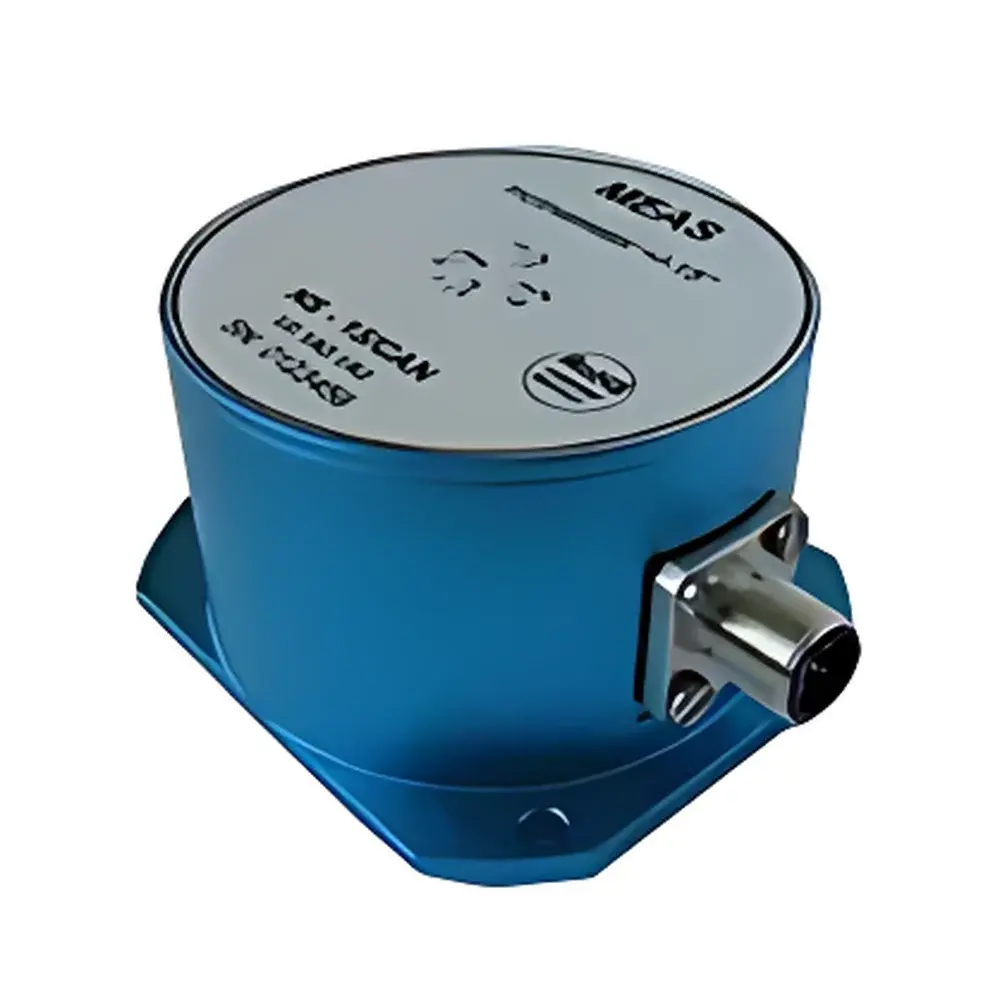
NS15/CAN Dual-Axis Inclinometer by MEAS (York Instrument)
| Brand | MEAS (York Instrument) |
|---|---|
| Origin | USA |
| Manufacturer Type | Original Equipment Manufacturer (OEM) |
| Origin Category | Imported |
| Model | NS15/CAN |
| Pricing | Upon Request |
Overview
The NS15/CAN Dual-Axis Inclinometer is a high-stability, industrial-grade angular displacement sensor engineered for precision tilt measurement across two orthogonal axes (X and Y). Based on MEMS capacitive sensing technology, it delivers deterministic angular response within a calibrated range of ±15°, with analog-to-digital conversion performed onboard using a temperature-compensated microprocessor. Unlike legacy potentiometric or electrolytic sensors, this device employs solid-state SMD construction and hermetically sealed signal conditioning circuitry to eliminate mechanical wear and long-term drift. Its aluminum housing meets IP67 ingress protection, enabling reliable operation in environments subject to dust, moisture, intermittent submersion, and wide thermal cycling — from −40 °C to +85 °C ambient. Designed explicitly for integration into mobile and stationary machinery control systems, the NS15/CAN operates as a deterministic feedback element in closed-loop leveling, stabilization, and structural alignment applications.
Key Features
- True dual-axis measurement with independent X/Y channel outputs and cross-axis coupling < 0.2% full scale
- Digital CANopen interface compliant with CiA 301 v4.2, supporting configurable node ID, baud rate (programmable from 10 kbit/s to 250 kbit/s), and PDO mapping
- Onboard linearization and real-time temperature compensation algorithms implemented in embedded firmware, minimizing zero-point drift to ≤0.06° over −40 °C to +85 °C
- High-resolution output: 0.001° digital resolution with absolute accuracy of ±0.08° at 25 °C and ±0.15° across full operating temperature range
- Robust mechanical architecture: machined aluminum enclosure, vibration-rated to IEC 60068-2-6 (10–2000 Hz, 10 g RMS), shock-rated to IEC 60068-2-27 (50 g, 11 ms half-sine)
- Low-noise performance: angular noise floor ≤0.001° RMS under static conditions; dynamic response bandwidth of 23 Hz (−3 dB point)
- Wide DC supply tolerance: 10–30 VDC, with typical current draw of 20 mA at 24 VDC
Sample Compatibility & Compliance
The NS15/CAN is designed for direct PCB-level integration or panel-mount deployment in OEM equipment. It complies with key international electromagnetic compatibility and environmental stress standards, including EN 61000-6-2 (immunity), EN 61000-6-4 (emissions), ISO 11452-2 (automotive component immunity), and ISO 16750-4 (mechanical loads). Its CANopen implementation conforms to CiA DS-301 and supports standardized object dictionary entries for angle data (0x2000–0x2001), status flags (0x2002), and configuration parameters (0x2100–0x21FF). The device is suitable for use in safety-related subsystems when integrated under functional safety frameworks such as ISO 26262 ASIL-B or IEC 61508 SIL-2 — pending system-level validation per application-specific hazard analysis.
Software & Data Management
Configuration and calibration are performed via the vendor-supplied PC-based utility software, which communicates over USB-to-CAN adapter. Users may adjust zero offset (electronic nulling), set CAN node ID and baud rate, define transmission timing (e.g., cyclic PDO update interval), and enable/disable diagnostic reporting. All parameter changes are stored non-volatilely in EEPROM. The software logs timestamped angle data in CSV format and supports real-time plotting for verification during commissioning. Firmware updates are supported through CAN-based bootloader protocol. Audit trails and configuration history are retained locally but do not include FDA 21 CFR Part 11-compliant electronic signatures — appropriate for industrial automation rather than regulated pharmaceutical or clinical diagnostics use.
Applications
- Construction equipment: automatic grading control in motor graders, slope monitoring in tunnel boring machines, and boom angle feedback in telescopic handlers
- Material handling: load-leveling feedback in container cranes, platform stabilization in scissor lifts and aerial work platforms
- Transportation: chassis inclination sensing in heavy-duty trucks and railcar suspension monitoring
- Infrastructure: structural health monitoring of bridges, wind turbine tower alignment, and elevator car leveling verification
- Energy: solar tracker tilt feedback, wind turbine nacelle pitch control, and battery rack inclination in mobile energy storage units
- Defense & aerospace: weapon platform stabilization, UAV gimbal reference, and ground vehicle posture estimation
FAQ
What communication protocols does the NS15/CAN support?
The sensor implements CANopen (CiA 301) exclusively. RS232/TTL output is not available on the NS15/CAN variant — that functionality belongs to the separate NS15/RS series.
Is the sensor calibrated traceable to NIST or other national standards?
Each unit undergoes factory calibration against reference-grade autocollimators with uncertainty budgets documented per ISO/IEC 17025 principles; full calibration certificates are available upon request.
Can multiple NS15/CAN sensors operate on the same CAN bus?
Yes — up to 127 nodes can coexist on one physical CAN network, provided each is assigned a unique node ID and baud rate settings are synchronized across all devices.
Does the device support automatic temperature compensation during operation?
Yes — compensation is applied continuously in real time using an onboard thermistor and pre-characterized polynomial coefficients stored in flash memory.
What is the maximum cable length between the sensor and CAN controller?
At 250 kbit/s, recommended maximum is 100 m using shielded twisted-pair (STP) cable meeting ISO 11898-2 specifications; at 10 kbit/s, lengths up to 5 km are feasible with appropriate termination.