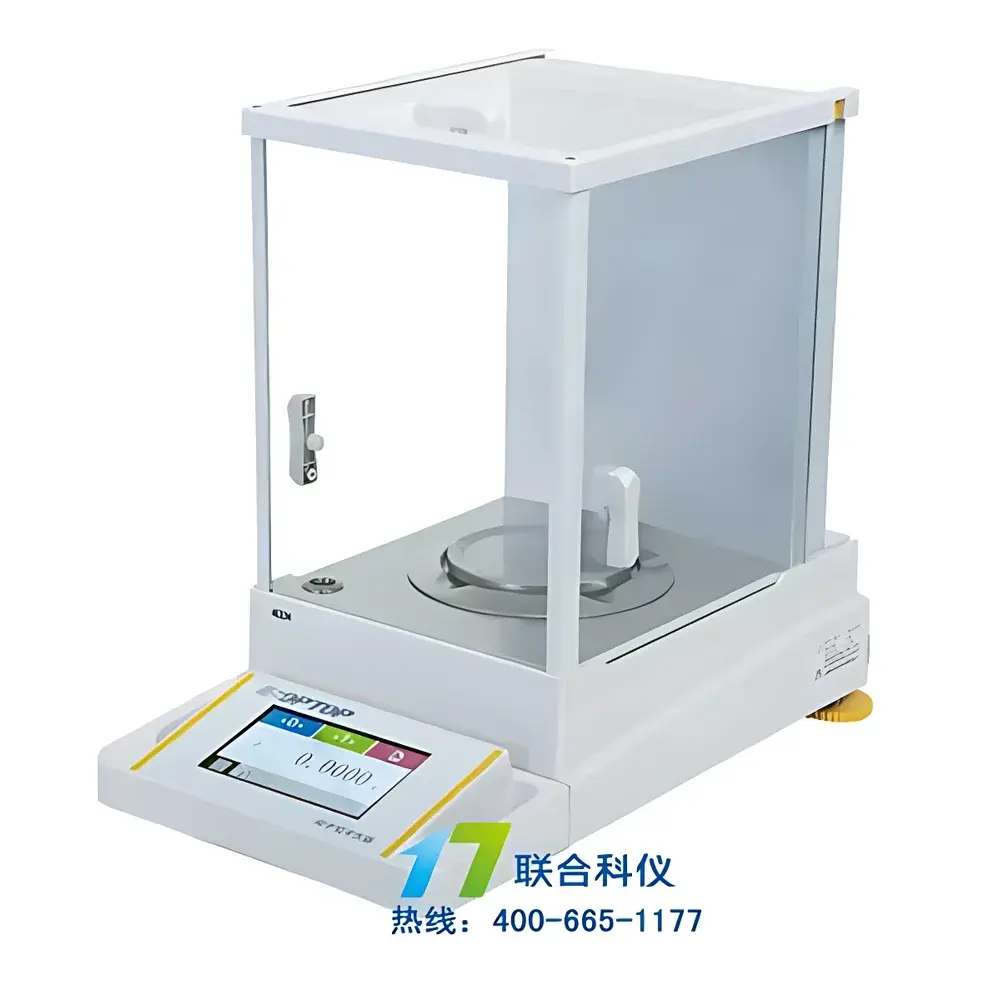
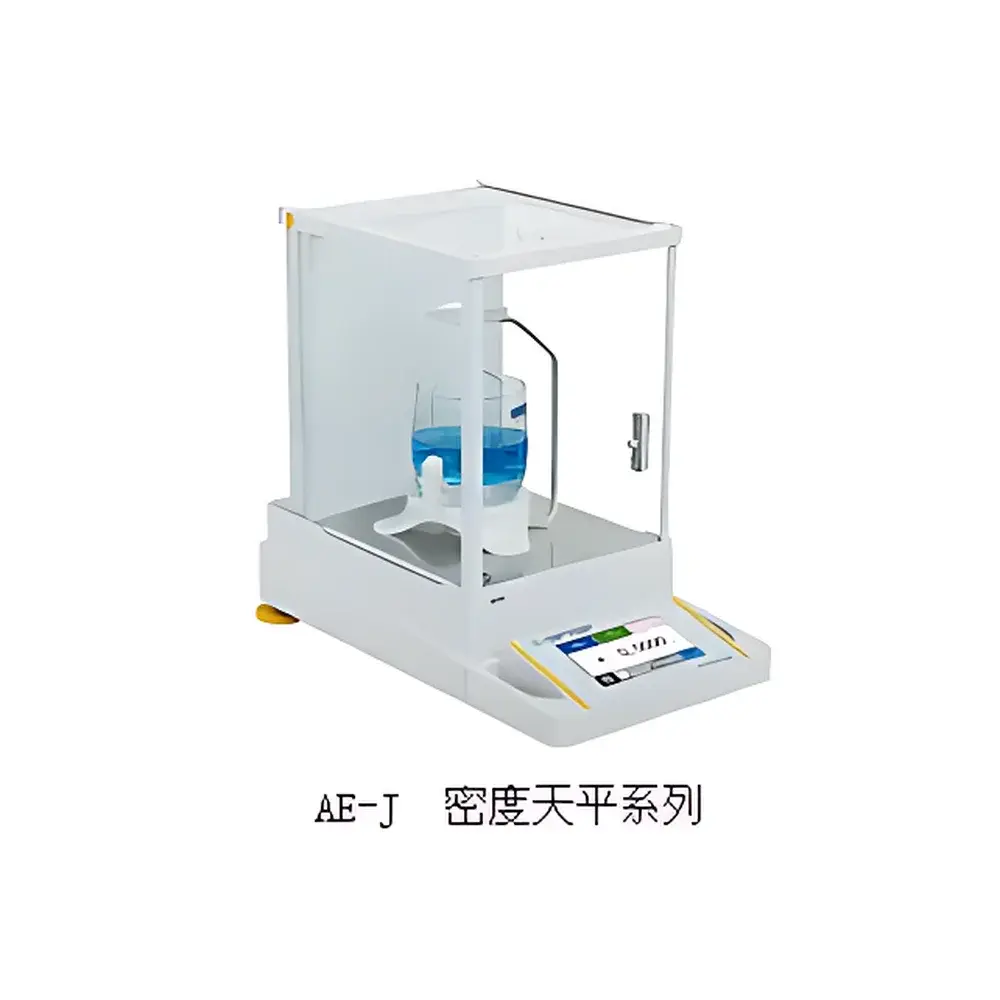
SOP TOP AE224J Density Balance
| Brand | SOP TOP |
|---|---|
| Origin | Shanghai, China |
| Model | AE224J |
| Maximum Capacity | 220 g |
| Readability | 0.0001 g |
| Repeatability (SD) | 0.0001 g |
| Calibration | External |
| Pan Diameter | Ø90 mm |
| Draft Shield Internal Volume | 160 × 165 × 200 mm |
| Dimensions (W×D×H) | 365 × 223 × 338 mm |
| Net Weight | 6 kg |
| Power Supply | AC 100–240 V, 50/60 Hz |
Overview
The SOP TOP AE224J Density Balance is a high-precision analytical balance engineered for laboratory-grade density determination of solid and liquid samples using the Archimedean principle. It combines a 220 g maximum capacity with 0.0001 g readability and sub-milligram repeatability (standard deviation ≤ 0.0001 g), making it suitable for applications requiring strict mass resolution in quality control, materials science, and academic research. The instrument operates on dual-mode weighing: first in air, then immersed in a reference fluid (typically distilled water or ethanol), enabling automatic calculation of sample density based on buoyancy correction. Its robust electromagnetic force compensation sensor architecture ensures long-term stability and minimal drift under standard laboratory conditions (20–25 °C, <70% RH, vibration-isolated benchtop). Designed to meet foundational metrological requirements for routine density analysis, the AE224J supports traceable measurement workflows when used with NIST-traceable external calibration weights.
Key Features
- True-color 4.3-inch TFT LCD touchscreen interface with intuitive icon-based navigation — operable with standard laboratory gloves without loss of accuracy or responsiveness.
- Ergonomic front-panel leveling system with integrated bubble-level indicator for rapid, repeatable horizontal alignment—critical for minimizing gravitational vector error in high-resolution weighing.
- Integrated draft shield with 160 × 165 × 200 mm usable internal volume and magnetic glass door latches; includes transport lock mechanism to prevent shock-induced sensor displacement during relocation.
- Overload-protected weighing pan (Ø90 mm stainless steel) featuring reinforced suspension geometry to absorb mechanical impact and preserve sensor integrity beyond rated capacity.
- Pre-installed density application software with automated calculation routines for solid density (g/cm³), relative density (specific gravity), and percent concentration (for binary solutions).
- Comprehensive unit conversion library (g, mg, oz, ct, carat, momme, tael, etc.) accessible via single-touch toggle; all conversions maintain full 0.0001 g resolution without rounding artifacts.
- Scratch-resistant display cover and dust-sealed keypad design extend service life in shared or high-traffic lab environments.
Sample Compatibility & Compliance
The AE224J accommodates solid specimens up to 220 g and densities ranging from ~0.1 g/cm³ to >20 g/cm³, including metals, polymers, ceramics, and porous composites. For liquids, it supports density measurement across viscosities up to 100 mPa·s using standardized immersion fixtures. The balance conforms to OIML R76-1 (2017) Class II requirements for non-automatic weighing instruments and meets essential performance criteria outlined in ISO 9001 calibration management clauses. While not pre-certified for GLP/GMP-regulated production environments, its external calibration architecture and audit-ready operation log (via optional RS232/USB data export) support integration into validated workflows compliant with ISO/IEC 17025 and FDA 21 CFR Part 11 when paired with documented procedures and qualified calibration standards.
Software & Data Management
The onboard firmware includes a built-in density application that stores up to 50 user-defined material profiles (e.g., reference fluid density, temperature coefficient, immersion wire correction factor). All weighing events—including tare, gross, net, and buoyancy-weight sequences—are timestamped and logged internally. Raw data can be exported in CSV format via USB host port or RS232 serial interface for post-processing in Excel, MATLAB, or LIMS platforms. No proprietary software installation is required for basic operation; however, optional SOP TOP DataLink PC software enables remote configuration, batch report generation, and electronic signature capture for compliance documentation.
Applications
- Determination of bulk density and apparent density of powdered metallurgical feedstocks per ASTM B527 and ISO 3953.
- Verification of alloy composition consistency in precision machining QA labs via density deviation thresholds.
- Quality assurance of polymer injection-molded parts where void content affects functional density.
- Academic teaching labs performing Archimedes’ principle experiments with undergraduate physics and materials engineering students.
- Pharmaceutical excipient characterization where density correlates with flowability and compressibility (aligned with USP <1174>).
- Environmental testing of soil aggregate stability through wet/dry density ratio analysis.
FAQ
What calibration weight is required for routine verification of the AE224J?
A 200 g Class M2 or better external calibration weight (traceable to national standards) is recommended for daily performance checks.
Does the AE224J support internal calibration?
No—it is configured exclusively for external calibration to maintain mechanical simplicity and thermal stability in ambient lab environments.
Can the density function measure irregularly shaped objects?
Yes—provided the sample is fully submersible and non-reactive with the selected immersion fluid, no geometric assumptions are required.
Is temperature compensation available for density calculations?
Manual input of fluid temperature is supported; users must apply appropriate density-temperature coefficients from standard references (e.g., NIST TR 274, IAPWS formulations).
What maintenance intervals are recommended for optimal long-term accuracy?
Biannual sensor diagnostic verification and annual mechanical inspection of pan suspension and leveling feet are advised per SOP TOP Technical Bulletin TB-AE-2023-01.