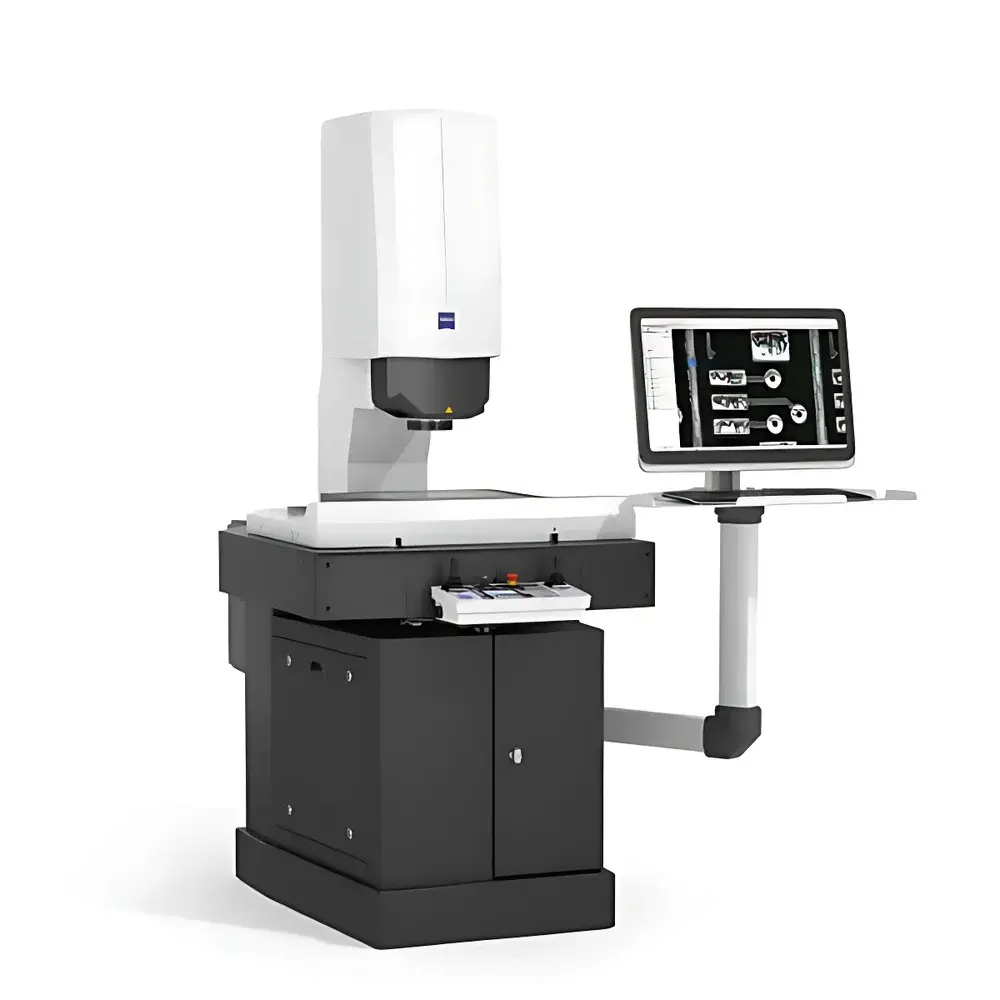
ZEISS O-DETECT Image Measuring System
| Brand | ZEISS |
|---|---|
| Origin | Shanghai, China |
| Manufacturer Type | Original Equipment Manufacturer (OEM) |
| Product Origin | Domestic (China) |
| Model | O-DETECT |
| Operation Mode | Fully Automatic |
| Measurement Volume | 300 × 200 × 200 mm³ / 500 × 400 × 300 mm³ |
| Camera | ZEISS INVENTA D1 |
| Illumination | Backlight, Coaxial LED, Top Ring Light |
| Optional Sensor | ZEISS XDT Single-Point Tactile Probe |
Overview
The ZEISS O-DETECT Image Measuring System is a high-precision, fully automated coordinate measuring machine (CMM) engineered for non-contact geometric metrology of small- to medium-sized mechanical components. It operates on the principle of high-resolution digital image acquisition combined with sub-pixel edge detection algorithms, enabling traceable 2D and 3D dimensional analysis in accordance with ISO 10360 and VDI/VDE 2617 standards. Designed for integration into quality control laboratories and production-integrated metrology cells, the system delivers metrological reliability across diverse industrial sectors—including automotive powertrain components, precision machined parts, medical device assemblies, and micro-electromechanical systems (MEMS). Its modular architecture supports both optical measurement as the primary modality and optional tactile probing via the ZEISS XDT sensor—ensuring comprehensive coverage of features inaccessible to vision-based inspection alone.
Key Features
- Fully automatic operation with CNC-driven stage motion and programmable illumination sequencing for repeatable measurement cycles.
- Dual-volume configurations (300 × 200 × 200 mm³ and 500 × 400 × 300 mm³) accommodate varying part footprints while maintaining thermal stability and mechanical rigidity per ZEISS metrological design principles.
- ZEISS INVENTA D1 high-dynamic-range camera system with motorized zoom lens and real-time autofocus ensures consistent resolution across field-of-view and depth-of-field variations.
- Multi-spectral illumination suite comprising calibrated LED backlight (for silhouette edge detection), coaxial telecentric lighting (for surface texture-insensitive profile capture), and adjustable top ring light (for diffuse surface contrast enhancement).
- Optional ZEISS XDT single-point tactile probe enables hybrid measurement workflows: optical imaging for planar geometry and tactile probing for blind holes, recessed grooves, undercuts, and other optically occluded features.
- Passive tactile sensing architecture of the XDT probe guarantees high repeatability—each probing point is sampled at ≥100 Hz over ≥500 ms, with statistical averaging applied to eliminate transient mechanical noise and ensure stable centroid determination.
Sample Compatibility & Compliance
The ZEISS O-DETECT accommodates metallic, ceramic, polymer, and composite workpieces ranging from 5 mm to 450 mm in maximum dimension. Surface finish requirements are minimal: matte or lightly anodized surfaces yield optimal edge contrast; highly reflective or transparent materials may require application-specific contrast enhancement (e.g., matting spray or temporary coating). The system complies with ISO/IEC 17025 calibration traceability frameworks when operated with ZEISS-certified calibration artifacts (e.g., ZEISS CALIBRATOR 300). All measurement routines support audit-ready documentation per GLP and GMP environments, including full measurement uncertainty budgets calculated in accordance with GUM (JCGM 100:2008) and embedded compliance with FDA 21 CFR Part 11 electronic record and signature requirements through optional ZEISS CALYPSO software modules.
Software & Data Management
Controlled by ZEISS CALYPSO metrology software (v7.10 or later), the O-DETECT supports scriptable measurement programming, GD&T evaluation per ASME Y14.5 and ISO 1101, and automated report generation in PDF, XML, and CSV formats. Measurement data—including raw images, illumination parameters, probe trigger logs, and uncertainty metadata—is stored in a relational database with version-controlled revision history. Integration with enterprise quality management systems (QMS) is enabled via OPC UA and RESTful API interfaces. Audit trails record all user actions, parameter modifications, and calibration events with time-stamped, digitally signed entries compliant with ISO 9001:2015 clause 7.1.5.2.
Applications
- Verification of stamped sheet metal components against nominal CAD models (GD&T: position, concentricity, profile of a line/surface).
- Dimensional validation of injection-molded plastic housings—including wall thickness, boss height, and snap-fit geometry.
- First-article inspection of precision-machined aerospace brackets and hydraulic manifolds.
- Micro-feature metrology on semiconductor packaging substrates (e.g., solder pad pitch, land width, coplanarity).
- Tool wear monitoring via periodic measurement of cutting tool inserts and die cavity dimensions.
FAQ
Does the ZEISS O-DETECT support multi-sensor fusion in a single program?
Yes—the system synchronizes optical image acquisition and XDT tactile probing within one CNC measurement routine, enabling seamless switching between modalities without manual repositioning.
Is the ZEISS INVENTA D1 camera calibrated per ISO 10360-8?
Yes—factory calibration includes photogrammetric verification of pixel scale, distortion coefficients, and depth-of-field limits, with certificate issued per ISO/IEC 17025-accredited procedures.
Can measurement programs be exported for offline simulation or validation?
Yes—CALYPSO programs export as .cal files compatible with ZEISS INSPECT offline simulation environment, supporting virtual commissioning and tolerance stack-up analysis.
What environmental conditions are required for optimal performance?
Operating temperature: 20 ± 1 °C with <0.5 °C/h drift; humidity: 40–60% RH non-condensing; vibration isolation recommended per ISO 22957 Class 2 for metrology-grade stability.
Is remote diagnostics and firmware update supported?
Yes—via ZEISS Remote Service Portal with TLS 1.3 encryption, requiring prior customer authorization and network segmentation per IEC 62443-3-3 cybersecurity guidelines.