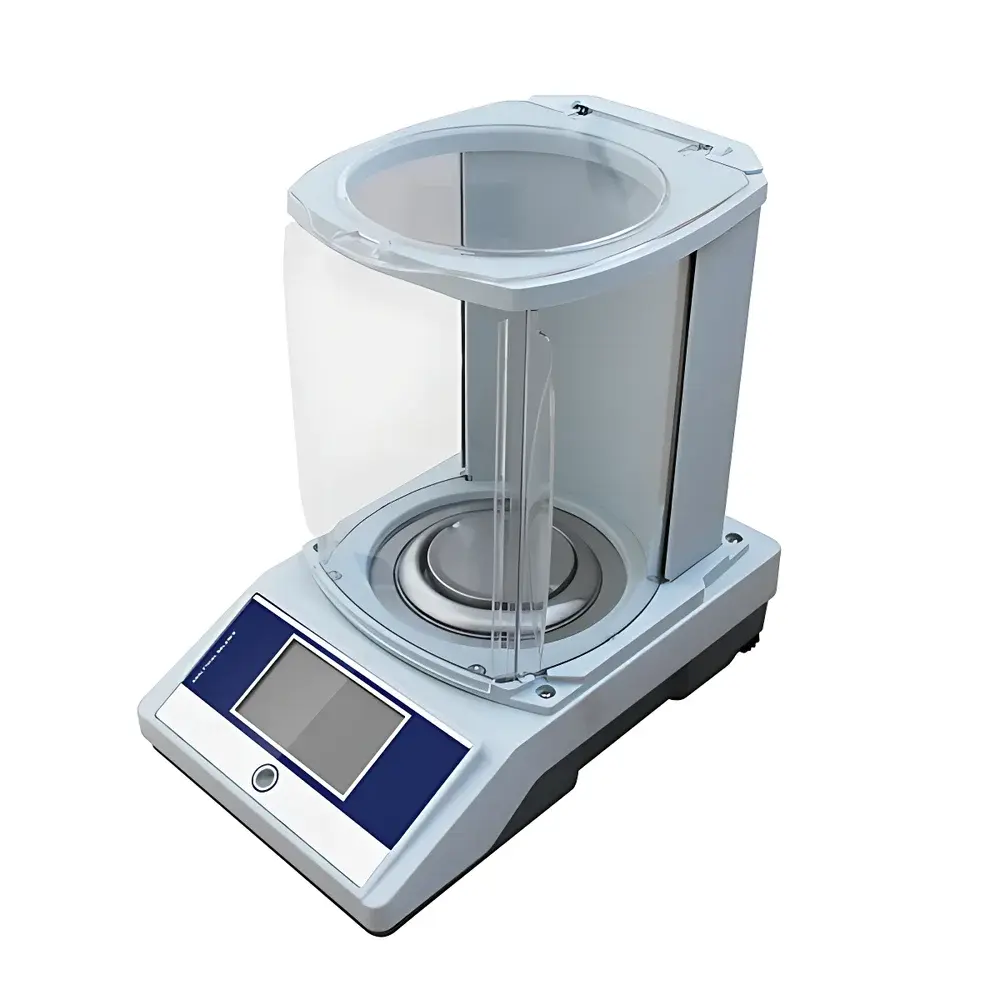
Yoke GT Series Touchscreen Analytical Balance
| Brand | Yoke |
|---|---|
| Origin | Shanghai, China |
| Manufacturer Type | Manufacturer |
| Product Category | Domestic |
| Model Series | GT Series |
| Instrument Type | Analytical Balance |
| Capacity Range | 100–220 g |
| Readability | 0.1 mg |
| Accuracy Class | Class I (OIML R76) |
| Calibration | External |
| Repeatability | ±0.5e (0 ≤ m ≤ 50 g), ±1.0e (50 g ≤ m ≤ 200 g), ±1.5e (m > 200 g) |
| Pan Diameter | 90 mm |
| Dimensions (W×D×H) | 360 × 220 × 350 mm |
| Net Weight (incl. packaging) | 7.5 kg |
| Power Supply | DC 9 V / 1 A |
Overview
The Yoke GT Series Touchscreen Analytical Balance is a Class I precision weighing instrument engineered for laboratory environments requiring high reproducibility, traceable mass measurement, and operational robustness. Based on electromagnetic force compensation (EMFC) transduction—where sample weight is counterbalanced by a precisely regulated magnetic field—the GT Series delivers stable, drift-resistant readings with 0.1 mg readability across its full capacity range (100 g to 220 g). Its sealed draft shield minimizes air-current-induced fluctuations, while the integrated ARM32 microprocessor enables real-time digital filtering, adaptive response tuning, and noise suppression without compromising resolution. Designed in compliance with OIML R76-1:2017 and ISO/IEC 17025:2017 metrological requirements, the GT Series supports GLP/GMP workflows through audit-ready operation logs and external calibration traceability.
Key Features
- Electromagnetic force compensation sensor system manufactured using CNC-machined high-stability components for long-term linearity and thermal drift resistance.
- Capacitive touchscreen interface with white-backlit BTN black-matrix LCD display—optimized for legibility under variable ambient lighting and gloved operation.
- Advanced digital signal processing architecture enabling configurable filtering, dynamic stabilization algorithms, and automatic drift compensation.
- Integrated multi-function weighing modes: piece counting, checkweighing, density determination (with optional sinker kit), and animal/dynamic weighing with auto-hold and averaging.
- Surface-mount technology (SMT) PCB assembly ensuring enhanced thermal stability, reduced solder-joint failure risk, and improved ESD immunity.
- Modular draft shield design with front-access sliding doors and seamless acrylic construction—meets ISO 17025 environmental control recommendations for vibration- and airflow-sensitive applications.
Sample Compatibility & Compliance
The GT Series accommodates standard laboratory samples—including powders, granules, liquids in tared containers, and small solid specimens—within its 90 mm diameter stainless-steel weighing pan. Its external calibration protocol requires certified Class E2 or better weights (100 g or 200 g, depending on model), ensuring traceability to national metrology institutes (NMI) via documented calibration certificates. The balance conforms to OIML R76-1:2017 accuracy class I specifications and satisfies key regulatory prerequisites for pharmaceutical QC (USP , EP 2.1.3), chemical testing (ASTM E898), and academic research reporting. While not FDA 21 CFR Part 11–compliant out-of-the-box, its audit trail functionality (via optional USB data export) supports manual documentation for GLP audits.
Software & Data Management
Data output is supported via RS232 serial interface (standard) and optional USB-to-serial adapter for PC connectivity. Raw weight values, timestamps, net/gross/tare states, and mode identifiers are exportable in ASCII format for integration into LIMS, ELN, or Excel-based QA/QC tracking systems. Internal memory retains up to 200 recent weighing records with time/date stamps. Firmware updates are performed via micro-USB port using manufacturer-provided utilities—no proprietary software installation required. All configuration changes (e.g., filter settings, unit selection, auto-zero threshold) are retained after power cycling and logged with timestamped metadata.
Applications
- Pharmaceutical formulation: active ingredient dosing, excipient ratio verification, and tablet weight uniformity testing per USP .
- Materials science: catalyst loading, polymer blend composition analysis, and nanomaterial dispersion quantification.
- Environmental testing labs: gravimetric analysis of filter residues (e.g., PM2.5, TSP), moisture content determination, and ash residue weighing.
- Academic research: stoichiometric reagent preparation, calibration standard preparation, and micro-scale reaction yield assessment.
- Food safety laboratories: allergen cross-contamination verification, nutrient labeling compliance checks, and moisture loss-on-drying protocols.
FAQ
What calibration standards are required for routine verification?
External calibration must be performed using certified weights traceable to NIST, PTB, or equivalent NMIs—Class E2 tolerance (±0.5 mg at 100 g) is recommended for full-range validation.
Does the GT Series support internal calibration?
No—this series relies exclusively on external calibration to maintain metrological integrity and simplify regulatory documentation workflows.
Can the balance be used in controlled humidity environments?
Yes—operating specifications cover 10–85% RH non-condensing; however, prolonged exposure above 70% RH requires desiccant placement inside the draft chamber to prevent condensation on sensor components.
Is the firmware upgradeable in the field?
Yes—firmware updates are distributed as signed binary files and installed via micro-USB using Yoke’s official utility, with version rollback capability and checksum validation.
How is measurement uncertainty estimated for ISO/IEC 17025 reporting?
Uncertainty contributors include readability (0.1 mg), repeatability (±0.5e–±1.5e), eccentricity error (<±0.5e), and calibration uncertainty (typically ±0.3 mg for E2 100 g weight)—combined using root-sum-square methodology per GUM (JCGM 100:2008).