Yoke GT-C Series Touchscreen Internal Calibration Analytical Balance
| Brand | Yoke |
|---|---|
| Origin | Shanghai, China |
| Manufacturer Type | Manufacturer |
| Product Category | Domestic |
| Model | GT-C Series |
| Instrument Type | Analytical Balance |
| Capacity Range | 100–220 g |
| Readability | 0.1 mg |
| Internal Calibration | Yes |
| Maximum Capacity | 220 g |
| Repeatability | 0.1 mg |
| Accuracy Class | Class I (per OIML R76) |
| Pan Diameter | 80 mm |
| Dimensions (W×D×H) | 360 × 220 × 350 mm |
| Net Weight (incl. packaging) | 8 kg |
| Power Supply | DC 9 V / 1 A |
Overview
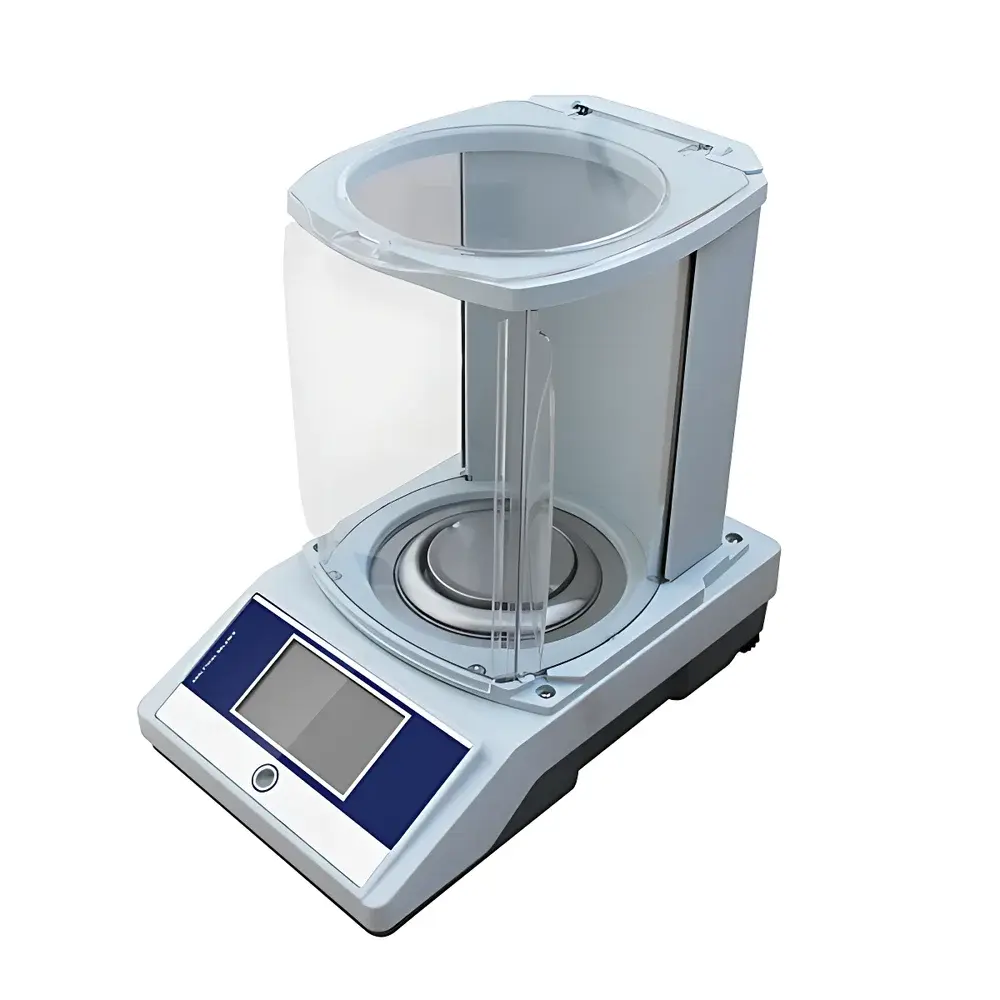
The Yoke GT-C Series Touchscreen Internal Calibration Analytical Balance is a high-precision mass measurement instrument engineered for laboratories requiring reliable, traceable, and repeatable weighing performance at the 0.1 mg readability level. Designed in accordance with OIML R76-1 (2017) requirements for Class I analytical balances, the GT-C series employs electromagnetic force compensation (EMFC) technology — the industry-standard principle for high-resolution analytical weighing. This architecture ensures minimal drift, excellent linearity, and long-term stability under varying environmental conditions. The integrated internal calibration mechanism utilizes a motor-driven, temperature-compensated calibration weight to perform automatic recalibration at user-defined intervals or upon power-up, eliminating manual handling of external standards and reducing operator-induced uncertainty. All GT-C models (GT104C to GT224C) share a common mechanical platform and firmware architecture, enabling consistent metrological behavior across the 100 g to 220 g capacity range.
Key Features
- ARM32-bit embedded microprocessor enabling real-time data processing, fast stabilization (<1.5 s typical), and low-noise signal acquisition;
- Digitally optimized filtering algorithms that dynamically adjust response time based on load magnitude and environmental vibration, enhancing both speed and accuracy;
- High-stability electromagnetic sensor assembly manufactured using CNC-machined precision components and hermetically sealed coil housing to minimize thermal drift and mechanical hysteresis;
- Integrated draft shield with streamlined, fully enclosed design (80 mm diameter weighing pan) providing ISO/IEC 17025-compliant protection against air currents and thermal convection;
- Multi-function operating modes including piece counting, checkweighing, density determination (with optional density kit), and animal/dynamic weighing — all accessible via intuitive touchscreen interface;
- Surface-mount technology (SMT) PCB assembly ensuring enhanced thermal management, reduced solder joint fatigue, and improved long-term reliability;
- Backlit BTN black-on-gray LCD display with wide viewing angle and high contrast for clear readability under varied ambient lighting conditions.
Sample Compatibility & Compliance
The GT-C series supports a broad spectrum of sample types — from pharmaceutical powders and reference standards to micro-volume liquid aliquots (using tare vessels) and small metallic components. Its 80 mm stainless steel pan accommodates standard weighing boats, crucibles, and volumetric glassware. All models comply with international metrological standards including OIML R76-1 (Class I), EN 45501, and ISO 9001:2015. The internal calibration system satisfies GLP/GMP documentation requirements when used in conjunction with audit-trail-enabled software (see Software & Data Management). While not FDA 21 CFR Part 11–certified out-of-the-box, the balance’s deterministic calibration events, timestamped logs, and non-modifiable internal memory support validated workflows in regulated environments when integrated into a compliant laboratory information management system (LIMS).
Software & Data Management
Data output is supported via RS232 serial interface (standard) with optional USB-to-serial adapter compatibility. The balance transmits stable weight values, net/gross/tare status, units, and calibration timestamps in ASCII format, compatible with industry-standard data acquisition platforms including LabX (Mettler Toledo), WinWedge, and custom Python/Excel VBA scripts. Internal memory stores up to 200 calibration event records with date/time stamps, operator ID (if configured), and deviation values — accessible via menu navigation. Firmware supports user-defined print formats and configurable auto-print triggers (e.g., after stabilization or calibration). For full electronic record integrity, integration with validated third-party software is recommended to enforce ALCOA+ principles (Attributable, Legible, Contemporaneous, Original, Accurate) in regulated QC/QA settings.
Applications
- Pharmaceutical formulation: active pharmaceutical ingredient (API) dispensing, excipient blending, and tablet weight uniformity testing per USP <41>;
- Chemical synthesis: stoichiometric reagent weighing, catalyst dosage, and yield calculation in R&D and pilot-scale labs;
- Materials science: powder density characterization, thin-film mass loading verification, and nanomaterial dispersion quantification;
- Environmental testing: filter weighing for PM2.5/PM10 gravimetric analysis (EPA Method IO-4.2 compliant with proper environmental control);
- Academic research: teaching labs requiring robust, student-proof instrumentation with multi-mode functionality and low maintenance overhead.
FAQ
What calibration standards does the internal calibration mechanism reference?
The internal calibrator uses a factory-characterized, temperature-compensated weight traceable to national metrology institutes (NMI) via Yoke’s ISO/IEC 17025-accredited calibration lab. It does not replace periodic external verification with certified weights.
Is the GT-C series suitable for use in a Class A/B cleanroom?
Yes — the sealed electronics, smooth surfaces, and absence of ventilation grilles meet ISO 14644-1 particle generation requirements when operated within specified temperature (15–30 °C) and humidity (40–60% RH) ranges.
Can the balance be connected to a networked LIMS?
Direct Ethernet or Wi-Fi is not supported; however, RS232 output can be bridged to TCP/IP networks via industrial serial servers, enabling seamless integration with modern LIMS and ELN platforms.
Does the instrument support user-level access control?
No — the GT-C series lacks password-protected configuration tiers. Critical parameters (e.g., calibration lock, unit selection) are accessible without authentication, making it appropriate for general lab use but requiring procedural controls in highly regulated settings.
What is the expected service life under continuous operation?
With routine cleaning and biannual preventive maintenance (sensor inspection, draft shield alignment, leveling verification), the EMFC mechanism typically maintains Class I performance for ≥8 years based on accelerated life testing and field data from 2019–2024 deployments.