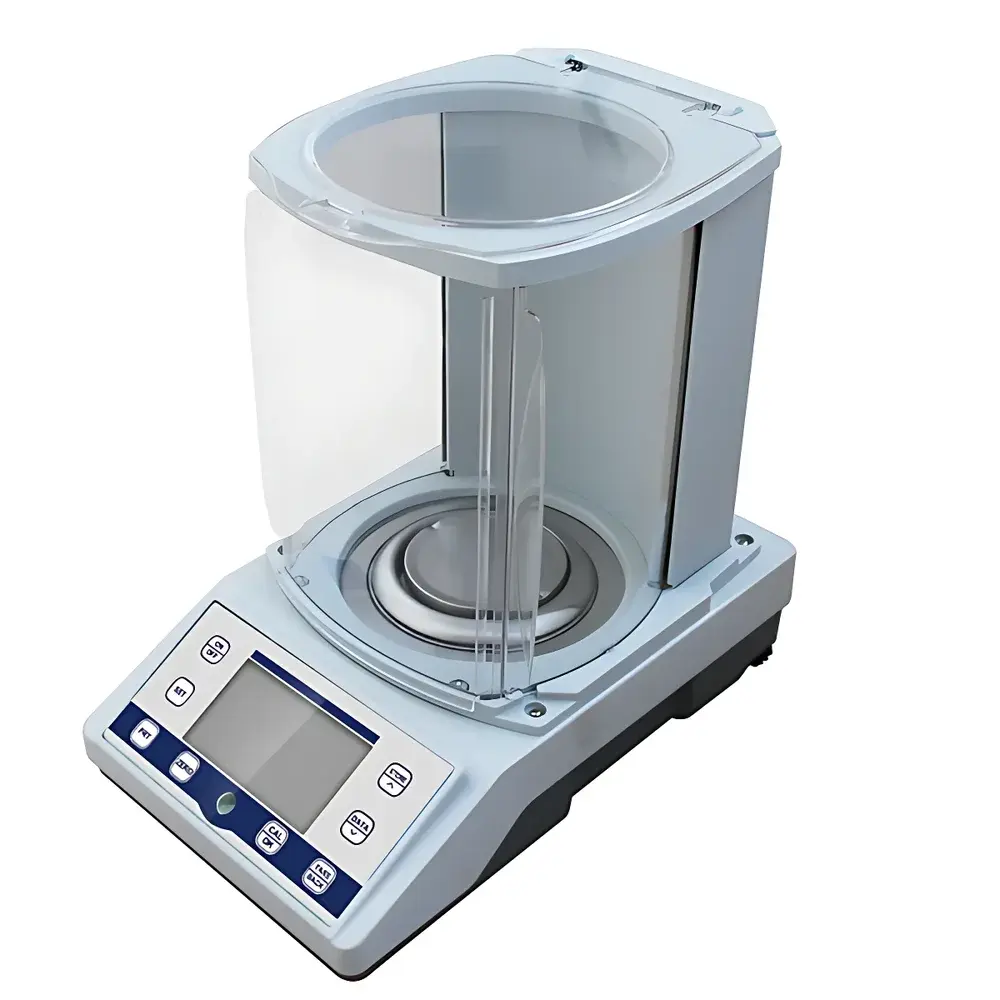
Yoke GC-C Series Analytical Balance with Internal Calibration
| Brand | Yoke |
|---|---|
| Origin | Shanghai, China |
| Manufacturer | Yoke Instrument Co., Ltd. |
| Model | GC-C Series |
| Capacity | 100–220 g |
| Readability | 0.1 mg |
| Calibration | Internal |
| Accuracy Class | Class I (OIML R76) |
| Repeatability | ±0.1 mg |
| Pan Diameter | 80 mm |
| Dimensions (W×D×H) | 360 × 220 × 350 mm |
| Weight (incl. packaging) | 8 kg |
| Power Supply | DC 9 V / 1 A |
Overview
The Yoke GC-C Series Analytical Balance is a high-precision Class I analytical balance engineered for laboratories requiring consistent 0.1 mg readability across capacities ranging from 100 g to 220 g. Based on electromagnetic force compensation (EMFC) principle, the balance employs a high-stability electromagnetic sensor manufactured using CNC-machined precision components to ensure long-term linearity, thermal drift resistance, and mechanical robustness. Its internal calibration system—activated at user-defined intervals or automatically upon power-on or temperature shift—eliminates dependency on external weights while maintaining traceability to national standards. Designed in strict compliance with OIML R76 and ISO 9001 quality management requirements, the GC-C Series meets foundational metrological criteria for routine analytical weighing in QC labs, pharmaceutical formulation units, academic research facilities, and materials testing environments where repeatability ≤0.1 mg and linearity error within ±0.5e to ±1.5e (per OIML tolerance bands) are operationally mandated.
Key Features
- Electromagnetic force compensation (EMFC) transducer with CNC-fabricated core components for enhanced sensitivity and stability under variable ambient conditions.
- ARM32-bit microprocessor architecture enabling real-time digital filtering, adaptive response optimization, and noise suppression without compromising measurement integrity.
- Integrated internal calibration mechanism compliant with ISO/IEC 17025 verification workflows; supports scheduled auto-calibration triggered by time, temperature delta (>1.5 °C), or manual initiation.
- Sealed draft shield assembly with ergonomic sliding doors and anti-static acrylic panels—minimizes air turbulence and electrostatic interference during microgram-level weighing.
- Multi-function operating modes: counting (with sample count auto-averaging), checkweighing (HI/OK/LO thresholds), density determination (using auxiliary sinker kit), and dynamic animal weighing with damping algorithm.
- SMT-assembled PCBs ensuring thermal resilience, reduced solder joint failure risk, and extended mean time between failures (MTBF) in continuous-use settings.
- High-contrast BTN black-on-white LCD with white LED backlight—optimized for low-glare visibility under varied lab lighting, including UV-protected hoods and laminar flow cabinets.
Sample Compatibility & Compliance
The GC-C Series accommodates standard laboratory samples—including powders, granules, small metallic parts, filter papers, and vials—within its 80 mm diameter stainless-steel weighing pan. The balance’s structural design conforms to IP42 ingress protection (dust-resistant, drip-shielded) and operates reliably in ambient temperatures of 10–30 °C with relative humidity ≤80 % RH (non-condensing). It satisfies essential regulatory prerequisites for GLP-compliant environments: audit-trail-ready operation logs (via optional RS232/USB data export), documented calibration history, and full traceability of internal calibration events. While not pre-certified for FDA 21 CFR Part 11, its firmware architecture supports third-party validation protocols required for GMP-aligned pharmaceutical manufacturing and USP testing applications.
Software & Data Management
Data output is supported via standard RS232 serial interface (configurable baud rates up to 115200 bps) and USB virtual COM port, enabling seamless integration with LIMS, ELN, and statistical process control (SPC) platforms. Optional YokeBalance PC software provides real-time graphing, batch export (CSV/TXT), statistical summary (mean, SD, CV%), and customizable report templates aligned with ISO/IEC 17025 documentation expectations. All weighing sessions—including tare, net weight, unit count, and calibration timestamps—are timestamped and stored locally in non-volatile memory (retains ≥1000 records). Firmware updates are performed via USB drive without proprietary tools, ensuring long-term maintainability and cybersecurity readiness.
Applications
- Pharmaceutical QC: Active pharmaceutical ingredient (API) dispensing, reference standard preparation, and USP repeatability verification.
- Academic Research: Gravimetric analysis, catalyst loading, nanomaterial mass quantification, and stoichiometric reagent preparation.
- Materials Science: Powder density profiling, coating thickness validation via mass loss/gain, and composite blend uniformity assessment.
- Environmental Labs: Filter weighing for TSP/PM2.5 gravimetric analysis per EPA Method IO-4.2 and ISO 12103-1.
- Food & Beverage: Nutrient fortification dosing, moisture content determination (loss-on-drying), and portion control auditing.
FAQ
What calibration standards does the internal calibration system reference?
The internal calibrator uses a factory-traceable, temperature-compensated reference mass certified to ISO/IEC 17025-accredited standards. No external weights are required for routine operation, though periodic verification with Class E2 or better砝码 is recommended per ISO 17025 clause 6.5.2.
Is the balance compatible with regulated environments requiring audit trails?
Yes—when connected to validated PC software, all critical events (weighings, calibrations, configuration changes) are logged with date/time stamps and user ID fields, supporting ALCOA+ data integrity principles.
Can the GC-C Series be used for density determination of irregular solids?
Yes—via the built-in density mode with optional immersion kit (sinker + thermometer input), supporting both solid and liquid density calculations per ISO 1183-1.
What environmental conditions affect repeatability performance?
Vibrations, air currents, static charge, and rapid ambient temperature shifts (>1.5 °C within 30 min) may impact 0.1 mg stability. Installation on a dedicated vibration-dampened bench away from HVAC vents and centrifuges is strongly advised.
Does the balance support multiple user profiles with role-based access?
No—the GC-C Series does not feature multi-user authentication. Access control and permission management must be implemented externally via host software or network policies.