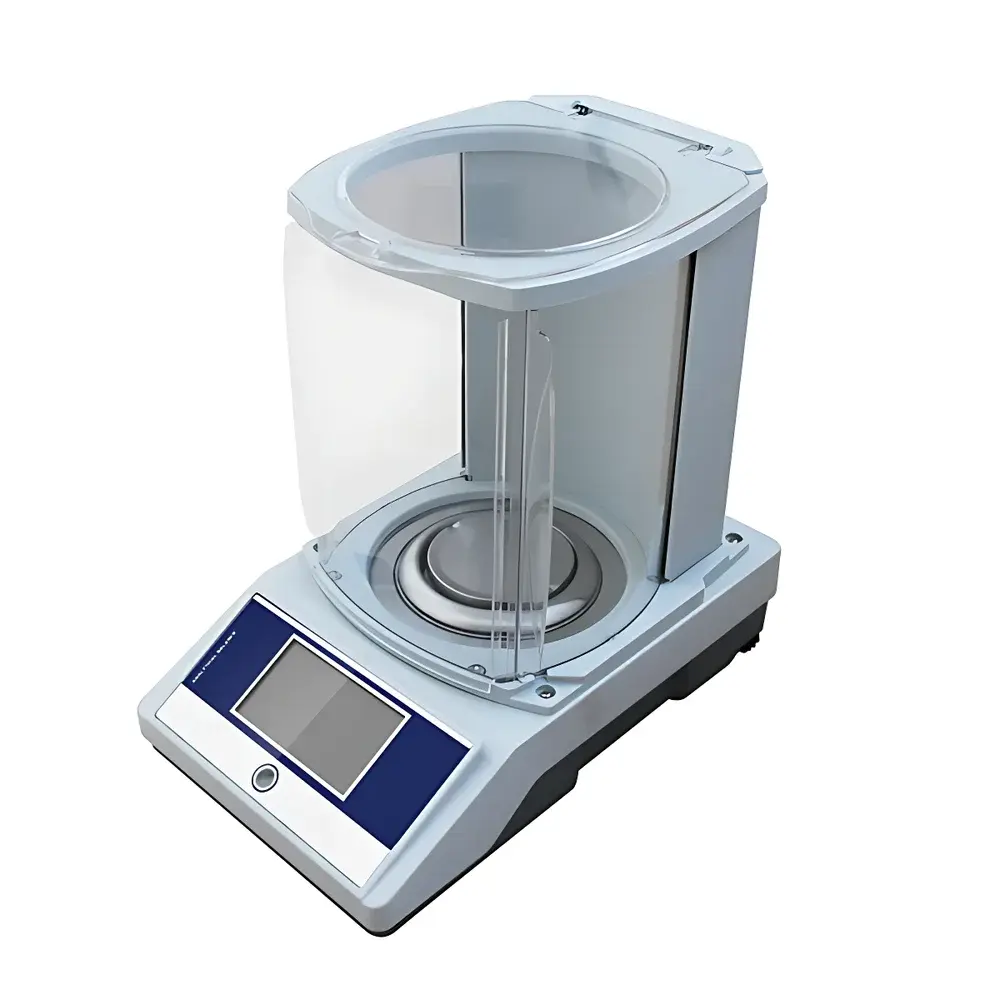
Yoke GT-C Series Touchscreen Internal Calibration Precision Balance
| Brand | Yoke |
|---|---|
| Origin | Shanghai, China |
| Manufacturer Type | Manufacturer |
| Product Category | Domestic |
| Model | GT-C |
| Instrument Type | Precision Balance |
| Capacity Range | 100–200 g |
| Readability | 0.001 g (1 mg) |
| Calibration Method | Internal Calibration |
| Maximum Capacity | 500 g |
| Repeatability | ±1 mg |
| Accuracy Class | Class II (per OIML R76) |
Overview
The Yoke GT-C Series Touchscreen Internal Calibration Precision Balance is a high-reliability analytical-grade weighing instrument engineered for laboratories requiring consistent 1 mg readability across capacities from 100 g to 500 g. Designed in accordance with OIML R76-1:2017 and compliant with ISO/IEC 17025 calibration traceability requirements, the GT-C series employs electromagnetic force compensation (EMFC) technology — a principle widely adopted in precision balances for its superior linearity, thermal stability, and long-term drift resistance. Each unit integrates a hermetically sealed electromagnetic sensor fabricated via CNC-machined high-purity ferromagnetic components, ensuring minimal hysteresis and optimized signal-to-noise ratio. The balance operates under Class II accuracy specifications per international metrological standards, supporting routine quality control, formulation verification, and sample preparation workflows in pharmaceutical, chemical, academic, and materials testing environments.
Key Features
- Integrated ARM32-bit microprocessor enabling real-time data processing, adaptive digital filtering, and optimized response dynamics without compromising resolution or stability
- Internal motorized calibration system with automatic temperature-compensated recalibration — eliminating manual weight handling and reducing operator-induced error
- Sealed draft shield enclosure with ergonomic front-access design, minimizing air current interference while maintaining full visibility and ease of sample placement
- Multi-function weighing modes including piece counting, checkweighing, density determination (with optional density kit), and dynamic animal weighing — all accessible via intuitive touchscreen interface
- SMT (Surface-Mount Technology) PCB assembly enhancing circuit integrity, thermal dissipation, and long-term operational reliability under continuous laboratory use
- High-contrast BTN black-on-white LCD display with white LED backlight — optimized for low-glare viewing under varied ambient lighting conditions
Sample Compatibility & Compliance
The GT-C series accommodates standard laboratory samples up to Ø90 mm diameter on its stainless-steel weighing pan. Its sealed sensor architecture and internal calibration mechanism meet environmental robustness requirements for ISO 14644-1 Class 8 cleanroom-adjacent operation. All models conform to OIML R76 Class II maximum permissible errors (MPE): ±0.5e (0–50 g), ±1.0e (50–200 g), ±1.5e (>200 g), where e = 1 mg. Units are factory-calibrated using NIST-traceable reference masses and support user-performed external calibration per ASTM E898–22 guidelines. Documentation includes full metrological certificate, conformity declaration (CE marking), and compliance statement for GLP/GMP-aligned recordkeeping.
Software & Data Management
The GT-C features a built-in RS232 interface compatible with Windows- and macOS-based LIMS, ELN, and ERP systems. Optional USB-to-serial adapters enable direct connection to PCs for automated data logging. All weighing events — including tare, net/gross, calibration timestamps, and mode selections — are timestamped and stored locally with audit trail capability. While the base firmware does not include FDA 21 CFR Part 11-compliant electronic signature functionality, the device supports integration with validated third-party software platforms that provide full ALCOA+ (Attributable, Legible, Contemporaneous, Original, Accurate) data governance. Firmware updates are delivered via secure USB flash drive protocol.
Applications
- Pharmaceutical QC: Active pharmaceutical ingredient (API) dispensing, excipient blending verification, and tablet weight uniformity testing per USP
- Chemical R&D: Stoichiometric reagent weighing, catalyst dosage control, and gravimetric standard solution preparation
- Academic Teaching Labs: Introductory metrology instruction, uncertainty analysis exercises, and comparative weighing methodology studies
- Materials Science: Powder density characterization, composite mixture ratio validation, and thin-film substrate mass profiling
- Food & Beverage QA: Portion control auditing, additive concentration verification, and shelf-life stability sample tracking
FAQ
What does “internal calibration” mean for the GT-C series?
Internal calibration uses an integrated motor-driven calibration mass and electromagnetic actuation system to perform fully automated, temperature-compensated recalibration — no external weights required.
Is the GT-C series suitable for ISO/IEC 17025-accredited laboratories?
Yes — when operated within specified environmental conditions (20 ±2°C, ≤50% RH, vibration-free surface), and with documented periodic verification using traceable standards, it meets the metrological requirements for accredited testing.
Can the GT-C connect to laboratory information management systems (LIMS)?
Yes — via RS232 serial output with ASCII protocol; configuration parameters and output formatting are programmable through onboard menu settings.
What is the recommended warm-up time before first use?
Minimum 30 minutes at stable ambient temperature is advised to achieve thermal equilibrium of the EMFC sensor and ensure optimal repeatability.
Does the GT-C series support density determination?
Yes — with optional density kit (not included), users can perform solid density measurements using Archimedes’ principle with dual-pan suspension and air buoyancy correction algorithms.