
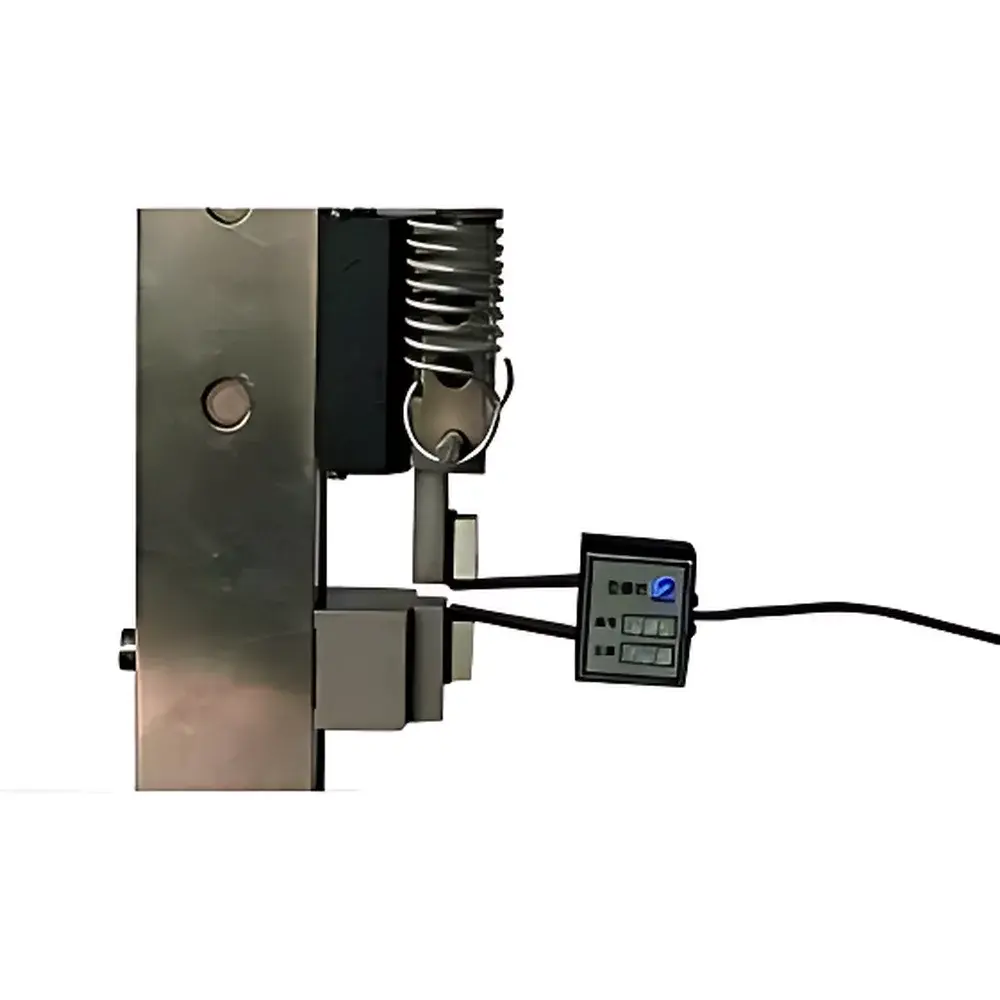
COD Series Clip-On Extensometer
| Brand | CIMACH |
|---|---|
| Origin | Jilin, China |
| Model | COD Series |
| Gauge Lengths | 10 mm & 12 mm |
| Maximum Extension Range | 2 mm |
| Accuracy Class | Class 1 (±0.5% FS) |
| Radial Design | CBY1-J Type |
Overview
The COD Series Clip-On Extensometer is a precision mechanical displacement transducer engineered for high-fidelity strain measurement during uniaxial tensile, compression, and cyclic testing of metallic, polymeric, and composite specimens. Designed in accordance with ISO 9513:2012 (Metallic materials — Calibration of extensometers used in uniaxial testing) and compatible with ASTM E83 Class B-1 requirements, this radial-mount extensometer operates on the principle of direct mechanical lever amplification coupled with high-stability linear variable differential transformer (LVDT) or strain-gauge-based sensing. Its non-contact-free clamping mechanism ensures minimal specimen interference while maintaining consistent gage length definition throughout the test—critical for accurate modulus, yield strength, and elongation-at-break determination in materials qualification and quality control laboratories.
Key Features
- Radial clip-on design (CBY1-J configuration) enables rapid, tool-free attachment and removal without altering specimen geometry or introducing bending moments.
- Two standard gauge lengths available: 10 mm (COD 10-2) and 12 mm (COD 12-2), both calibrated to Class 1 accuracy per ISO 9513 (±0.5% of full scale).
- Full-scale extension range of 2 mm supports measurement across elastic deformation, yield transition, and early plastic strain regimes for standard metallic coupons (e.g., ASTM E8/E21 specimens) and rigid polymers.
- Robust aluminum alloy housing with hardened stainless-steel jaws ensures long-term dimensional stability and resistance to wear under repeated loading cycles.
- Integrated low-noise analog output (±10 V or 4–20 mA) compatible with universal testing machines (UTMs) from Instron, MTS, Shimadzu, and Tinius Olsen via standard analog input modules.
- Zero-drift compensation circuitry minimizes thermal drift over extended test durations (≥30 min), supporting reliable data acquisition in ambient laboratory environments (15–30 °C).
Sample Compatibility & Compliance
The COD Series is optimized for flat, rectangular, or round cross-section specimens with thicknesses between 0.5 mm and 12 mm and widths/diameters up to 25 mm. Jaw curvature and adjustable spring force accommodate minor surface irregularities without slippage—validated per ISO 527-2 Annex B for polymer tensile testing. All units are supplied with traceable calibration certificates conforming to ISO/IEC 17025 requirements, including as-found/as-left data, uncertainty budgets (<0.35% k=2), and reference to NIM (National Institute of Metrology, China) standards. The device meets essential safety and EMC criteria per GB/T 18268.1–2010 (equivalent to IEC 61326-1) for laboratory measurement equipment.
Software & Data Management
While the COD extensometer operates as a hardware-level analog sensor, its output integrates seamlessly into industry-standard UTM control software platforms—including Bluehill (Instron), TestXpert (Zwick), and TREM (Shimadzu)—enabling real-time strain channel synchronization with load and displacement signals. When paired with compliant data acquisition systems, the instrument supports audit-trail-enabled recording per FDA 21 CFR Part 11 (when implemented at the host software level), including user authentication, electronic signatures, and immutable data logging. Raw analog voltage outputs may be digitized using 16-bit or higher resolution DAQ cards, permitting post-test reprocessing with third-party analysis tools such as MATLAB or Python-based SciPy workflows for strain-rate-dependent modeling.
Applications
- Tensile property characterization per ASTM E8, ISO 6892-1, and GB/T 228.1 for structural steels, aluminum alloys, and titanium grades.
- Yield point detection and proof stress determination (Rp0.2) in high-strength fastener and aerospace component validation.
- Modulus of elasticity (E-modulus) measurement in QA/QC labs for incoming raw material verification against mill test reports.
- Cyclic fatigue pre-testing to establish baseline elastic behavior prior to servo-hydraulic endurance trials.
- Educational use in university mechanics of materials laboratories for hands-on demonstration of Hooke’s law and strain localization phenomena.
FAQ
What gauge lengths are supported by the COD Series?
The series offers two calibrated configurations: COD 10-2 (10 mm gauge length) and COD 12-2 (12 mm gauge length), both rated for 2 mm maximum extension.
Is the extensometer compatible with non-metallic specimens?
Yes—validated for rigid plastics (e.g., PC, ABS, PA6), fiber-reinforced composites, and sintered ceramics meeting minimum surface hardness (≥HV 150) and flatness tolerances (≤0.02 mm deviation over gauge length).
Does it require external power or signal conditioning?
No external excitation is needed for passive strain-gauge variants; LVDT-equipped models require ±15 V DC supply, typically provided by the host UTM’s analog interface module.
Can it be recalibrated in-house?
Recalibration must be performed by an ISO/IEC 17025-accredited laboratory using traceable micrometer-based displacement standards; field zeroing is permitted but does not constitute full calibration.



