
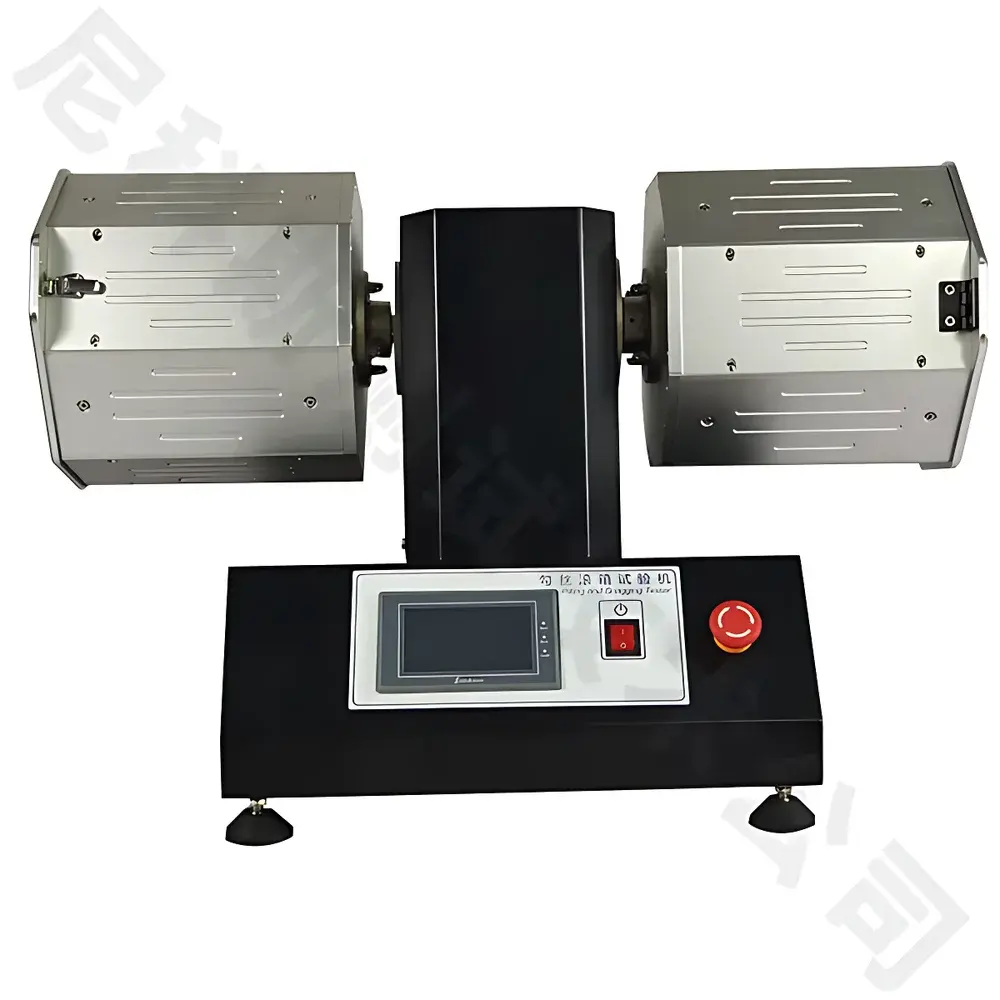
BS 8479 Pilling and Snagging Tester – NYX NY-715E2 Dual-Station Rotating Octagonal Tumbler
| Brand | NYX |
|---|---|
| Origin | Tianjin, China |
| Manufacturer Type | Direct Manufacturer |
| Country of Origin | China |
| Model | NY-715E2 |
| Pricing | Upon Request |
| Test Stations | 2 |
| Sample Size | 140 × 140 mm |
| Rotational Speed | 60 ± 2 rpm |
| Tumbler Geometry | Octagonal, Flat-to-Flat Width 224.5 mm, Depth 228 mm |
| Snagging Pins per Tumbler | 4 rods × 20 pins each |
| Pin Diameter | 1 mm |
| Pin Inclination Angle | 60° |
| Pin Protrusion Length | 5 mm |
| Sample Mounting Tube ID | 25 ± 1 mm, Wall Thickness: 3 ± 0.5 mm, Length: 70 ± 1 mm (4 tubes per tumbler) |
| Cycle Counter Range | 0–999,999, Programmable |
| Control Interface | Industrial Touchscreen HMI |
Overview
The NYX NY-715E2 BS 8479 Pilling and Snagging Tester is a precision-engineered dual-station rotating tumbler designed to evaluate the propensity of woven and knitted textile fabrics to develop snags—surface distortions caused by entanglement with external protrusions—under controlled mechanical agitation without applied compressive load. It operates in strict accordance with British Standard BS 8479:2005 “Textiles — Methods of test for resistance to snagging — Method using an octagonal tumbler”, which specifies the geometry, kinematics, and evaluation protocol for standardized snagging assessment. The instrument utilizes a symmetrical octagonal drum housing four rigidly mounted snagging rods, each fitted with twenty precisely oriented stainless steel pins. Fabric specimens are mounted over compliant polyurethane tubes and subjected to repeated rolling motion at 60 ± 2 rpm, simulating low-pressure mechanical contact encountered during wear, laundering, or handling. Post-test visual evaluation is performed against standardized BS 8479 reference rating cards (Grade 1–5), where Grade 5 indicates no observable snagging and Grade 1 reflects severe surface disruption.
Key Features
- Dual independent test stations enable parallel evaluation of two fabric samples under identical mechanical conditions, improving throughput and inter-sample comparability.
- Octagonal tumbler fabricated from high-rigidity anodized aluminum alloy ensures dimensional stability and long-term repeatability of rotational geometry (flat-to-flat width: 224.5 mm; depth: 228 mm).
- Precision-machined snagging pins (Ø1.0 mm, 60° inclination, 5 mm protrusion) are mounted on hardened stainless steel rods with positional tolerance ≤ ±0.1 mm to guarantee consistent snag initiation mechanics across all cycles.
- Calibrated polyurethane mounting tubes (ID: 25 ± 1 mm; wall thickness: 3 ± 0.5 mm; length: 70 ± 1 mm) replicate the elastic support required by BS 8479, minimizing specimen slippage and ensuring uniform stress distribution during tumbling.
- Industrial-grade touchscreen HMI provides intuitive cycle programming, real-time speed monitoring, and non-volatile cycle counting (0–999,999) with password-protected parameter locking for GLP-compliant operation.
- Integrated safety interlock system halts rotation immediately upon door opening, meeting EN 61000-6-2 EMC and EN ISO 13857 mechanical safety requirements.
Sample Compatibility & Compliance
The NY-715E2 accommodates standard 140 × 140 mm fabric specimens cut with grain alignment per BS 8479 Section 6. It supports both single-layer and folded specimens, provided mounting tube compatibility is maintained. The instrument is validated for use with natural fibers (e.g., wool, cotton), synthetic filaments (polyester, nylon), blends, and technical textiles—including coated and laminated substrates—provided surface integrity remains intact during mounting. Compliance extends to related international standards including ISO 12945-2 (pilling resistance via rotary box method) and ASTM D3512 (pilling resistance of textile fabrics), though formal conformance statements require user-specific validation per ISO/IEC 17025. All mechanical dimensions, pin specifications, and rotational parameters are traceably verified against BS 8479 Annex A calibration requirements.
Software & Data Management
The embedded control firmware supports audit-trail-enabled operation: every test run logs timestamp, operator ID (via optional RFID badge integration), programmed cycle count, actual measured rpm, and completion status. Data export is available via USB 2.0 to CSV format for integration into LIMS or quality management systems. While the base unit does not include PC-based analysis software, optional NYX LabLink™ Suite (v3.2+) provides automated report generation aligned with ISO 17025 documentation templates, including uncertainty estimation per GUM (JCGM 100:2008) for cycle count repeatability (CV ≤ 0.8% at n = 10). Firmware updates are delivered via signed binary packages with SHA-256 verification to satisfy FDA 21 CFR Part 11 electronic record integrity requirements.
Applications
- Quality assurance laboratories evaluating snag resistance of apparel fabrics prior to bulk production.
- R&D departments optimizing yarn twist, fabric density, finishing chemistry, or fiber cross-section design for improved surface durability.
- Third-party testing facilities performing accredited BS 8479 assessments for certification bodies (e.g., UKAS, CNAS).
- Technical textile developers assessing snag behavior of geotextiles, filtration media, and medical nonwovens under simulated abrasion.
- Academic research on fabric–pin interaction mechanics, including finite element modeling validation of snag initiation thresholds.
FAQ
Does the NY-715E2 comply with the latest revision of BS 8479?
Yes—the instrument conforms to BS 8479:2005 and incorporates all geometric, kinematic, and procedural requirements defined therein, including pin configuration, tumbler dimensions, and rotational tolerance.
Can the tester be used for pilling assessment per ISO 12945-2?
While mechanically compatible, ISO 12945-2 requires different pin arrangement (no rods) and evaluation criteria; users must validate method transfer per ISO 17025 before claiming compliance.
Are replacement polyurethane mounting tubes supplied with NIST-traceable dimensional certification?
Standard tubes are supplied with factory calibration certificate; traceable metrology reports (including CMM verification) are available as optional add-on (Order Code: NY-TUBE-CERT).
Is remote diagnostic support available for firmware or HMI issues?
Yes—NYX offers secure TLS-encrypted remote maintenance via TeamViewer QuickSupport (ISO 27001-certified channel), subject to signed remote access agreement.
What maintenance intervals are recommended for pin wear verification?
Visual inspection and micrometer verification of pin diameter and protrusion length are recommended every 5,000 cycles or quarterly, whichever occurs first; replacement kits (Part No. NY-PIN-KIT-20) include calibration gauge.



