
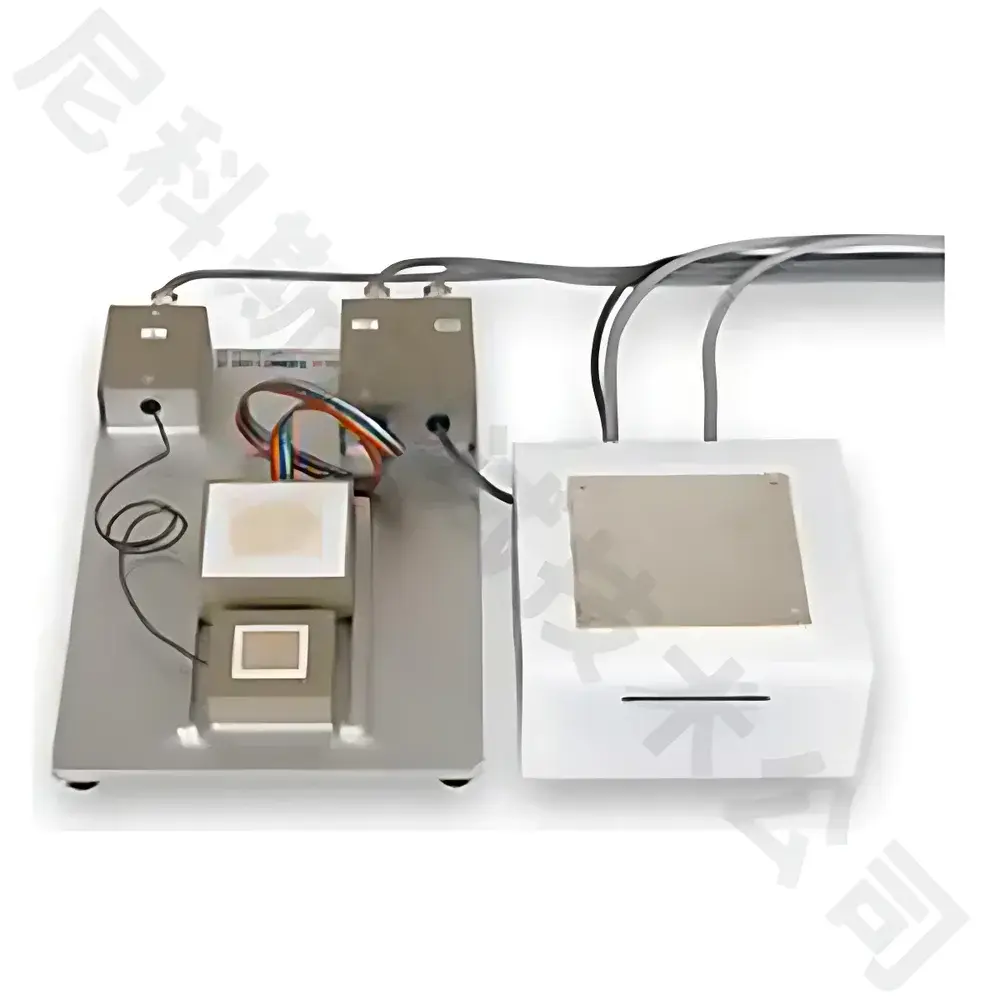
KES-F7 Contact Thermal Sensation Tester
| Brand | NYX |
|---|---|
| Origin | Tianjin, China |
| Manufacturer Type | Manufacturer |
| Origin Category | Domestic |
| Model | CWT-A1-2 |
| Pricing | Upon Request |
Overview
The KES-F7 Contact Thermal Sensation Tester is an engineered instrument designed for quantitative evaluation of instantaneous thermal perception—specifically the contact coolness or warmth—between textile materials and human skin. It operates on the principle of transient heat transfer measurement under controlled, standardized mechanical and thermal boundary conditions. The device complies with GB/T 35263–2017 and FTTS-FA-019, two widely recognized protocols for determining the maximum contact heat flux (Qmax, expressed in J/(cm²·s)) during initial skin–fabric interaction. Unlike subjective sensory panels, the KES-F7 delivers objective, repeatable, and traceable thermal response data by simulating the thermophysical interface between a calibrated copper plate (acting as a surrogate for skin surface) and the test specimen under defined contact pressure and temperature differential.
Key Features
- Thermally regulated copper detection plate (9 cm² active area) with precise temperature control from 20 °C to 40 °C, enabling systematic assessment across physiologically relevant skin-surface temperature ranges.
- Controlled contact force of (0.1 ± 0.01) N/cm², maintained via calibrated mechanical loading system to ensure consistent interfacial pressure—critical for reproducible Qmax derivation.
- High-speed thermal acquisition architecture: integrated high-resolution temperature sensors (0.1 °C resolution, ≤0.2 s response time) coupled with a dedicated data acquisition card for sub-second transient thermal profiling.
- Temperature-stabilized sample stage with independent thermal regulation; capable of sustaining a fixed ΔT of 15 °C relative to the detection plate—essential for minimizing ambient drift and meeting the ≤0.08 J/(cm²·s) baseline stability requirement per standard methodology.
- Rugged, benchtop-integrated design optimized for laboratory environments: AC 220 V / 50 Hz / 600 W power input, operational within (20 ± 2) °C and (65 ± 4)% RH ambient conditions.
Sample Compatibility & Compliance
The KES-F7 accommodates flat, flexible textile specimens—including woven, knitted, nonwovens, laminates, and coated fabrics—up to standard dimensions required by GB/T 35263–2017 (typically ≥10 cm × 10 cm). Specimens are mounted tautly on the thermostatically controlled stage without adhesives or clamping artifacts that could impede natural thermal contact. The system supports full compliance documentation generation for internal quality audits and third-party certification workflows. While not certified to ISO/IEC 17025 out-of-the-box, its measurement traceability aligns with principles outlined in ISO/IEC Guide 99 (VIM) and ASTM E29—enabling calibration verification against NIST-traceable reference standards. Data integrity meets GLP-aligned requirements, including operator ID logging, timestamped acquisition, and immutable raw-data archiving.
Software & Data Management
The included PC-based software provides real-time visualization of temperature decay curves, automatic Qmax calculation using the standardized integral method (dQ/dt = h·ΔT(t), where h is interfacial conductance), and export of tabular results in CSV and PDF formats. All measurement sessions are logged with metadata: date/time, operator ID, sample ID, plate temperature, stage temperature, ambient conditions, and pass/fail status against method-defined thresholds. Audit trails comply with basic 21 CFR Part 11 readiness (user authentication, electronic signatures optional via Windows domain integration), supporting laboratories operating under GMP or regulated R&D frameworks.
Applications
- Objective validation of “cool-touch” claims for sportswear, medical textiles, and summer apparel.
- Material development support for phase-change material (PCM)-integrated fabrics and moisture-wicking composites.
- Quality assurance testing across production batches to monitor consistency in thermal interface performance.
- Comparative analysis of fiber blends, finishing treatments (e.g., silicone, ceramic coatings), and structural parameters (e.g., yarn count, loop length, fabric weight).
- Research into skin–material thermophysiology, including correlation studies between Qmax values and psychophysical panel scores.
FAQ
What standards does the KES-F7 explicitly support?
GB/T 35263–2017 and FTTS-FA-019 are fully implemented in the software’s test protocol engine and reporting templates.
Is calibration service available with the instrument?
Yes—initial factory calibration certificate is provided; annual recalibration using traceable thermal reference blocks is recommended and supported by NYX technical service centers in China.
Can the system be integrated into a LIMS environment?
Raw data export (CSV) and structured metadata enable seamless ingestion into common LIMS platforms via script-based automation or manual import.
Does the instrument require external cooling or heating utilities?
No—the detection plate and sample stage incorporate self-contained Peltier-based thermal control; only standard AC mains power is required.
What is the typical measurement duration per sample?
Each test cycle—including thermal equilibration, contact initiation, and data capture—completes within 60 seconds, allowing throughput of up to 40 samples per 8-hour shift.



