
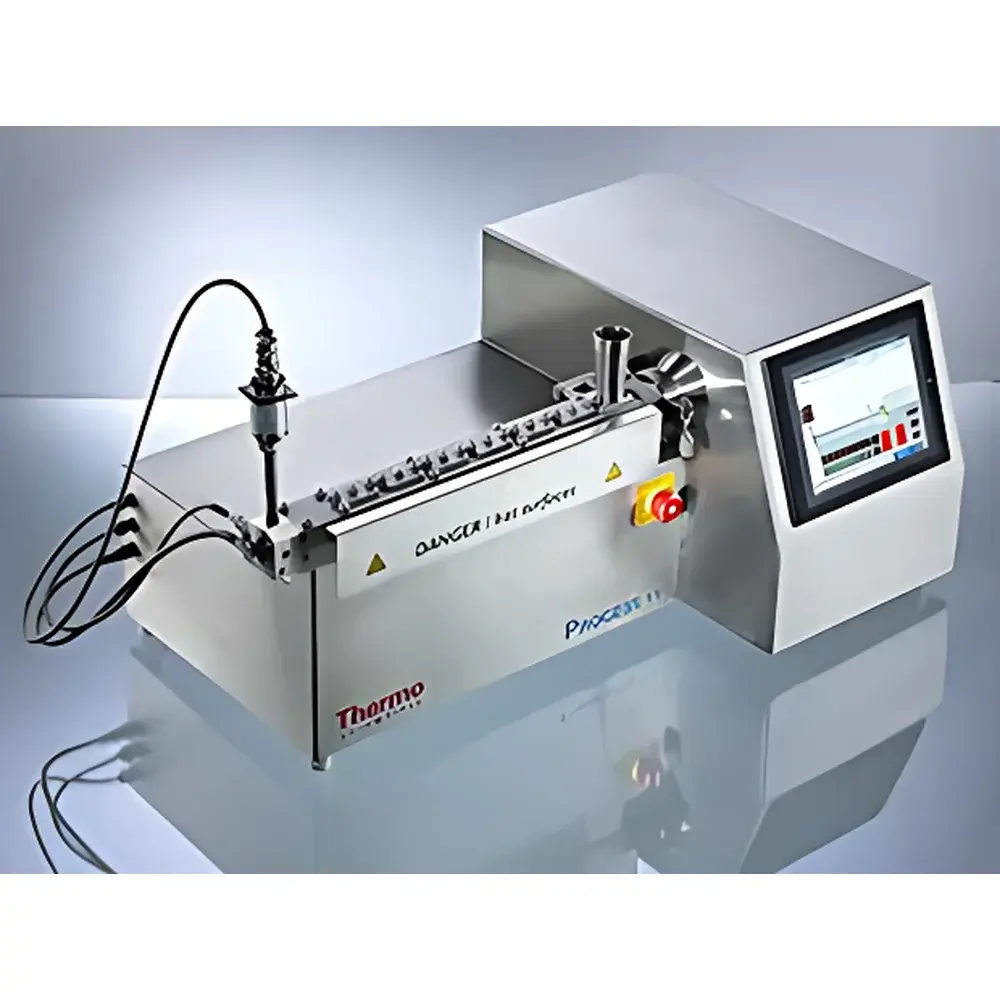
HAAKE Process 11 Miniature Twin-Screw Extruder
| Brand | HAAKE |
|---|---|
| Origin | USA |
| Model | Process 11 |
| Instrument Type | Torque Rheometer |
| Motor Bearing | Mechanical Bearing |
| Speed Range | 10–1000 rpm |
| Torque Resolution | 6 N·m |
| Screw Diameter | 11 mm |
| L/D Ratio | 40 |
| Barrel Material | Nitrided Steel EN 1.7365 (40B) |
| Max Operating Temperature | 350 °C (optional 450 °C) |
| Max Pressure | 100 bar |
| Heating Zones | 7 × 5D electric |
| Cooling | Optional water-cooling |
| Dimensions (L×W×H) | 820 × 480 × 410 mm |
| Weight | 55 kg |
Overview
The HAAKE Process 11 is a compact, desktop-scale co-rotating twin-screw extruder engineered for laboratory-scale compounding, reactive extrusion, and formulation development of thermoplastic polymers. Based on Couette-type flow principles and torque-based rheological monitoring, it delivers quantitative process data—including melt pressure, temperature profiles, torque consumption, and specific mechanical energy—enabling direct correlation between lab-scale behavior and industrial-scale production. Its 11 mm screw diameter and 40 L/D barrel length replicate the geometric scaling and shear history characteristics of full-scale production extruders, supporting robust scale-up validation per ASTM D3835 and ISO 11443 standards. Designed for precision and repeatability in R&D environments, the Process 11 integrates real-time process analytics with modular hardware architecture to support iterative material screening under controlled thermal, shear, and residence time conditions.
Key Features
- Co-rotating, intermeshing twin-screw geometry with standardized modular screw elements—identical in profile and pitch to production-grade HAAKE extruders—to ensure faithful process transferability.
- Horizontally split barrel design with quick-release clamping enables tool-free access to all screw and barrel segments for rapid cleaning, configuration changes, or wear inspection.
- Integrated 7-zone electric heating system (5D per zone), each independently controlled via PID algorithms with ±1 °C stability; optional water-cooling jackets support precise thermal profiling down to sub-ambient temperatures.
- High-resolution torque measurement (6 N·m resolution) coupled with 10–1000 rpm speed control (0.1 rpm increment) allows precise characterization of viscosity, elasticity, and melt strength across wide shear rate ranges.
- Color touchscreen HMI with embedded firmware provides intuitive operation, real-time trend visualization, and configurable alarm thresholds for pressure (max 100 bar), temperature (up to 350 °C standard; 450 °C optional), and motor load.
- Compact footprint (820 × 480 × 410 mm) and 55 kg mass facilitate benchtop deployment in fume hoods, glove boxes, or shared analytical labs without dedicated floor space or structural reinforcement.
Sample Compatibility & Compliance
The HAAKE Process 11 accommodates granules, pellets, powders, and pre-compounded masterbatches of engineering thermoplastics (e.g., PA6, PBT, PC, PEEK), elastomers (TPE, TPU), biopolymers (PLA, PHA), and filled systems (glass/carbon fiber, mineral, nanocellulose). It supports solvent-assisted processing and low-volume reactive extrusion (e.g., grafting, polymerization initiation) with optional vacuum venting (via integrated vacuum port) compliant with ISO 15512 Annex B. All wetted parts meet USP Class VI and FDA 21 CFR 177.2400 requirements for food-contact and pharmaceutical excipient processing. Full audit trail logging, user access levels, and electronic signature capability align with GLP and GMP documentation frameworks per 21 CFR Part 11 when paired with Thermo Scientific™ RheoWin software.
Software & Data Management
RheoWin Control software (v5.0+) provides synchronized acquisition of torque, temperature, pressure, screw speed, and feed rate data at up to 10 Hz sampling frequency. Raw datasets are stored in HDF5 format with embedded metadata (operator ID, timestamp, method file hash) to ensure traceability. Batch comparison tools enable overlay of multiple runs for statistical evaluation of parameter sensitivity (e.g., screw configuration, temperature ramp, feed rate). Export options include CSV, Excel, and PDF reports compliant with internal QA templates. Optional RheoWin Analytics module supports advanced modeling—such as power law fitting, Carreau-Yasuda regression, and specific mechanical energy (SME) integration—for predictive process optimization.
Applications
- Formulation screening of polymer blends and nanocomposites, including dispersion quality assessment via torque transients and melt homogeneity mapping.
- Reactive extrusion studies—grafting, transesterification, and in-situ compatibilization—with real-time monitoring of exothermic events and viscosity evolution.
- Thermal stability testing under shear: identification of onset degradation temperature and residence time distribution (RTD) using tracer injection protocols.
- Process window definition for high-performance polymers (e.g., PPS, PEI, PEEK) requiring precise thermal management and low shear history—enabled by optional 450 °C barrel and liquid cooling.
- Scale-up validation: correlation of lab-scale SME, melt pressure gradient, and die swell ratio with pilot- and production-line data using dimensionless number analysis (e.g., Reynolds, Weissenberg).
FAQ
What is the minimum sample requirement for a valid experiment?
Typical minimum batch size is 20 g for stable torque signal acquisition; however, method-specific validation may require ≥50 g for statistically robust residence time distribution analysis.
Can the HAAKE Process 11 be used for moisture-sensitive materials?
Yes—when equipped with vacuum venting and operated under inert gas purge (N₂ or Ar), it supports processing of hygroscopic resins such as polyamide or polycarbonate without hydrolytic degradation.
Is screw configuration flexibility limited to standard elements?
No—the modular screw system accepts custom geometries (e.g., kneading blocks, reverse elements, mixing discs) manufactured to ISO 11443-compliant tolerances, enabling tailored dispersive/distributive mixing intensity.
How is calibration traceability maintained?
Torque and temperature sensors are factory-calibrated against NIST-traceable references; annual verification kits and certified calibration services are available through Thermo Fisher Scientific Service Centers.
Does the system support continuous feeding and pelletizing integration?
While the base unit operates in batch or semi-continuous mode, it interfaces with gravimetric feeders (e.g., Brabender WT20) and downstream strand pelletizers via analog I/O and Modbus TCP for end-to-end process simulation.
Related Products



