
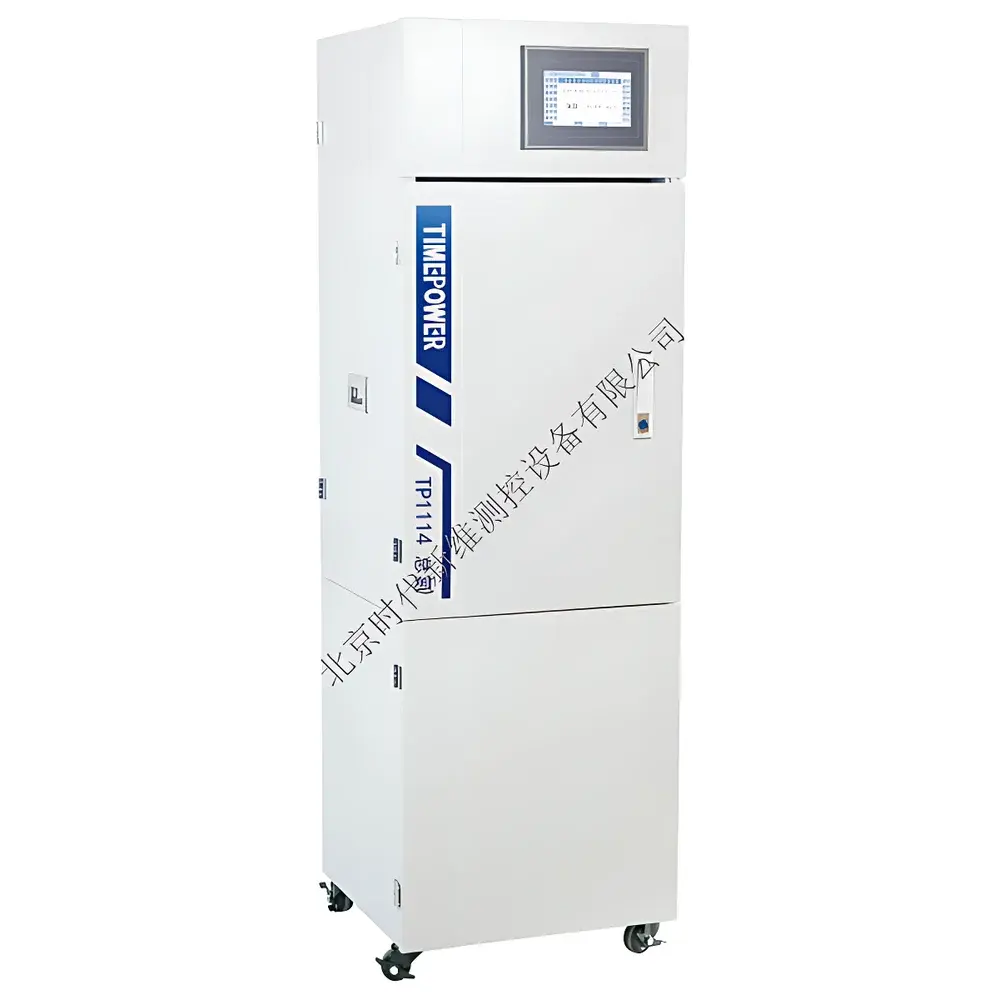
TimePower TP1114 Online Total Nitrogen Analyzer
| Brand | TimePower |
|---|---|
| Model | TP 1114 |
| Origin | Beijing, China |
| Manufacturer Type | Direct Manufacturer |
| Instrument Type | Online Analyzer |
| Measurement Principle | Alkaline Potassium Persulfate Digestion + UV-Visible Spectrophotometry |
| Measurement Range | 0.002–20 mg/L (customizable up to 100 mg/L) |
| Accuracy | ≤ ±5% of reading |
| Detection Limit | 0.01 mg/L |
| Resolution | 0.001 mg/L |
| Display | 7.0-inch color LCD |
| Digestion Time | Programmable (default 10 min) |
| Zero Drift | ±5% FS/24h |
| Span Drift | ±10% FS/24h |
| Repeatability | ≤10% RSD |
| Communication Interfaces | RS-232, RS-485, 4–20 mA analog output |
| Power Supply | AC 220 V ±10%, 50 Hz |
| Power Consumption | ≤180 W |
| Operating Temperature | 5–40 °C |
| Relative Humidity | ≤85% RH (non-condensing) |
| Dimensions | 510 × 470 × 1570 mm (L×W×H) |
| Compliance | HJ 636–2012 “Water Quality — Determination of Total Nitrogen — Alkaline Potassium Persulfate Digestion Ultraviolet Spectrophotometric Method” |
Overview
The TimePower TP1114 Online Total Nitrogen Analyzer is a fully automated, laboratory-grade continuous monitoring system engineered for precise quantification of total nitrogen (TN) in aqueous matrices. It implements the standardized alkaline potassium persulfate digestion method followed by ultraviolet–visible (UV-Vis) spectrophotometric detection at 220 nm and 275 nm, in strict accordance with China’s national standard HJ 636–2012. This dual-wavelength correction approach compensates for interference from dissolved organic matter and nitrate absorbance, ensuring high specificity and metrological traceability. Designed for unattended operation in municipal water treatment plants, industrial effluent discharge points, surface water monitoring stations, and wastewater reclamation facilities, the TP1114 integrates digestion, photometric measurement, fluidic control, and data reporting into a single robust architecture. Its closed-loop, pressurized digestion chamber operates under elevated temperature and pressure conditions—eliminating volatile loss of nitrogenous species and minimizing corrosion risks associated with open-system acid or oxidant handling.
Key Features
- Optimized digestion kinetics: Programmable high-temperature/pressure digestion module (up to 125 °C, 0.2 MPa) reduces reaction time to 10 minutes while achieving >95% oxidation efficiency for refractory nitrogen compounds (e.g., organic nitrogen, nitrite, ammonium).
- Precision fluid handling: Air-gap isolation between reagents and peristaltic pump tubing prevents chemical degradation of elastomeric components; imported modified PTFE transparent tubing (ID ≥1.5 mm) minimizes clogging from suspended solids.
- Stable optical path: High-intensity, long-life cold light source with narrow-band interference filters ensures low-noise absorbance measurement across the UV range; optical alignment is factory-calibrated and drift-compensated via internal reference channels.
- Real-time self-diagnosis: Automated zero/span verification, leak detection, digestion completeness validation, and reagent depletion alerts support predictive maintenance scheduling.
- Modular hardware design: Field-replaceable digestion cells, flow cells, and sensor cartridges enable rapid service without full system downtime.
- Regulatory-ready outputs: Analog (4–20 mA) and digital (RS-232/RS-485 Modbus RTU) interfaces facilitate integration into SCADA, DCS, or LIMS platforms compliant with IEC 62443 and ISO/IEC 17025 data integrity requirements.
Sample Compatibility & Compliance
The TP1114 accepts raw influent, clarified effluent, drinking water, surface water, and high-strength industrial wastewater without pre-filtration (for samples with turbidity <100 NTU). It meets the performance criteria specified in HJ 636–2012 for accuracy, precision, detection limit, and interferences. While not certified to EPA Method 353.2 or ISO 11905-1, its analytical methodology is functionally equivalent and has been validated against certified reference materials (CRMs) traceable to NIST SRM 2168 (Total Nitrogen in Water). The instrument’s firmware supports audit trail logging, user access levels, and electronic signature capability—aligning with GLP and basic GMP documentation expectations for environmental QA/QC laboratories.
Software & Data Management
Embedded firmware provides intuitive navigation via the 7-inch capacitive color touchscreen, supporting multilingual UI (English, Chinese, Spanish). All measurement data—including raw absorbance values, digestion status flags, calibration logs, and maintenance timestamps—are stored locally on industrial-grade SD card with cyclic overwrite protection. Remote configuration and real-time diagnostics are enabled via optional Ethernet/Wi-Fi gateway module. Export formats include CSV and XML, compatible with third-party data aggregation tools. Optional software add-ons provide trend analysis, alarm escalation (SMS/email), and automated report generation aligned with local environmental authority submission templates (e.g., MEP Form 12-1).
Applications
- Continuous compliance monitoring at municipal wastewater treatment plant (WWTP) discharge outfalls per GB 18918–2002 Class I-A limits.
- Process control in denitrification basins to optimize carbon dosing and minimize nitrate residuals.
- Source water quality surveillance in reservoirs and rivers for early eutrophication warning.
- Industrial pretreatment verification for electroplating, pharmaceutical, and food processing facilities discharging nitrogen-rich effluents.
- Research-grade TN profiling in limnological studies requiring sub-mg/L resolution and field-deployable ruggedness.
FAQ
What regulatory standards does the TP1114 comply with?
It is designed and verified to meet the analytical performance requirements of HJ 636–2012. Method equivalence to ISO 11905-1 and EPA 353.2 can be demonstrated through site-specific validation protocols.
Can the measurement range be extended beyond 20 mg/L?
Yes—custom calibration curves and dilution modules support extended ranges up to 100 mg/L, subject to application-specific validation.
How often does the system require maintenance?
Routine maintenance (reagent replacement, tubing inspection, optical window cleaning) is recommended every 30 days; full calibration verification is advised quarterly.
Is remote monitoring supported?
Standard RS-485 Modbus RTU enables integration with existing telemetry systems; optional cellular or Ethernet connectivity modules provide cloud-based dashboard access.
What safety provisions exist for handling digest reagents?
The sealed digestion chamber contains all high-pH, high-oxidant reactions; operators only handle pre-packaged, stabilized reagent kits—reducing direct exposure risk compared to manual benchtop methods.
Related Products







