
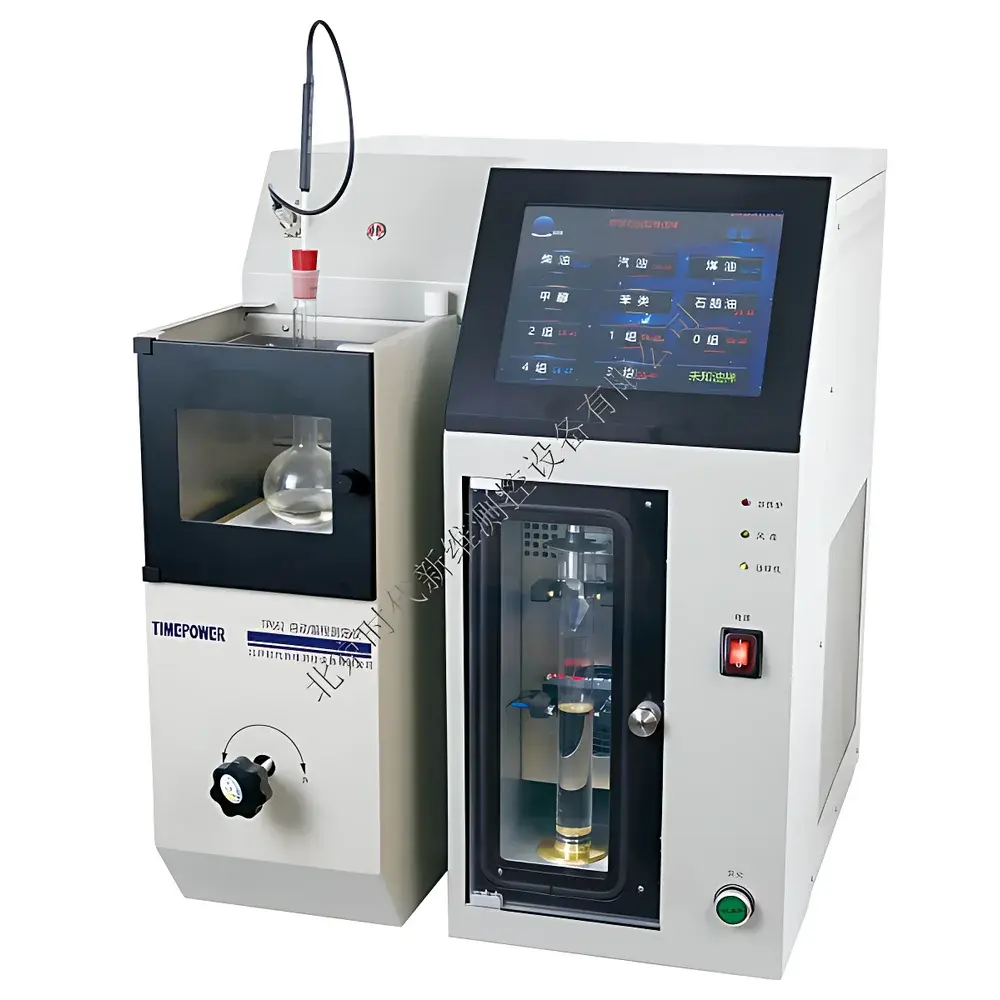
TimePower TP662 Automated Distillation Apparatus for Petroleum Products
| Brand | TimePower |
|---|---|
| Model | TP662 |
| Origin | Beijing, China |
| Manufacturer | TimePower Instruments Co., Ltd. |
| Type | Benchtop Automated ASTM D86 / ISO 3405 Compliant Distillation System |
| Temperature Range | 0–400 °C |
| Temperature Resolution | 0.1 °C |
| Distillate Volume Range | 0–100 mL |
| Volume Measurement Accuracy | ±0.1 mL |
| Condensate Chamber Temp Control | 10–40 °C |
| Cold Bath Temp Range | 0–60 °C |
| Ambient Operating Conditions | 10–35 °C, 10–70% RH |
| Power Supply | AC 220 V ±10%, 50 Hz ±1 Hz |
| Max Power Consumption | 2 kW (adjustable) |
| Dimensions | 500 × 500 × 600 mm |
| Weight | 50 kg |
| Certified Compliance | ASTM D86, ISO 3405, GB/T 6536, IP 123 |
| Sensor | Pt100 Platinum Resistance Thermometer (DIN Class A) |
| Refrigeration | Secop (Danfoss) Hermetic Compressor |
| Optical Detection | Imported Photoelectric Volume Tracker |
| Atmospheric Pressure Compensation | Integrated Barometric Sensor with Real-Time Standardization to 101.3 kPa |
| Safety | Manual Nitrogen Purge Activation for Flash Fire Suppression |
Overview
The TimePower TP662 Automated Distillation Apparatus is a fully integrated, benchtop system engineered for precise determination of distillation characteristics in petroleum products and volatile organic liquids according to standardized test methods including ASTM D86, ISO 3405, IP 123, and GB/T 6536. It implements the classical batch distillation principle—where a representative sample is heated under controlled conditions in a calibrated distillation flask, and vapor temperature, condensate volume, and recovery rate are continuously monitored throughout the boiling range. Unlike manual or semi-automated setups, the TP662 executes the entire sequence—including heating ramp control, vapor-phase temperature acquisition, condensate collection, real-time volume tracking via photoelectric detection, atmospheric pressure correction, and data logging—without operator intervention after method initialization. Its modular firmware architecture ensures deterministic timing and repeatability across multiple runs, making it suitable for routine quality control laboratories operating under GLP or refinery QA/QC frameworks.
Key Features
- 10.4-inch high-resolution color touchscreen interface with intuitive graphical workflow navigation and on-screen real-time visualization of temperature vs. volume curves.
- Imported high-stability Pt100 platinum resistance thermometer (DIN Class A) mounted at the standard ASTM D86 vapor temperature measurement position for traceable thermal accuracy.
- Photoelectric distillate volume detection system with sub-milliliter resolution (±0.1 mL), eliminating parallax error and mechanical drift associated with manual cylinder reading.
- Secop (Danfoss) hermetic refrigeration compressor enabling rapid, stable cold-bath temperature control from 0 °C to 60 °C—critical for consistent condensation efficiency across light and heavy fractions.
- Integrated barometric sensor automatically measures local atmospheric pressure and applies real-time correction to observed temperatures per ASTM D86 Annex A1, reporting results normalized to standard atmospheric pressure (101.3 kPa).
- Programmable termination logic: tests may be halted either upon reaching a user-defined vapor temperature threshold or after collecting a specified volume of distillate—supporting both endpoint-driven and volume-driven protocols.
- Dual-zone thermal management: independent regulation of condensate chamber temperature (10–40 °C) and cold-bath temperature ensures reproducible phase-change behavior regardless of ambient fluctuations.
- Manual nitrogen purge activation switch provides immediate inert-gas blanketing of the distillation flask during abnormal thermal events—mitigating fire risk from low-flashpoint samples such as gasoline or aviation turbine fuel.
Sample Compatibility & Compliance
The TP662 accommodates a wide range of petroleum-based and organic solvent samples, including but not limited to: motor gasoline (ASTM D439), aviation gasoline (ASTM D910), jet fuels (ASTM D1655), naphthas, kerosene, diesel fuels (ASTM D975), heating oils, and industrial solvents (e.g., toluene, xylene, acetone). It supports interchangeable ASTM D86-standard 125 mL distillation flasks and conforms to dimensional and procedural requirements defined in ASTM D86 Annexes A1–A4. The system’s design and calibration traceability align with ISO/IEC 17025 laboratory accreditation criteria. All electronic records—including raw temperature/time stamps, volume/time pairs, and environmental metadata—are timestamped and stored with audit-trail capability, supporting compliance with FDA 21 CFR Part 11 when configured with optional secure user authentication and electronic signature modules.
Software & Data Management
The embedded control software operates on a deterministic real-time kernel, ensuring uninterrupted data acquisition at ≥2 Hz sampling frequency for both temperature and volume channels. Each test generates a structured CSV and PDF report containing initial/final boiling points, 10–90% recovery intervals, loss and residue values, and graphical plots of T–V curves. Data export supports USB mass storage and optional Ethernet connectivity for integration into LIMS environments. Calibration parameters—including sensor offset, volume linearity coefficients, and pressure compensation factors—are digitally signed and password-protected to prevent unauthorized modification. Firmware updates are delivered via encrypted firmware packages validated using SHA-256 checksums, maintaining integrity across maintenance cycles.
Applications
This apparatus serves critical functions in upstream refining QC labs, independent testing facilities accredited to ISO/IEC 17025, petrochemical R&D centers, and regulatory compliance units verifying product conformity to specification limits in ASTM D4052, D4294, or EN 590. Typical use cases include: verification of gasoline volatility (RVP correlation), assessment of diesel cold-flow properties via 90% recovery temperature, evaluation of jet fuel thermal stability through initial boiling point consistency, and batch release testing of specialty solvents where narrow boiling ranges define functional performance. Its robustness and method fidelity also support method transfer studies between production sites and contract laboratories.
FAQ
What standards does the TP662 comply with?
It is fully compliant with ASTM D86, ISO 3405, IP 123, and GB/T 6536 for atmospheric distillation of petroleum products.
Can the system operate without network connectivity?
Yes—the instrument functions autonomously with all control, acquisition, and reporting handled onboard; network connectivity is optional for data export or remote diagnostics.
Is third-party calibration certification available?
Yes—TimePower provides NIST-traceable calibration certificates issued by CNAS-accredited laboratories upon request.
How is safety managed during high-volatility sample testing?
The system includes a manually activated nitrogen purge port connected to an external N₂ supply, allowing immediate inerting of the distillation flask in case of flash ignition or uncontrolled vapor generation.
What maintenance is required for long-term accuracy?
Annual verification of temperature sensor linearity, optical tracker alignment, and refrigeration system performance is recommended; full service kits and OEM spare parts (e.g., ASTM flasks, carbon-silicon heating plates) are available directly from TimePower.






