
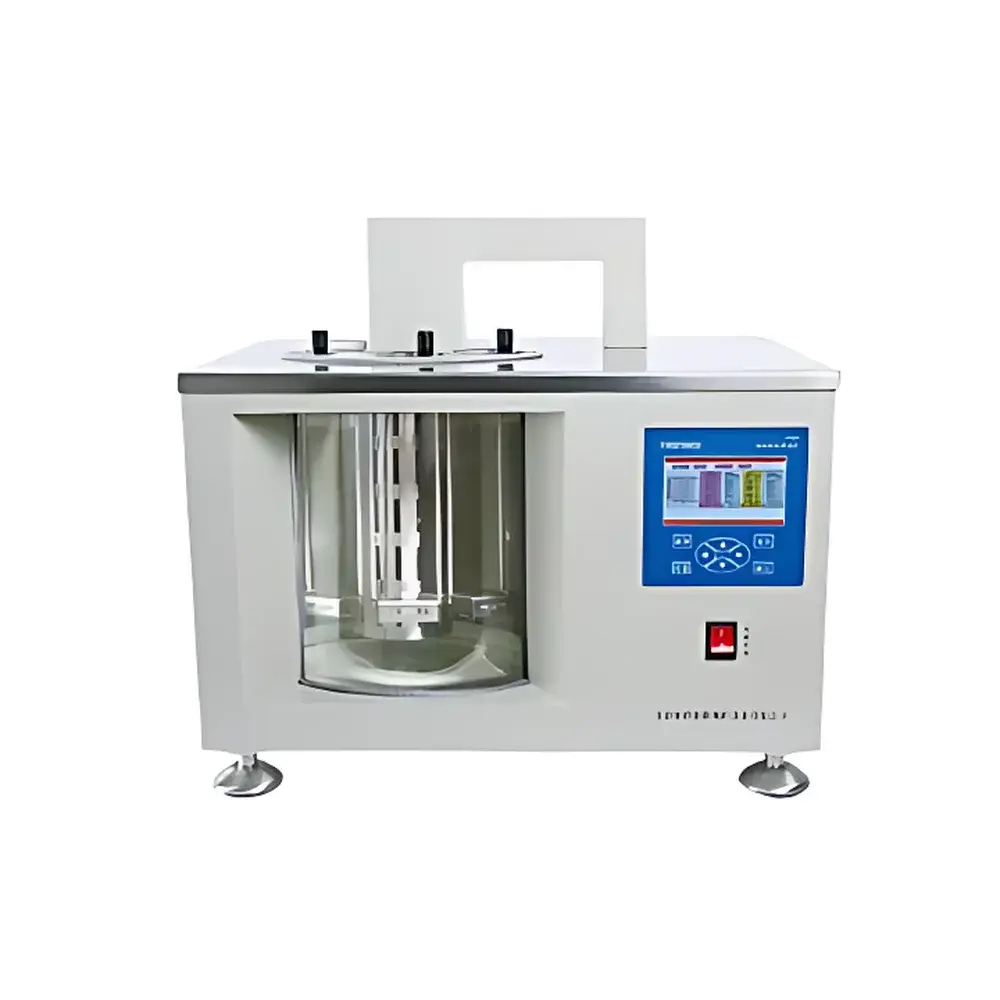
Timepower TP625 Kinematic Viscosity Tester
| Brand | Timepower |
|---|---|
| Model | TP625 |
| Origin | Beijing, China |
| Manufacturer | Timepower (Producer) |
| Country of Origin | China |
| Pricing | Upon Request |
| Temperature Control Range | 0–120 °C (0 °C to ambient requires optional chiller) |
| Temperature Stability | ±0.05 °C |
| Temperature Resolution | 0.01 °C |
| Bath Capacity | 4 capillary positions |
| Power Supply | AC 220 V ±10%, 50 Hz ±10% |
| Heating Power | ≤1500 W |
| Dimensions | 510 × 360 × 470 mm |
| Weight | 20 kg |
| Operating Environment | 5–40 °C, ≤85% RH |
| Display | Imported true-color LCD with real-time clock (year/month/day/hour/minute, battery-backed) |
| Control System | Microprocessor-based PID temperature regulation |
| Sensors | High-sensitivity imported platinum RTD temperature sensors |
| Illumination | Integrated LED backlight for capillary observation |
| Optional Accessories | Ubbelohde (standard), Reverse-flow (optional), Refrigeration unit (for sub-ambient testing) |
Overview
The Timepower TP625 Kinematic Viscosity Tester is a microprocessor-controlled, fully automated instrument engineered for precise determination of kinematic viscosity in petroleum and related hydrocarbon liquids according to ASTM D445, ISO 3104, and GB/T 265–1988 standards. It operates on the fundamental principle of gravity-driven capillary flow: a fixed volume of sample is drawn into a calibrated glass capillary tube (e.g., Ubbelohde or reverse-flow type), immersed in a thermostatically stabilized bath, and timed as it flows between two etched marks under gravitational force. Kinematic viscosity (ν, in mm²/s or cSt) is calculated as the product of the capillary constant (K) and the measured efflux time (t), i.e., ν = K × t. Designed for routine QC/QA laboratories in power generation, petrochemical refining, commodity inspection, and R&D facilities, the TP625 delivers high reproducibility across the full operational range of 0–120 °C — with optional refrigeration enabling low-temperature testing down to 0 °C.
Key Features
- Four-position thermostatic bath accommodating simultaneous or sequential testing of multiple capillaries — optimized for throughput without cross-contamination.
- PID-based digital temperature control with ±0.05 °C stability and 0.01 °C resolution, using certified platinum resistance thermometers (RTDs) for traceable thermal accuracy.
- True-color LCD interface with integrated real-time clock (battery-backed for uninterrupted timekeeping during power loss), supporting intuitive menu navigation and parameter configuration.
- Dedicated optical illumination system enhancing visual clarity during manual timing verification or capillary alignment checks.
- Comprehensive safety architecture: over-temperature cutoff, dry-run protection, and fused mains input — compliant with IEC 61010-1 for laboratory electrical safety.
- Modular design supports field-upgradable accessories, including reverse-flow capillaries for high-viscosity or volatile samples and external chiller integration for sub-ambient measurements.
Sample Compatibility & Compliance
The TP625 is validated for use with transparent and opaque Newtonian and near-Newtonian petroleum products, including lubricating oils, transformer oils, diesel fuels, jet fuels, and base stocks. It accommodates standard Ubbelohde-type capillaries (ASTM D445 Annex A1) and reverse-flow variants (ASTM D445 Annex A2) to address viscosity ranges from 1 to >10⁶ mm²/s. All temperature calibration procedures align with ISO/IEC 17025 requirements for measurement traceability. The instrument’s thermal performance meets the repeatability and reproducibility criteria specified in ASTM D445 (≤0.35% RSD for repeatability; ≤1.0% RSD for reproducibility) when operated under controlled environmental conditions (5–40 °C, ≤85% RH). Documentation packages support GLP/GMP audit readiness, including calibration logs, maintenance records, and user-defined SOP templates.
Software & Data Management
While the TP625 operates as a standalone benchtop unit with embedded firmware, its data output protocol supports RS-232 serial communication for integration into LIMS or centralized lab informatics platforms. Measurement results — including efflux time, bath temperature, calculated kinematic viscosity, test date/time stamp, and operator ID — are stored locally with non-volatile memory retention (>10,000 test records). Export formats include CSV and plain-text log files compatible with Excel, MATLAB, or statistical process control (SPC) software. Audit trail functionality captures all parameter changes, calibration events, and user logins — satisfying FDA 21 CFR Part 11 requirements when deployed with appropriate access controls and electronic signature protocols.
Applications
- Quality assurance of insulating oils in electric utility substations per IEEE Std C57.106 and IEC 60296.
- Viscosity grading of engine oils and gear oils against SAE J300 and API service categories.
- Batch release testing of aviation turbine fuels (Jet A/A-1) per ASTM D1655 and DEF STAN 91-91.
- Research-level characterization of bio-based lubricants and synthetic esters under variable thermal profiles.
- Regulatory compliance testing for customs clearance and export certification of crude fractions and distillates.
FAQ
What capillary types are supported by the TP625?
The instrument ships standard with Ubbelohde-type capillaries compliant with ASTM D445 Annex A1; reverse-flow capillaries (Annex A2) are available as optional accessories for high-viscosity or low-volatility samples.
Is external refrigeration required to operate below ambient temperature?
Yes — the built-in heater only supports temperatures from ambient up to 120 °C. For tests at 0–25 °C, an externally connected chiller unit is mandatory and must be specified at time of order.
How is temperature calibration verified?
Users must periodically validate bath temperature using a NIST-traceable mercury-in-glass or digital reference thermometer prior to each test series, per GB/T 265–1988 Section 5.2 and ASTM D445 Section 7.3.
Can the TP625 be integrated into a networked laboratory environment?
Yes — via RS-232 interface and ASCII command set, enabling bidirectional communication with LIMS, SCADA systems, or custom QA dashboards using standard serial-to-Ethernet gateways.
What maintenance intervals are recommended for long-term reliability?
Capillary cleaning after every 10 tests; bath fluid replacement every 6 months; annual verification of RTD calibration and PID controller response using certified reference standards.





