
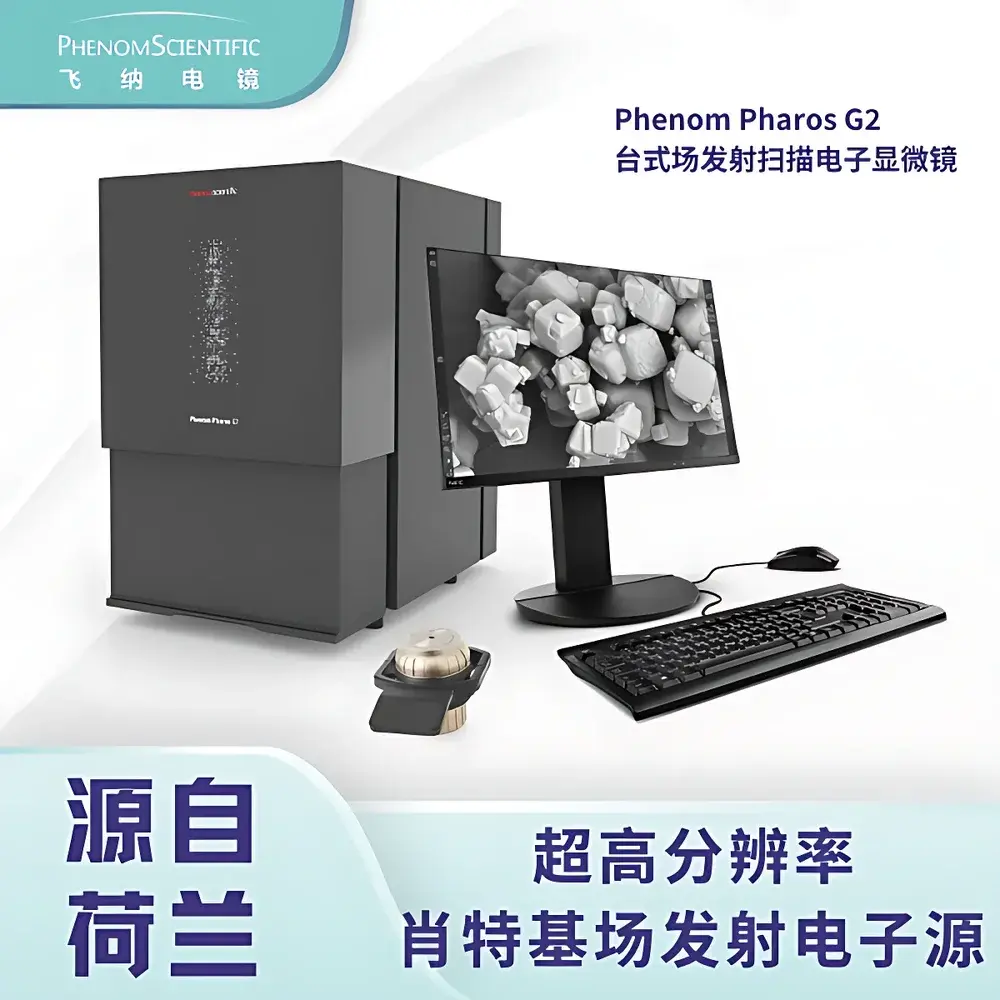
Phenom Pharos G2 Desktop Field-Emission Scanning Electron Microscope
| Brand | Phenom |
|---|---|
| Origin | Netherlands |
| Manufacturer | Phenom-World B.V. |
| Type | Desktop SEM |
| Electron Source | Schottky Field-Emission |
| Resolution (SE & BSE) | 1.5 nm @ 1 kV |
| Maximum Magnification | 2,000,000× |
| Accelerating Voltage Range | 1–20 kV |
| Integrated EDS Capability | Yes |
| Vacuum Pumping Time | <15 s |
| Vibration Isolation | 27 independent passive damping units |
| Sample Stage | Motorized, fully automated |
| Optical Navigation | Integrated color optical microscope with panoramic overview |
Overview
The Phenom Pharos G2 is a high-performance desktop field-emission scanning electron microscope (FE-SEM) engineered for nanoscale imaging and elemental analysis in routine laboratory environments. Unlike conventional floor-standing SEMs, the Pharos G2 integrates a thermally assisted Schottky field-emission electron source into a compact, vibration-isolated benchtop platform—enabling sub-2 nm resolution at low accelerating voltages (down to 1 kV) without cryogenic cooling or ultra-high vacuum infrastructure. Its operational principle relies on coherent electron beam generation via thermal-field emission, delivering high brightness (>1 × 10⁹ A/cm²·sr) and exceptional beam stability over extended acquisition periods. This architecture supports both secondary electron (SE) and backscattered electron (BSE) detection simultaneously, facilitating topographic, compositional, and phase contrast imaging in a single instrument. Designed for laboratories requiring rapid turnaround, minimal infrastructure dependency, and compliance with GLP/GMP workflows, the Pharos G2 operates under standard ambient conditions and requires no dedicated shielding room or liquid nitrogen.
Key Features
- Sub-2 nm resolution at 1 kV—optimized for surface-sensitive imaging of beam-sensitive, insulating, or uncoated specimens
- Schottky field-emission source with >3,000-hour typical lifetime and zero filament replacement during normal operation
- Integrated color optical microscope with panoramic navigation (5×–100×) for precise region-of-interest selection prior to SEM imaging
- Fully motorized, five-axis sample stage with programmable positioning accuracy of ±0.5 µm
- Automated vacuum system achieving <1 × 10⁻⁴ mbar in under 15 seconds via turbomolecular pumping and integrated vacuum lock
- Passive vibration isolation using 27 independently tuned damping units—eliminates need for external anti-vibration tables
- Beam current stability better than ±1.5% over 8 hours, enabling reproducible EDS quantification and time-lapse imaging
- Electron-optical column designed for zero-user maintenance: no alignment routines, aperture cleaning, or lens tuning required
Sample Compatibility & Compliance
The Pharos G2 accommodates samples up to 100 mm in diameter and 50 mm in height—including powders, polymers, biological tissues, ceramics, composites, and semiconductor wafers—without mandatory conductive coating. Its low-kV imaging capability (1–5 kV) minimizes charging artifacts and subsurface electron penetration, preserving native morphology of insulators and beam-labile materials. The system complies with IEC 61000-6-3 (EMC emissions), IEC 61000-6-2 (immunity), and meets CE marking requirements for laboratory equipment. For regulated environments, optional audit trail logging and user access control modules support adherence to FDA 21 CFR Part 11 and ISO/IEC 17025 documentation standards. Routine operation satisfies ASTM E1558 (SEM imaging practice) and ISO 16700 (EDS microanalysis) guidelines.
Software & Data Management
Operation is managed through Phenom Desktop Software v5.x—a Windows-based interface supporting full remote operation, script-driven batch acquisition, and real-time image stitching. All imaging and EDS data are stored in vendor-neutral formats (TIFF, CSV, NIST-compatible .msa) with embedded metadata including acquisition parameters, calibration history, and instrument configuration snapshots. The software includes built-in EDS quantification tools compliant with ZAF matrix correction algorithms and supports spectral library matching against the NIST Standard Reference Database (SRD 109). Audit logs record operator ID, timestamp, parameter changes, and export events—enabling traceability for quality assurance and regulatory review. Optional integration with LIMS platforms is available via OPC UA and RESTful API interfaces.
Applications
The Pharos G2 serves as a primary characterization tool across materials science, failure analysis, life sciences, geology, and quality control labs. Typical use cases include: high-magnification inspection of nanoparticle dispersion in battery cathodes; cross-sectional analysis of thin-film coatings on flexible substrates; morphological assessment of freeze-dried biologics without carbon coating; pore structure quantification in catalyst supports; and rapid EDS mapping of inclusion phases in metallurgical samples. Its low-voltage performance makes it especially suited for in situ monitoring of electrochemical processes, polymer degradation studies, and forensic fiber analysis where surface integrity must be preserved.
FAQ
Does the Pharos G2 require external water cooling or compressed air?
No—the system uses passive heat dissipation and solid-state vacuum components; no auxiliary utilities are needed.
Can non-conductive samples be imaged without sputter coating?
Yes—low-kV SE/BSE imaging at 1–3 kV eliminates charging on ceramics, plastics, and biological specimens without metal coating.
Is EDS hardware included as standard?
Yes—integrated silicon drift detector (SDD) with ≥10 eV Mn-Kα resolution and real-time spectrum acquisition is factory-installed.
What is the mean time between failures (MTBF) for the electron source?
Based on accelerated life testing, the Schottky emitter demonstrates MTBF >12,000 hours under continuous operation at 5 kV.
How does the system handle vibration from nearby equipment?
The 27-element passive isolation system attenuates frequencies from 0.5 Hz to 100 Hz by >40 dB, meeting ISO 25316 Class 2 vibration sensitivity requirements.




