
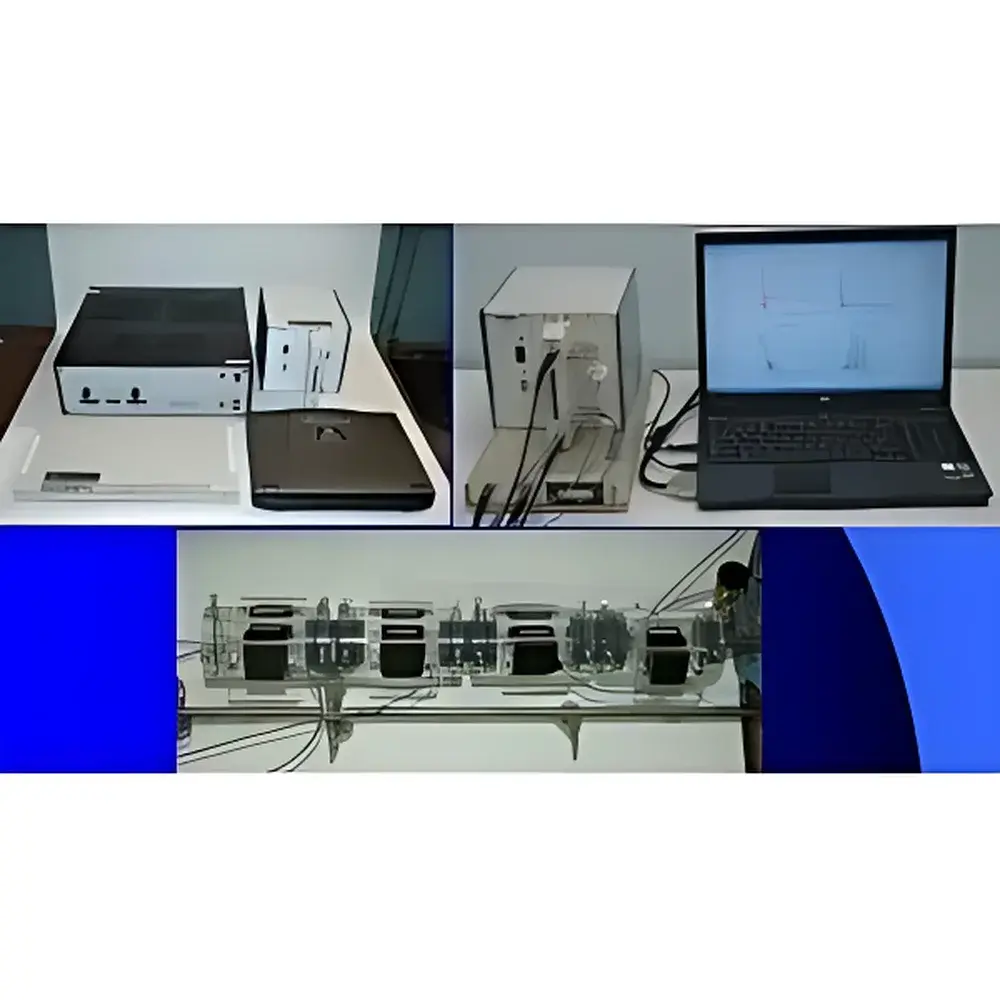
Acoustic Bubble Spectrometer (ABS) – DYNAFLOW, INC. Model Worldwide
| Origin | USA |
|---|---|
| Manufacturer Type | Authorized Distributor |
| Import Status | Imported |
| Model | Worldwide |
| Pricing | Available Upon Request |
Overview
The Acoustic Bubble Spectrometer (ABS) is a precision-engineered, non-invasive acoustic measurement system developed by DYNAFLOW, INC. (Annapolis, MD, USA) for quantitative characterization of bubble size distribution and void fraction in opaque, multiphase liquid flows. Unlike optical techniques—such as high-speed imaging or laser diffraction—the ABS leverages broadband ultrasonic scattering principles to discriminate gas-filled bubbles from solid particles based on their distinct acoustic contrast impedance. Bubbles exhibit orders-of-magnitude higher compressibility than suspended solids or the host liquid, resulting in significantly stronger backscattered signals at ultrasonic frequencies (typically 1–10 MHz). This physical distinction enables reliable detection and sizing of bubbles down to sub-millimeter diameters—even in highly turbid, aerated, or optically dense fluids where optical methods fail entirely.
Key Features
- Non-optical, ultrasound-based detection—operates independently of fluid transparency, container material, or ambient lighting conditions
- Real-time, continuous measurement of bubble size distribution (BSD) and local void fraction with high temporal resolution
- Integrated high-speed data acquisition system: up to 10 MS/s per channel (upgraded configuration), supporting dynamic cavitation events and transient bubbly flow regimes
- Dual-mode transducer support: standard ½″ hydrophone configuration with calibrated broadband response; optional multi-transducer arrays for spatial profiling
- Windows-native software platform with intuitive graphical user interface (GUI), designed specifically for fluid dynamics and multiphase flow researchers
- Factory-calibrated signal chain—including pulse generator, low-noise preamplifier, and digitizer—ensuring traceable acoustic pressure sensitivity and repeatability
Sample Compatibility & Compliance
The ABS is validated for use across a broad range of industrial and research environments involving opaque or aggressive media—including seawater, crude oil emulsions, wastewater slurries, blood analogs, and cryogenic or high-pressure hydraulic fluids. It requires no sample preparation, flow conditioning, or intrusive probes. The system complies with IEC 61000-6-3 (EMC emissions) and IEC 61000-6-2 (immunity) standards. While not a medical device, its measurement methodology aligns with ASTM E2978-14 (Standard Guide for Acoustic Characterization of Cavitation Bubbles) and supports GLP-compliant experimental documentation when used with audit-trail-enabled software configurations. All hardware components meet RoHS 3 and REACH regulatory requirements.
Software & Data Management
The ABS is operated via proprietary Windows-based software featuring real-time spectral analysis, time-resolved BSD reconstruction, and void fraction mapping. Raw RF data is stored in HDF5 format for long-term archival and third-party post-processing (e.g., MATLAB, Python SciPy). Software modules include automated calibration routines, multi-frequency deconvolution algorithms to resolve overlapping bubble populations, and export tools compatible with ISO/IEC 17025-compliant reporting templates. Optional FDA 21 CFR Part 11 compliance packages are available upon request, providing electronic signature capability, user access control, and immutable audit trails for regulated environments such as pharmaceutical process development or biomedical device validation.
Applications
- Marine & Propulsion Engineering: Quantification of cavitation nuclei populations upstream of propellers, pumps, and hydrofoils; correlation of bubble spectra with erosion rates and noise signatures
- Power Generation: Monitoring air entrainment and degassing efficiency in turbine cooling circuits and condenser feedwater systems
- Biomedical Fluid Mechanics: Detection of microbubble emboli in extracorporeal circulation loops; assessment of gas nucleation during decompression protocols
- Environmental Engineering: In-situ quantification of air bubble size distributions in wastewater aeration basins and riverine oxygen transfer studies
- Space Systems Research: Characterization of bubble dynamics under microgravity conditions—critical for life-support system design and two-phase thermal management
- Fundamental Multiphase Flow Science: Validation of CFD models (e.g., population balance equations coupled with Navier–Stokes solvers) using experimentally resolved BSD boundary conditions
FAQ
What physical principle does the ABS use to distinguish bubbles from solid particles?
It exploits the large difference in adiabatic compressibility between gas-filled bubbles and solid particles—resulting in orders-of-magnitude higher acoustic backscatter cross-sections for bubbles at ultrasonic frequencies.
Can the ABS measure in opaque or highly viscous fluids?
Yes—its ultrasound-based operation is unaffected by optical opacity, color, turbidity, or moderate viscosity changes typical of industrial process streams.
Is calibration required before each measurement?
No—factory calibration is traceable to NIST-accredited acoustic pressure standards; field verification is performed using reference scatterers or known bubble-generating fixtures.
Does the system support integration with existing lab DAQ infrastructure?
Yes—digital trigger I/O, TCP/IP API, and LabVIEW-compatible drivers are included for synchronization with high-speed cameras, PIV systems, or PLC-controlled test rigs.
What is the minimum detectable bubble diameter?
Detection threshold depends on transducer frequency and signal-to-noise ratio; typical operational lower limit is ~20–50 µm in water at 5 MHz, with resolution improving at lower frequencies for larger bubbles.



