
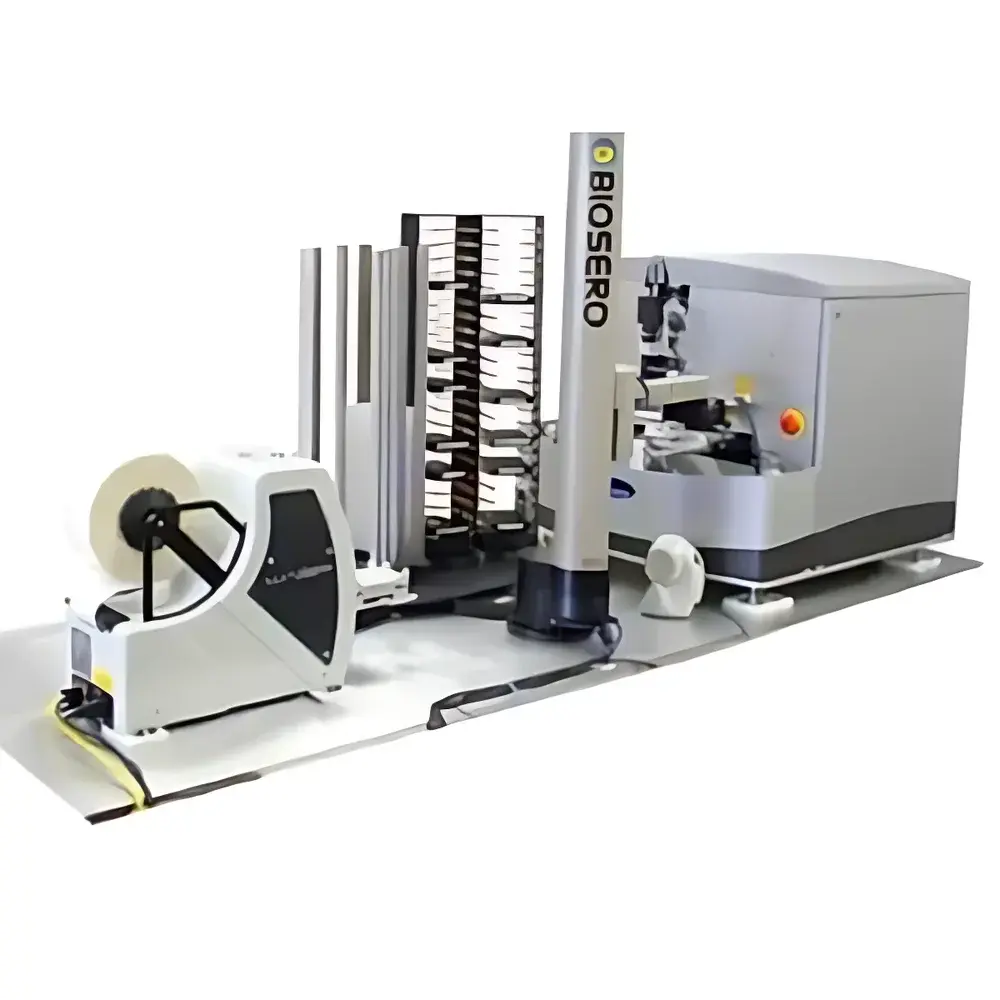
QNET ATS Gen4+ Acoustic Single-Cell Sorting and Sample Preprocessing System
| Brand | QNET |
|---|---|
| Model | ATS Gen4+ |
| Type | Fully Automated |
| Sorting Speed | 10 cells/sec |
| Total Sortable Cells | 10,000 |
| Sample Throughput | 0–10 samples |
| Processing Time | 30 minutes |
| Detection | High-Resolution CMOS Imaging with Real-Time Droplet Monitoring |
| Collection Formats | Microscope Slides, 96-well, 384-well, 1536-well, or Custom Microwell Plates |
| Actuation Principle | Contactless Acoustic Droplet Ejection (ADE) |
| Dead Volume | <1 µL per transfer |
| Integration Ready | Yes (Lab Automation Bus, RS-232, Ethernet) |
Overview
The QNET ATS Gen4+ Acoustic Single-Cell Sorting and Sample Preprocessing System is a fully automated, sheath-free platform engineered for high-fidelity isolation and precise nanoliter-scale deposition of individual cells into defined microenvironments. Unlike conventional fluorescence-activated cell sorters (FACS) that rely on hydrodynamic focusing, high-pressure fluidics, and electrostatic charging—processes inherently associated with shear stress, aerosol generation, and viability compromise—the ATS Gen4+ employs contactless acoustic droplet ejection (ADE). This physics-based method uses focused ultrasonic energy to transiently displace liquid from a source well without physical contact, enabling gentle, label-free, and contamination-free transfer of single cells suspended in low-volume aqueous media. The system integrates real-time CMOS-based morphological and fluorescent phenotyping at the droplet level, ensuring deterministic sorting decisions grounded in empirical image data—not probabilistic signal thresholds. Designed for reproducible single-cell genomics, spatial transcriptomics, and clonal expansion workflows, the ATS Gen4+ delivers traceable, audit-ready cell placement with sub-50 ms closed-loop feedback control.
Key Features
- Contactless acoustic transfer eliminates nozzle clogging, cross-contamination, and shear-induced cell damage—no sheath fluid, no pins, no thermal stress.
- High-resolution CMOS imaging engine captures full-frame, time-stamped images of every ejected droplet, recording cell diameter, circularity, fluorescence intensity, and positional coordinates for post-hoc validation.
- Real-time acoustic path sensing: Before each ejection pulse, the system emits a diagnostic ultrasound pulse (#1), analyzes the echo return (#2), dynamically adjusts transducer focus and energy amplitude, then executes the transfer pulse (#3)—all within <50 ms.
- Adaptive droplet recycling: Droplets failing single-cell criteria (empty or multi-cell) are redirected to a recovery reservoir and reprocessed until target well occupancy is confirmed.
- Modular collection compatibility: Supports standard formats including glass slides, 96-well, 384-well, and 1536-well plates—plus custom microwell arrays—without performance degradation or increased dead volume.
- Plug-and-play integration: Native support for common lab automation protocols (RS-232, TCP/IP, LabVIEW drivers) enables seamless coupling with liquid handlers, incubators, and downstream sequencers.
Sample Compatibility & Compliance
The ATS Gen4+ accommodates mammalian, bacterial, yeast, and plant cells across a broad size range (5–40 µm diameter) in native or low-viscosity buffers (e.g., PBS, HBSS, 0.1–1% BSA). It requires no antibody labeling or viability dyes for basic morphological sorting; optional fluorescent co-detection is supported via integrated LED excitation and emission filters (405/488/561/640 nm). All hardware and firmware comply with IEC 61000-6-3 (EMC) and IEC 61010-1 (safety). Software adheres to ALCOA+ principles for data integrity and supports 21 CFR Part 11-compliant user access control, electronic signatures, and immutable audit trails when deployed in GLP/GMP environments.
Software & Data Management
The instrument is controlled via OptiScan’s proprietary ATS Control Suite—a Windows-based application featuring intuitive workflow templating, live image overlay, and batch parameter scripting. Each sorting event generates a structured metadata file (.json) containing timestamp, well address, droplet image (PNG), measured parameters (area, intensity, centroid), and system calibration logs. Raw image archives are stored in vendor-neutral formats compatible with third-party analysis tools (e.g., ImageJ, CellProfiler, Python scikit-image). Data export supports CSV, HDF5, and MIAME-compliant annotation schemas for direct submission to GEO or SRA repositories.
Applications
- Single-cell RNA-seq library preparation with minimal input bias and reduced amplification artifacts.
- Clonal isolation of CRISPR-edited or drug-resistant cell lines for functional validation.
- Spatially resolved cell printing onto functionalized substrates for organoid initiation.
- Low-volume reagent dispensing in assay development (e.g., dose-response matrices in 1536-well format).
- Integration into end-to-end automated workflows for high-content screening and bioprocess monitoring.
FAQ
How does the ATS Gen4+ ensure true single-cell deposition without optical or flow cytometry gating?
It combines real-time CMOS imaging of the ejection meniscus with deterministic droplet classification—only droplets containing exactly one object meeting user-defined size and fluorescence thresholds trigger actuation.
Is the system compatible with viscous or serum-containing media?
Yes—validated for use with up to 10% FBS and methylcellulose-based suspensions; acoustic coupling efficiency is maintained via adaptive energy compensation algorithms.
What maintenance is required beyond routine cleaning?
No consumable nozzles, lasers, or fluidic tubing; only periodic transducer surface inspection and calibration using certified reference wells—typically performed quarterly.
Can sorting parameters be exported for regulatory submissions?
Yes—full audit trail, raw image archive, and metadata export meet FDA and EMA expectations for analytical method validation and traceability.
Does the system support multi-color fluorescence detection during sorting?
Yes—four-channel LED excitation with configurable exposure times and gain settings enables simultaneous detection of GFP, RFP, mCherry, and DAPI-like stains.





