
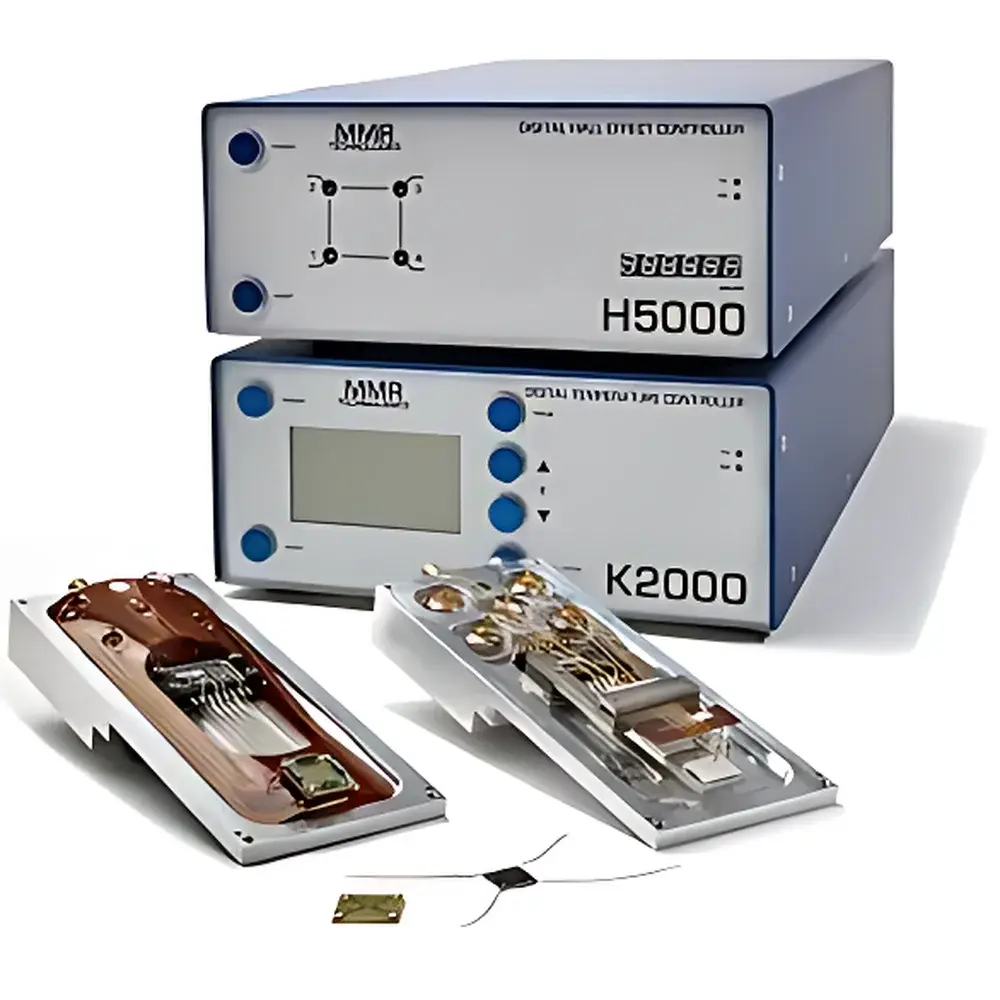
MMR Model 1000 Seebeck Effect Measurement System
| Origin | USA |
|---|---|
| Manufacturer Type | Authorized Distributor |
| Origin Category | Imported |
| Model | 1000 |
| Price Range | USD 14,000 – 28,000 |
| Sample Length | 2–10 mm |
| Voltage Resolution | 50 nV |
| Gain Mismatch Between Sample and Reference | <0.1% |
| Repeatability Cycles | Up to 128 (with automated averaging) |
| Temperature Range Options | 70–730 K, 80–580 K, 70–580 K, 80–730 K, or RT–730 K |
| Measurement Method | Differential Comparative Technique |
| Optional Integration | Hall Effect Module |
Overview
The MMR Model 1000 Seebeck Effect Measurement System is a precision-engineered platform designed for quantitative thermoelectric characterization of bulk and thin-film materials under controlled thermal gradients. Operating on the principle of differential comparative measurement—where a reference sample with known thermopower is measured simultaneously with the test specimen—the system eliminates common-mode drift and minimizes systematic errors associated with absolute voltage calibration. This architecture ensures high reproducibility (<0.1% gain mismatch between sample and reference) and enables reliable extraction of the Seebeck coefficient (S = −ΔV/ΔT) across wide temperature ranges—from cryogenic conditions (as low as 70 K) up to 730 K. The instrument is widely deployed in academic and industrial R&D laboratories focused on next-generation thermoelectrics, including skutterudites, half-Heuslers, chalcogenides, and oxide-based systems. Its compact chamber design allows integration into superconducting magnet systems (up to 9 T), facilitating concurrent thermoelectric and magnetic transport studies essential for understanding spin-entropy coupling and magneto-thermoelectric phenomena.
Key Features
- Differential dual-sample configuration with active gain-matching circuitry ensuring <0.1% mismatch tolerance between test and reference legs
- High-resolution nanovolt sensing (50 nV resolution) synchronized with calibrated thermocouple arrays for accurate ΔT determination
- Modular temperature control supporting five configurable ranges: 70–730 K, 80–580 K, 70–580 K, 80–730 K, and RT–730 K—each optimized for specific cryostat or furnace compatibility
- Automated measurement sequencing with up to 128 repeated acquisitions per temperature step, including real-time averaging and statistical uncertainty reporting
- Compact vacuum-compatible chamber (≤120 mm outer diameter) enabling insertion into bore tubes of superconducting magnets without field distortion
- Optional Hall effect add-on module providing simultaneous carrier concentration (nH) and mobility (μH) extraction using van der Pauw geometry
Sample Compatibility & Compliance
The system accommodates rectangular or bar-shaped specimens with lengths from 2 mm to 10 mm and cross-sections down to 0.2 × 0.2 mm². Standard contact pads are fabricated using Au/Ni/Cr metallization compatible with both sintered ceramics and single-crystal wafers. All thermal interfaces utilize high-conductivity silver paste or indium foil, validated per ASTM E2936–14 (Standard Practice for Thermoelectric Property Measurements). Data acquisition complies with GLP documentation requirements, including timestamped raw voltage/temperature logs, operator ID tagging, and audit-trail-enabled parameter versioning. Firmware supports export in HDF5 and CSV formats for traceable post-processing in MATLAB, Python (SciPy), or OriginLab environments.
Software & Data Management
Control and analysis are executed via MMR’s proprietary Thermoelectric Analysis Suite (TEAS v4.2), a Windows-based application featuring ISO/IEC 17025-aligned calibration management, configurable test protocols, and built-in error propagation modeling. The software implements NIST-traceable thermocouple polynomial fitting (ITS-90) and applies Joule heating corrections based on measured current density. All datasets include embedded metadata (sample ID, ambient pressure, cooling gas flow rate, thermal soak duration) required for journal submission (e.g., Advanced Energy Materials, Acta Materialia). TEAS supports 21 CFR Part 11-compliant electronic signatures when operated in locked-down network mode with domain-authenticated user roles.
Applications
- High-throughput screening of thermoelectric figure-of-merit (zT) candidates across composition libraries
- Temperature-dependent band structure mapping via Seebeck sign inversion analysis and Pisarenko relationship fitting
- Interface engineering studies in segmented or nanostructured composites (e.g., grain boundary scattering effects)
- Validation of ab initio transport simulations (Boltzmann transport + DFT) against experimental S(T) curves
- Quality assurance testing of thermoelectric modules for automotive waste-heat recovery systems (SAE J2908 compliance support)
- Correlative Hall–Seebeck investigations to decouple bipolar conduction contributions in narrow-gap semiconductors
FAQ
What temperature calibration standards does the system use?
The system employs NIST-traceable Type E thermocouples with ITS-90 polynomial coefficients embedded in firmware; optional Pt100 sensors available for primary reference calibration.
Can the system measure thin films deposited on substrates?
Yes—using lift-off shadow masks and micro-probe contact fixtures; minimum measurable film thickness is ~50 nm with substrate thermal shunt correction enabled.
Is vacuum or inert atmosphere operation supported?
Standard configuration includes a stainless-steel vacuum chamber rated to 10⁻⁵ mbar; optional glovebox-integrated feedthroughs support Ar/N₂ purging during high-temperature runs.
How is electrical isolation maintained during magnetic field measurements?
All signal lines use twisted-pair shielded cables with Faraday-cage grounding; differential amplifiers reject common-mode noise up to 120 dB at 1 kHz, verified per IEC 61000-4-8.
Does the Hall add-on module require separate power supplies or software?
No—it shares the same controller and TEAS software interface; Hall measurements are triggered synchronously with Seebeck sweeps to ensure identical thermal history and contact resistance conditions.



