
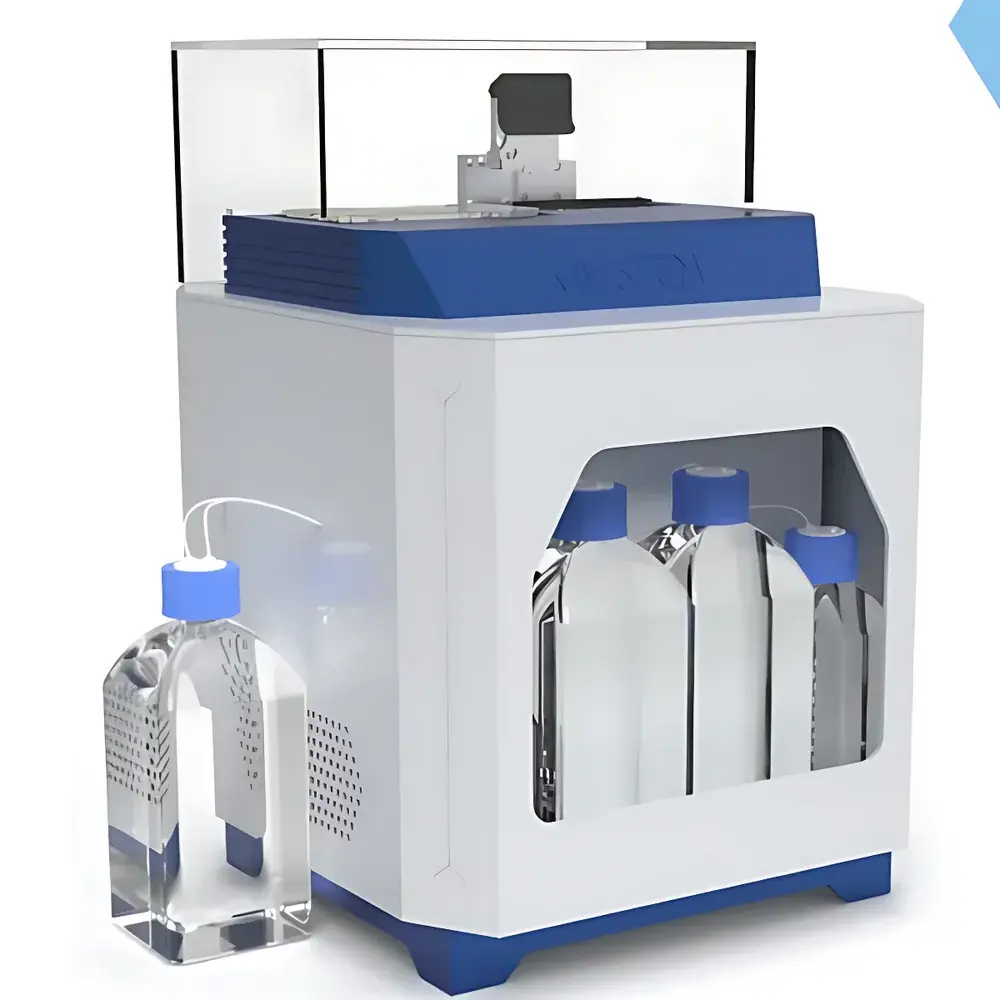
Graphene Liquid Cell (GLC) Naiad-1 by VitroTEM
| Brand | VitroTEM |
|---|---|
| Origin | Netherlands |
| Model | Naiad-1 |
| Type | Automated Graphene Encapsulation System for In Situ Liquid-Phase TEM Sample Preparation |
| Compliance | Designed for High-Vacuum TEM Compatibility and Cryo-EM Workflow Integration |
| Liquid Chamber Thickness | Adjustable down to ~10–50 nm (user-defined via piezoelectric control) |
| Graphene Membrane | CVD-grown, monolayer-to-bilayer transferable, pre-characterized for electron transparency (>95% at 200 kV) and mechanical stability |
| Maximum Operating Temperature | Ambient to 40 °C (non-heated configuration) |
| Vacuum Compatibility | Fully bakeable to 1×10⁻⁶ mbar |
| Software Interface | Windows-based control suite with real-time pressure monitoring, graphene tension feedback, and liquid volume calibration algorithms |
Overview
The VitroTEM Naiad-1 Graphene Liquid Cell (GLC) system is an automated, precision-engineered platform for preparing encapsulated aqueous specimens for in situ transmission electron microscopy (TEM). Unlike conventional cryo-EM or freeze-drying workflows, the Naiad-1 enables true liquid-phase imaging by sealing biological or nanomaterial suspensions between two atomically thin, electron-transparent graphene membranes—forming a hermetically sealed, sub-50 nm liquid chamber. This architecture leverages the intrinsic properties of chemical vapor deposition (CVD)-grown graphene: exceptional electron transmission (>95% at 200 kV), high thermal conductivity, negligible background scattering, and efficient charge dissipation—critical for mitigating beam-induced motion, radiolysis, and electrostatic charging during high-resolution imaging. The system operates under standard high-vacuum TEM conditions without compromising specimen integrity, enabling direct observation of hydrated biomolecules, live bacterial cells, catalytic nanoparticles in solution, and dynamic self-assembly processes at near-atomic resolution.
Key Features
- Automated graphene lamination: Integrated microfluidic alignment and piezoelectric compression ensure reproducible, contamination-free encapsulation of 1–10 µL liquid volumes between pre-mounted graphene membranes.
- Real-time chamber thickness control: Closed-loop feedback adjusts inter-membrane spacing from 10 nm to >100 nm with ±2 nm repeatability—enabling optimization for low-dose imaging or high-spatial-resolution tomography.
- Pre-characterized graphene substrates: Each batch undergoes Raman spectroscopy, electron energy-loss spectroscopy (EELS), and TEM contrast validation; supplied on standard 3.05 mm TEM grids with SiN or Au support frames.
- Vacuum-compatible design: All wetted components are UHV-bakeable (≤1×10⁻⁶ mbar); no adhesives or polymer seals used in the liquid chamber assembly.
- Modular integration: Compatible with JEOL, Thermo Fisher, and Hitachi TEM platforms; supports both bright-field, HAADF-STEM, and low-dose time-resolved acquisition modes.
Sample Compatibility & Compliance
The Naiad-1 accommodates a broad range of aqueous samples—including purified proteins, lipid vesicles, viral particles, whole prokaryotic cells (e.g., E. coli, B. subtilis), colloidal metal oxides, and quantum dots—without fixation, staining, or dehydration. Its encapsulation method preserves native hydration shells and permits observation of structural dynamics over minutes to hours under controlled beam dose. The system conforms to ISO/IEC 17025 requirements for sample preparation traceability and supports GLP-compliant documentation through audit-ready software logs. While not a medical device, its use aligns with ASTM E2936-22 guidelines for in situ liquid-phase TEM methodology validation and is routinely cited in publications adhering to Nature Methods reporting standards for correlative structural biology.
Software & Data Management
The Naiad Control Suite (v3.2+) provides intuitive, scriptable operation via USB 3.0 interface. Key functions include automated pressure ramping, graphene tension calibration using interferometric fringe analysis, liquid volume estimation based on meniscus geometry, and real-time vacuum leak detection. All parameters—including chamber thickness setpoint, pump cycle count, and environmental temperature—are timestamped and exportable as CSV or HDF5 for FAIR data principles compliance. Audit trails meet FDA 21 CFR Part 11 requirements for electronic records and signatures when deployed in regulated environments (e.g., biopharma formulation labs). Optional Python API enables integration with Micro-Manager, DigitalMicrograph, or custom acquisition pipelines.
Applications
- In situ observation of protein folding intermediates and amyloid fibril nucleation in buffered solution.
- Real-time tracking of nanoparticle coalescence, Ostwald ripening, and surface ligand exchange kinetics.
- High-resolution imaging of membrane remodeling in intact liposomes and Gram-negative outer membrane vesicles.
- Atomic-scale analysis of electrocatalyst interfaces (e.g., Pt, NiFe LDH) under operando electrochemical bias using integrated microelectrode variants.
- Correlative light-electron microscopy (CLEM): Fluorescently labeled specimens prepared in Naiad-1 retain viability and optical contrast prior to TEM transfer.
FAQ
What types of liquids are compatible with the Naiad-1 GLC system?
Aqueous buffers (e.g., PBS, HEPES), cell culture media (with reduced phenol red), low-viscosity ionic liquids (<50 cP), and dilute polymer solutions (e.g., PEG 1k–10k) are routinely used. Highly volatile solvents (e.g., ethanol, acetone) or strong acids/bases (pH 11) are not recommended due to graphene delamination risk.
Can the system be used for cryo-TEM sample preparation?
Yes—the Naiad-1-prepared GLCs are fully compatible with plunge-freezing protocols. Graphene’s high thermal conductivity enables rapid vitrification, minimizing ice crystal artifacts while retaining the liquid-cell architecture for subsequent cryo-TEM or cryo-ET.
Is user training required before operation?
VitroTEM provides a two-day on-site installation and operational certification program covering safety protocols, graphene handling, vacuum interlock verification, and troubleshooting common encapsulation failures (e.g., bubble entrapment, membrane rupture). Remote support is available via secure TeamViewer session.
How is graphene quality verified prior to use?
Each graphene chip includes a certificate of analysis (CoA) listing Raman I2D/IG ratio (>2.5), defect density (D/G < 0.05), and electron transparency measured via 200 kV zero-loss peak intensity relative to bare SiN reference.




