
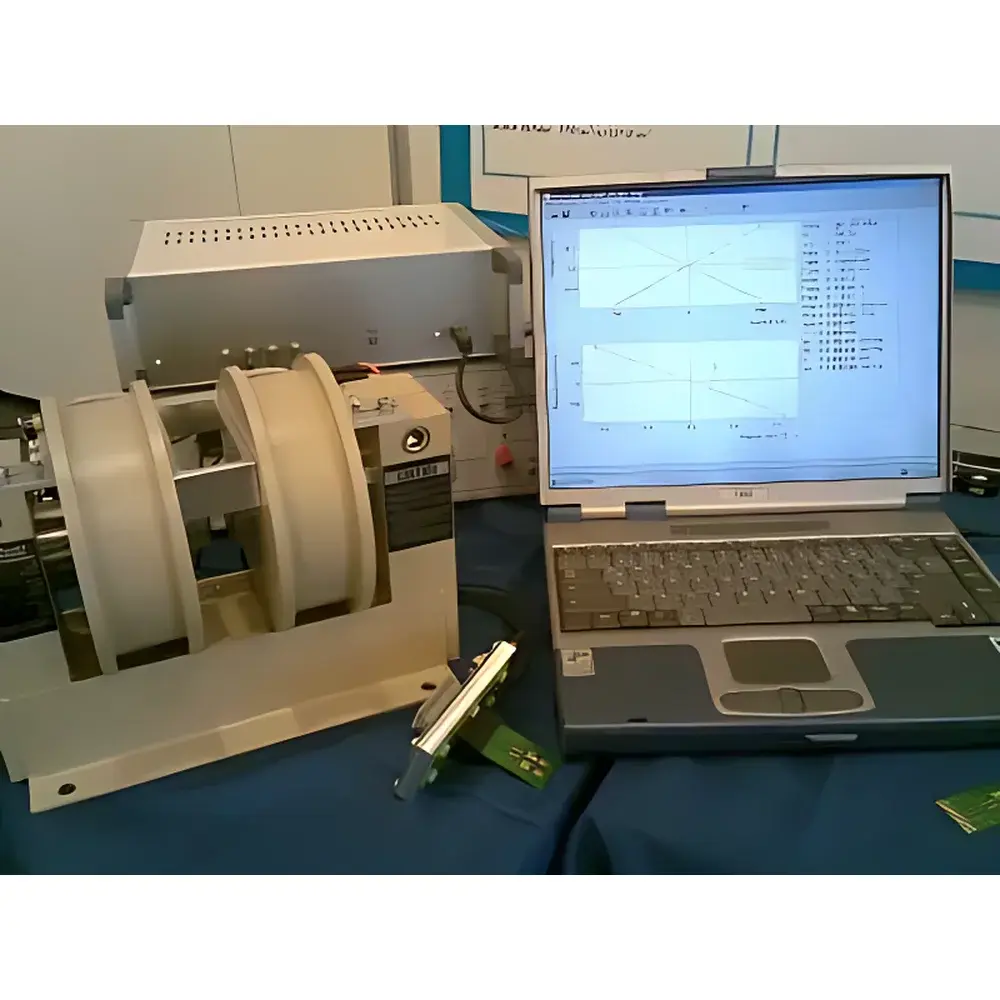
PhysTech RH2030 Hall Effect Measurement System
| Brand | PhysTech |
|---|---|
| Origin | Germany |
| Model | RH2030 |
| Magnet Type | Electromagnet (1 T) |
| Magnetic Field Uniformity | < ±1% over measurement area |
| Temperature Range | 77 K (liquid nitrogen) or ambient |
| Resistivity Range | 1 µΩ·cm to 10 MΩ·cm |
| Resistance Range | 0.1 mΩ to 10 GΩ |
| Carrier Concentration Range | 1×10⁷ – 1×10²¹ cm⁻³ |
| Mobility Range | 1×10⁻² – 1×10⁷ cm²/(V·s) |
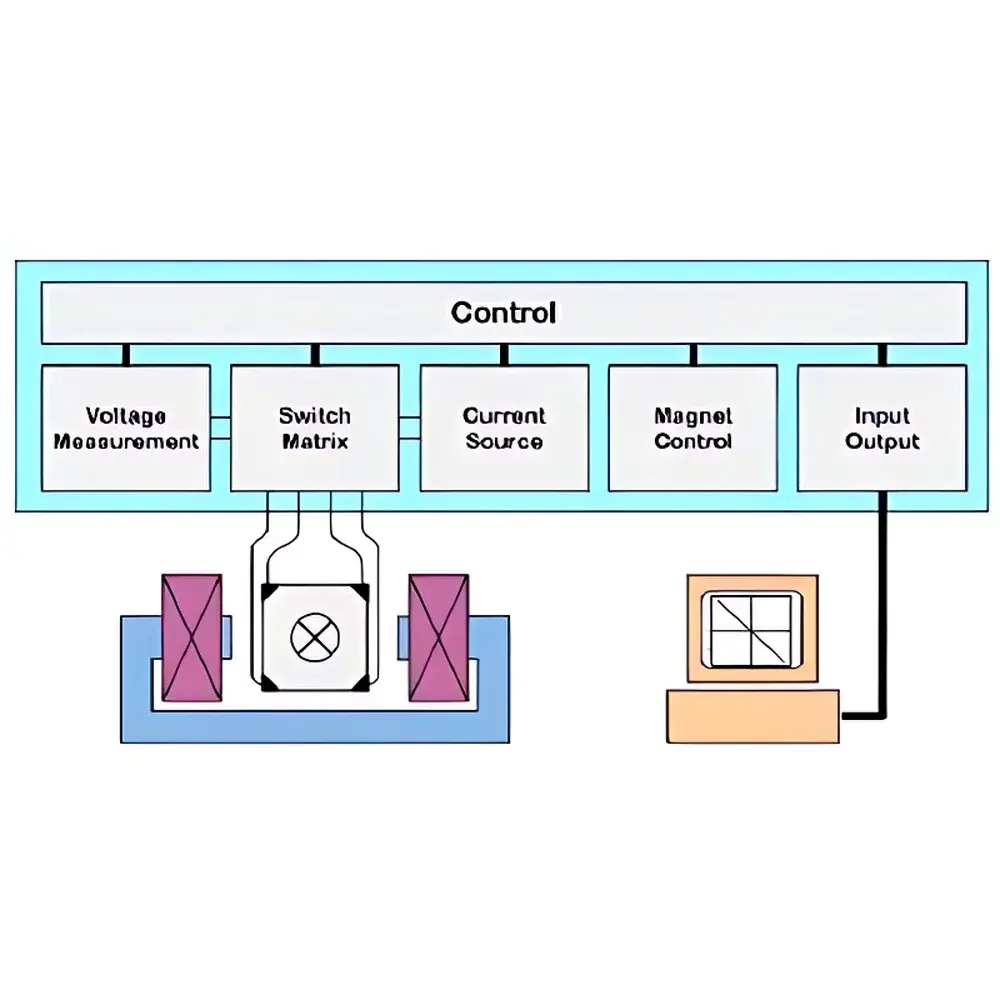
| Current Source | 1000 pA – 10 mA, resolution 25 pA (lowest range), accuracy ±2% |
| Voltage Measurement | ±10 V, resolution 1 µV |
| Compliance Standards | ASTM F76, ISO/IEC 17025 (when operated in accredited lab environment), supports GLP/GMP data integrity requirements via audit-trail-enabled software |
Overview
The PhysTech RH2030 Hall Effect Measurement System is a precision benchtop instrument engineered for quantitative characterization of semiconductor thin films and bulk materials. Based on the classical Hall effect principle—where a transverse voltage develops across a current-carrying conductor under perpendicular magnetic field—the RH2030 enables simultaneous extraction of carrier type (n- or p-type), carrier concentration, Hall mobility, electrical resistivity, and Hall coefficient. Its design adheres to standardized test methodologies defined in ASTM F76 (“Standard Test Method for Measuring Resistivity and Hall Coefficient of Semiconductor Materials Using the van der Pauw Technique”) and supports van der Pauw, linear four-point, and modified Hall bar configurations. The system integrates a stable 1 T electromagnet with sub-1% spatial field uniformity and long-term stability (< ±0.2% drift over 10 years), ensuring reproducible measurements across extended experimental campaigns. Dual-temperature capability (ambient and 77 K liquid nitrogen cooling) allows evaluation of temperature-dependent transport properties critical for device-grade material qualification.
Key Features
- Automated contact verification: Real-time ohmic contact assessment prior to measurement ensures data validity and eliminates false negatives from poor probe adhesion.
- Modular hardware architecture: Supports integration with third-party cryogenic systems (e.g., closed-cycle refrigerators), external magnet platforms (including Bio-Rad HL 5200), and custom temperature controllers—enabling future upgrades without full system replacement.
- Differential resistivity analysis: I/V curve acquisition with programmable sweep parameters enables precise determination of non-linear conduction behavior and contact resistance correction.
- Drift compensation algorithms: Dedicated voltage offset correction routines mitigate slow baseline drift—particularly effective for wide-bandgap oxides such as ZnO and SnO₂ where surface states dominate low-frequency response.
- Auto-field calibration: Onboard flux density mapping routine validates magnetic field strength at sample position using integrated Hall sensor feedback, eliminating reliance on external gaussmeter recalibration.
- Multi-range current source: Programmable compliance limits (voltage and power) protect sensitive samples during high-resistivity measurements; lowest current range (1 nA–10 µA) optimized for ultra-low-conductivity films.
- Configurable voltage input stages: Selectable amplifiers optimize signal-to-noise ratio for either microvolt-level Hall voltages (low-current regime) or millivolt-level longitudinal voltages (high-conductivity regime).
Sample Compatibility & Compliance
The RH2030 is validated for use with standard semiconductor materials including Si, SiGe, SiC, GaAs, InGaAs, InP, and GaN—both n-type and p-type doping configurations. Sample geometries compatible with van der Pauw and Hall bar layouts are accommodated via interchangeable sample stages with gold-plated spring-loaded probes. All electrical connections conform to IEC 61000-4-8 (power frequency magnetic field immunity) and IEC 61326-1 (EMC requirements for laboratory equipment). When deployed in regulated environments, the system’s software supports 21 CFR Part 11-compliant electronic signatures, user access control tiers, and immutable audit trails for raw data, calibration logs, and measurement history—facilitating FDA, EMA, or ISO/IEC 17025 laboratory accreditation.
Software & Data Management
The RH2030 operates with PhysTech’s proprietary HallSoft™ platform—a Windows-based application supporting both routine operation and advanced research workflows. Core capabilities include automated sequence scripting (e.g., temperature ramp + field sweep + current bias), real-time parameter visualization (carrier concentration vs. temperature, mobility vs. carrier density), and export to CSV, MATLAB .mat, or HDF5 formats. Calibration data—including magnet flux maps, probe resistance matrices, and thermal EMF corrections—is stored in encrypted project files with versioned metadata. Software updates are delivered via secure HTTPS channel with SHA-256 signature verification. Remote operation is supported via TCP/IP interface with IEEE-488 (GPIB) or RS-232 fallback for legacy integration.
Applications
- Process development and QC of epitaxial layers (MBE, MOCVD) for power electronics and RF devices.
- Characterization of transparent conducting oxides (TCOs) used in photovoltaics and display technologies.
- Failure analysis of gate dielectrics and channel layers in MOSFET and HEMT structures.
- Correlation studies between dopant activation efficiency and post-deposition annealing conditions.
- Transport property benchmarking of emerging 2D semiconductors (e.g., MoS₂, WS₂) on insulating substrates.
- Validation of sheet resistance and carrier profiles in ion-implanted wafers per SEMI MF1530.
FAQ
Does the RH2030 support variable-temperature measurements below 77 K?
Yes—its modular stage interface is compatible with commercial cryostats (e.g., Janis ST-500, BlueFrog) enabling continuous operation from 4 K to 473 K when paired with appropriate temperature controllers.
Can the system perform resistivity mapping across a wafer?
Not natively—but optional motorized XY stages with optical alignment can be integrated via PhysTech’s OEM interface protocol, enabling automated point-by-point Hall scans.
Is firmware upgradable in the field?
Yes—firmware updates are delivered as signed binary packages through HallSoft™ and applied via USB or Ethernet without requiring return to service center.
What probe configurations does the contact switching module support?
All standard configurations: van der Pauw (4-probe), linear 4-point, cloverleaf, and Hall bar—with automatic lead reversal to eliminate thermoelectric offsets.
How is measurement uncertainty quantified?
Uncertainty budgets follow GUM (JCGM 100:2008) methodology and include contributions from current source accuracy (±2%), voltage resolution (±1 µV), field uniformity (±0.5%), and temperature sensor tolerance (±0.2 K at 77 K).



