
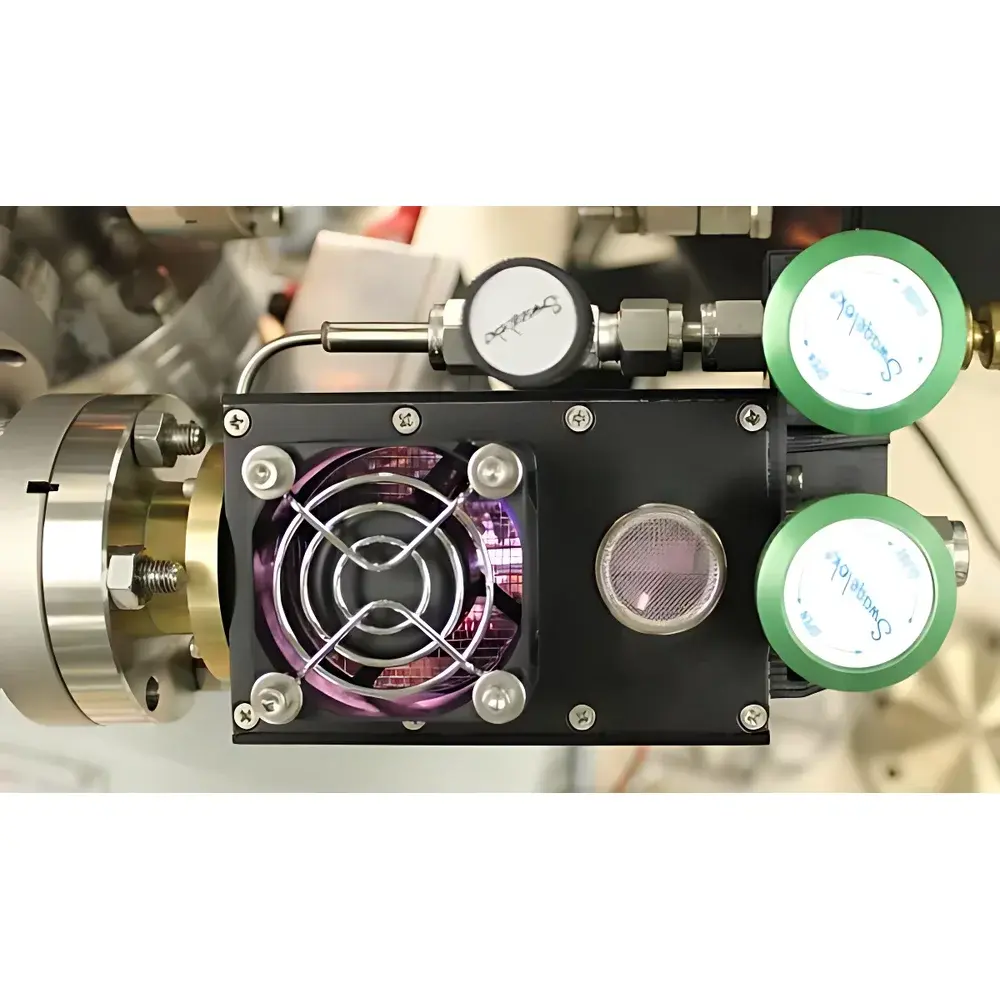
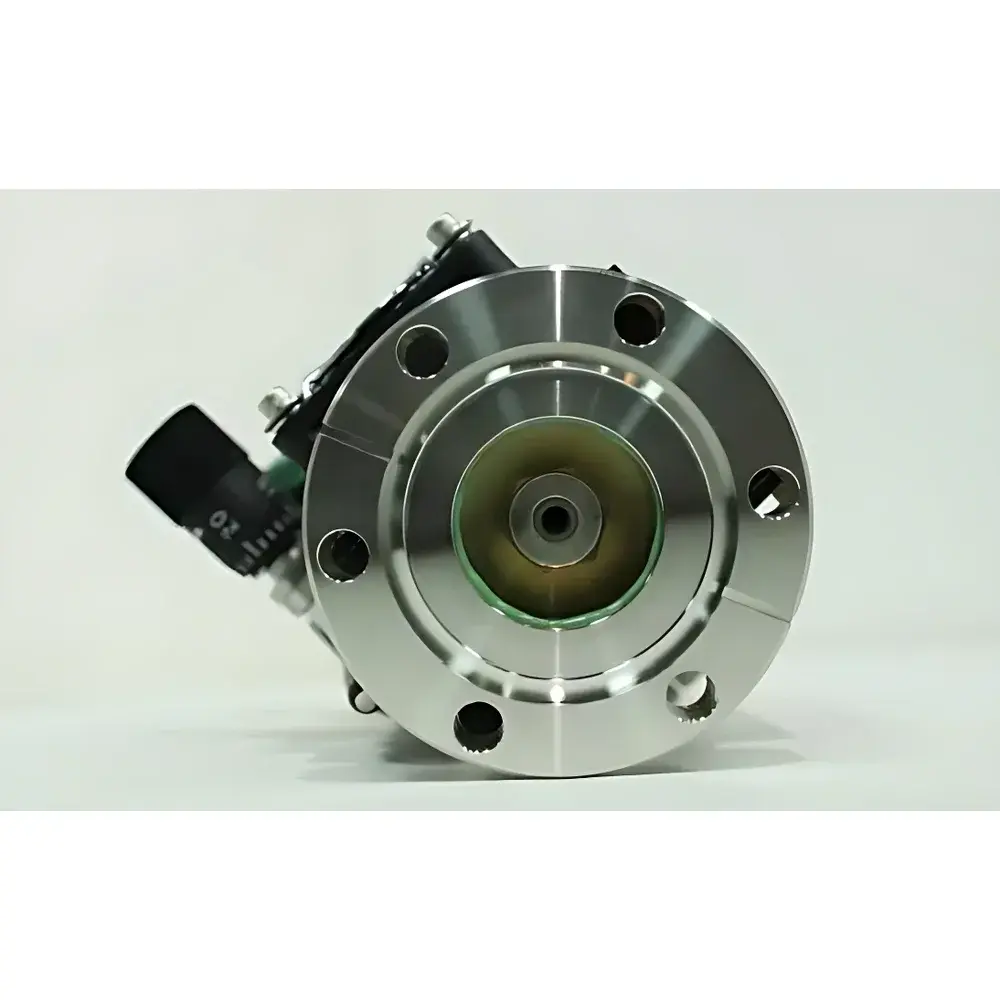
Resoce EUV-X-L Flow Lamp Extreme Ultraviolet Light Source
| Origin | Canada |
|---|---|
| Manufacturer Type | Authorized Distributor |
| Origin Category | Imported |
| Model | EUV-X-L Flow Lamp |
| Beam Geometry | Single-Beam Configuration |
| Detector Type | CCD-Based Photoreceiver |
| Wavelength Range | 24–800 nm |
| Wavelength Selection | Manual (via External Monochromator Integration) |
| Spectral Bandwidth | <30 nm |
| Wavelength Accuracy | ±1 nm |
| Stray Light | ≤0.01% T |
| Photon Flux | >1×10¹⁵ photons/sec/ster at primary EUV emission lines |
| Mass | <1 mg (lightweight integrated lamp head) |
| EUV Emission Capability | Extended output below 25 nm |
Overview
The Resoce EUV-X-L Flow Lamp is a compact, high-brightness extreme ultraviolet (EUV) light source engineered for laboratory-scale spectroscopic and photoelectron applications requiring stable, narrow-band radiation in the 24–25 nm spectral region. Unlike conventional deuterium or xenon arc lamps, the EUV-X-L employs a pulsed gas-flow discharge architecture optimized for efficient radiative decay from highly ionized species—primarily helium and nitrogen plasma—enabling intense line emission at key EUV wavelengths (e.g., He II at 30.4 nm, N V at 24.78 nm, and O IV at 27.96 nm). Its design emphasizes minimal thermal load, rapid gas replenishment, and compatibility with vacuum-compatible optical interfaces (CF-35 or KF-25 flanges), making it suitable for integration into UHV chambers (<1×10⁻⁷ mbar base pressure) without compromising source stability or lifetime. The lamp operates as a secondary source: it emits broadband EUV/VUV radiation that is spectrally resolved using an external scanning monochromator, thereby enabling tunable, quasi-monochromatic illumination across its full 24–800 nm output envelope.
Key Features
- High photon flux density: >1×10¹⁵ photons/sec/ster at principal EUV resonance lines, supporting time-resolved photoemission and absorption experiments with signal-to-noise ratios sufficient for single-shot detection.
- Sub-25 nm capability: Sustained, stable emission down to 24 nm—critical for probing core-level transitions in light elements (C, N, O, F) and valence-band structure of wide-bandgap materials.
- Ultra-low mass design: Lamp head mass <1 mg ensures minimal mechanical inertia and vibration coupling, facilitating integration into micro-positioning stages and synchrotron beamline end-stations where payload constraints apply.
- Monochromator-ready interface: Standard SMA-905 and vacuum feedthrough-compatible electrical connections enable direct coupling to grating-based monochromators (e.g., McPherson 248/310, Horiba iHR series) without optical realignment.
- Low stray light performance: ≤0.01% T stray light specification (measured at 254 nm using NaNO₂ solution per ASTM E387) ensures high dynamic range in absorbance measurements and reduces background interference in fluorescence yield detection.
- Single-beam optical architecture: Optimized for fixed-path UV-Vis-EUV reflectometry and transmission setups where beam stability and polarization preservation are prioritized over dual-beam referencing.
Sample Compatibility & Compliance
The EUV-X-L Flow Lamp supports solid, liquid, and gaseous samples under ambient, inert, or ultra-high vacuum conditions. Its 24–800 nm spectral coverage enables cross-platform method transfer between EUV photoelectron spectroscopy (PES), VUV circular dichroism (CD), and soft X-ray absorption near-edge structure (XANES) pre-edge analysis. Instrument compliance includes adherence to IEC 61000-6-3 (EMC emissions) and CE marking for laboratory equipment. While not classified as a medical device, its optical output meets ISO 15385:2020 requirements for spectral radiance calibration sources used in analytical spectrophotometry. Data acquisition workflows support GLP-compliant audit trails when paired with validated third-party software (e.g., LabVIEW 2022 SP1 with NI-DAQmx 23.5).
Software & Data Management
The lamp operates independently of proprietary firmware; control is achieved via TTL-triggered pulse modulation (1–10 kHz repetition rate, 10–100 ns pulse width) and analog current regulation (0–2 A DC). Integration with spectroscopic data systems follows IEEE 1159-compliant SCPI command syntax for external triggering and status reporting. Raw intensity data acquired via CCD detectors (e.g., Andor iDus DU420A-BU) is exportable in FITS and HDF5 formats, ensuring compatibility with open-source analysis pipelines (Python-based SciPy/NumPy, Igor Pro 9.0, or MATLAB R2023b). All wavelength calibration files adhere to NIST-traceable standards (SRM 2034, SRM 1935), with uncertainty budgets documented per ISO/IEC 17025:2017 Annex A.2.
Applications
- Atomic and molecular physics: Measurement of photoionization cross-sections and autoionizing resonances in noble gases and diatomic molecules.
- Surface science: In-situ EUV reflectometry for thin-film thickness monitoring during ALD and MBE growth processes.
- Materials characterization: Bandgap determination of 2D semiconductors (e.g., MoS₂, h-BN) via absorption edge analysis below 50 nm.
- Environmental chemistry: Quantification of radical quantum yields (OH•, Cl•) in aqueous photolysis studies using actinometry with potassium ferrioxalate.
- Biophysics: Vacuum-ultraviolet circular dichroism (VUV-CD) of protein secondary structure in the 170–200 nm range, enabled by extended low-wavelength throughput.
FAQ
What vacuum level is required for optimal EUV-X-L operation?
The lamp requires a base pressure ≤5×10⁻⁷ mbar for stable discharge and maximum EUV output; operation above 1×10⁻⁵ mbar results in rapid plasma quenching and spectral contamination from residual hydrocarbons.
Can the EUV-X-L be used with fiber-optic delivery?
No—standard silica fibers exhibit catastrophic absorption below 185 nm; only magnesium fluoride (MgF₂) or lithium fluoride (LiF) vacuum UV-transmitting optics are compatible, and these must be purged or operated in vacuum.
Is wavelength calibration traceable to NIST standards?
Yes—each unit ships with a certified calibration report referencing NIST SRM 2034 (deuterium lamp) and SRM 1935 (tungsten halogen), with uncertainty values reported per ISO/IEC 17025.
Does the lamp support automated wavelength scanning?
Not natively—the EUV-X-L is a fixed-output source; full spectral scanning requires external monochromator control via RS-232 or USB-TTL synchronization signals.
What maintenance intervals are recommended for the gas flow system?
Helium/N₂ supply lines should be inspected quarterly for leaks; the internal flow regulator is rated for ≥10,000 operating hours under continuous use at 1.2 sccm flow rate.



