
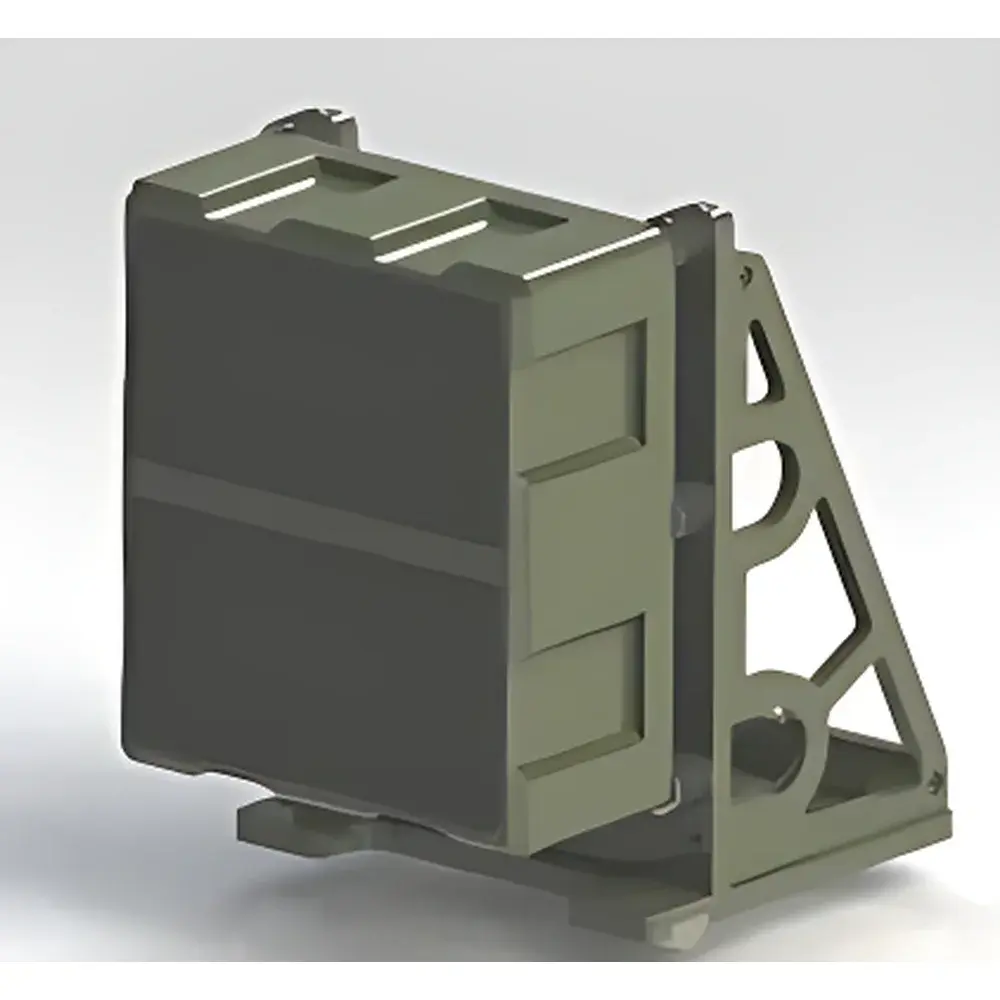
ED-2305C Compact Muzzle Velocity Radar System
| Origin | Canada |
|---|---|
| Manufacturer Type | Authorized Distributor |
| Origin Category | Imported |
| Model | ED-2305C |
| Price | Upon Request |
| Measurement Principle | Continuous-Wave Doppler Radar (X-band, 10.5 GHz nominal) |
| Velocity Range | 30–3000 m/s (100–10,000 fps) |
| Accuracy | < ±0.05% of reading |
| Precision | < ±0.05% of reading |
| Update Latency | ≤40 ms per shot |
| Max Rate of Fire Support | 1500 rpm |
| Caliber Compatibility | 4.5 mm to ≥155 mm |
| Ammunition Types Supported | Base-Bleed, Discarding Sabot, Tracer, Illuminating, Flare |
| Antenna Gain | >20 dBi (Tx/Rx) |
| Beamwidth | 10° × 20° (H×V) |
| Polarization | Linear |
| Transmit Power | 500 mW (+27 dBm) |
| Data Interfaces | RS-232, RS-422, USB 2.0, 10/100BASE-T Ethernet |
| Power Input | 10–36 VDC, <500 mA @ 24 VDC |
| Environmental Compliance | MIL-STD-810G (shock, vibration, temp, humidity) |
| EMI/EMC Compliance | MIL-STD-461G |
| Enclosure | Anodized aluminum, fully solid-state, no moving parts |
| Dimensions | 211 × 186 × 83 mm |
| Weight | 6.0 kg |
Overview
The ED-2305C Compact Muzzle Velocity Radar System is a field-deployable, solid-state X-band continuous-wave (CW) Doppler radar engineered for real-time, non-contact measurement of projectile muzzle velocity (MV) in artillery, naval gun, and small-arms test environments. Operating at a nominal frequency of 10.5 GHz, the system detects Doppler shift induced by high-velocity projectiles exiting the bore, enabling deterministic velocity calculation without optical line-of-sight constraints or physical instrumentation on the projectile. Its embedded digital signal processor (DSP) performs real-time Fast Fourier Transform (FFT) analysis on the reflected RF signal, resolving spectral peaks corresponding to individual projectiles—even under rapid-fire conditions up to 1500 rounds per minute. The radar’s low-latency architecture delivers MV results within ≤40 ms post-firing, supporting closed-loop fire control integration where timing-critical ballistic correction depends on immediate velocity feedback. Designed to meet military environmental and electromagnetic compatibility requirements—including MIL-STD-810G for mechanical ruggedness and MIL-STD-461G for conducted/radiated emissions—the ED-2305C functions reliably across extreme temperature, shock, and vibration profiles typical of mobile weapon platforms.
Key Features
- Fully solid-state construction with no moving parts or consumables—ensures long-term operational stability in high-G launch environments.
- Multi-caliber adaptability: validated for projectiles ranging from 4.5 mm (.177 in) airgun pellets to 155 mm and larger artillery shells, including base-bleed, discarding sabot, tracer, flare, and illuminating munitions.
- User-configurable ammunition libraries stored in non-volatile memory: pre-programmed ballistic parameters (e.g., nominal mass, drag coefficient proxies) enable automatic MV compensation for propellant temperature and projectile weight variations.
- Dual-mode antenna design with 10° × 20° beamwidth and >20 dBi gain ensures robust signal capture across varying standoff distances (typically 3–15 m from muzzle), while linear polarization minimizes cross-polar coupling in multi-gun emplacements.
- Integrated statistical engine computes not only instantaneous MV per round but also rolling mean, standard deviation, and shot-to-shot variance—critical for ammunition lot qualification and barrel wear trending.
- Comprehensive interface suite: native support for RS-232, RS-422, USB 2.0, and 10/100BASE-T Ethernet enables seamless integration with legacy fire control computers (FCCs), modern tactical displays, or test range data acquisition systems.
Sample Compatibility & Compliance
The ED-2305C is designed for direct mounting on weapon platforms—including towed howitzers, self-propelled artillery, naval turrets, and crew-served weapons—via its standard elastomeric isolation bracket set. Its compact footprint (211 × 186 × 83 mm) and 6.0 kg mass allow installation without compromising platform balance or recoil dynamics. The system complies with U.S. Department of Defense environmental standards per MIL-STD-810G (Methods 514.6, 516.6, 502.5, 500.5) for operational survivability under transport shock, random vibration, thermal cycling (−40°C to +71°C), and humidity exposure. Electromagnetic compatibility is certified to MIL-STD-461G (RS103, CS114, CS115), ensuring coexistence with onboard radar, comms, and navigation systems. No end-user calibration is required; factory calibration is traceable to NIST standards and maintained via internal reference oscillators.
Software & Data Management
The ED-2305C operates autonomously after initial configuration but supports external command-and-control via a documented ASCII-based serial protocol (Interface Specification E62-QS007, available upon request). This protocol defines standardized commands for system initialization, ammunition type selection, trigger mode activation (auto/manual), data streaming control, and memory dump. All measurements—including timestamp (UTC-sync capable), raw Doppler spectrum metadata, compensated MV, and statistical aggregates—are logged internally to flash memory (capacity: ≥4000 shots). Data export is supported via USB mass-storage emulation or Ethernet TCP/IP socket streaming. For laboratory or QA applications, optional PC software provides visualization of time-series MV trends, histogram distribution analysis, and export to CSV/Excel for ASTM E29 or ISO/IEC 17025-compliant reporting. Audit trails, user access logs, and firmware versioning are implemented to support GLP/GMP-aligned test documentation workflows.
Applications
- Real-time ballistic solution refinement in automated fire control systems (FCS), where muzzle velocity deviation directly impacts point-of-impact accuracy at extended ranges.
- Ammunition lot acceptance testing per MIL-STD-331 and NATO AEP-97, verifying consistency of propellant burn characteristics and projectile mass tolerance.
- Barrel life monitoring through longitudinal MV drift analysis—identifying erosion-induced velocity loss before catastrophic failure thresholds are reached.
- Small-arms and tank gun development testing, including evaluation of novel propellants, lightweight projectiles, and guided munition launch signatures.
- Range safety and diagnostics: detecting abnormal velocity outliers that may indicate squibs, hangfires, or structural anomalies in fired rounds.
FAQ
What is the minimum and maximum projectile velocity the ED-2305C can measure?
The system measures velocities from 30 m/s to 3000 m/s (100–10,000 fps), covering subsonic airgun pellets through hypervelocity kinetic energy penetrators.
Does the radar require line-of-sight alignment with the projectile trajectory?
Yes—optimal performance requires unobstructed RF path between the antenna aperture and the projectile’s expected flight path within the 10° × 20° beam envelope; however, minor angular misalignment is tolerated due to wide beam geometry.
Can the ED-2305C operate continuously during sustained rapid fire?
Yes—it supports burst rates up to 1500 rounds per minute with guaranteed ≤40 ms latency per valid MV result, provided thermal management (via passive conduction through the aluminum chassis) remains within spec.
Is firmware upgrade capability supported in-field?
Yes—firmware updates are delivered via USB or Ethernet using signed binary packages; update integrity and rollback protection are enforced by secure boot firmware.
What power conditioning is recommended for vehicle-mounted installations?
A MIL-STD-1275D-compliant DC-DC converter is advised to suppress transients and ripple; the unit accepts 10–36 VDC input but draws <500 mA at 24 VDC under full operational load.




