
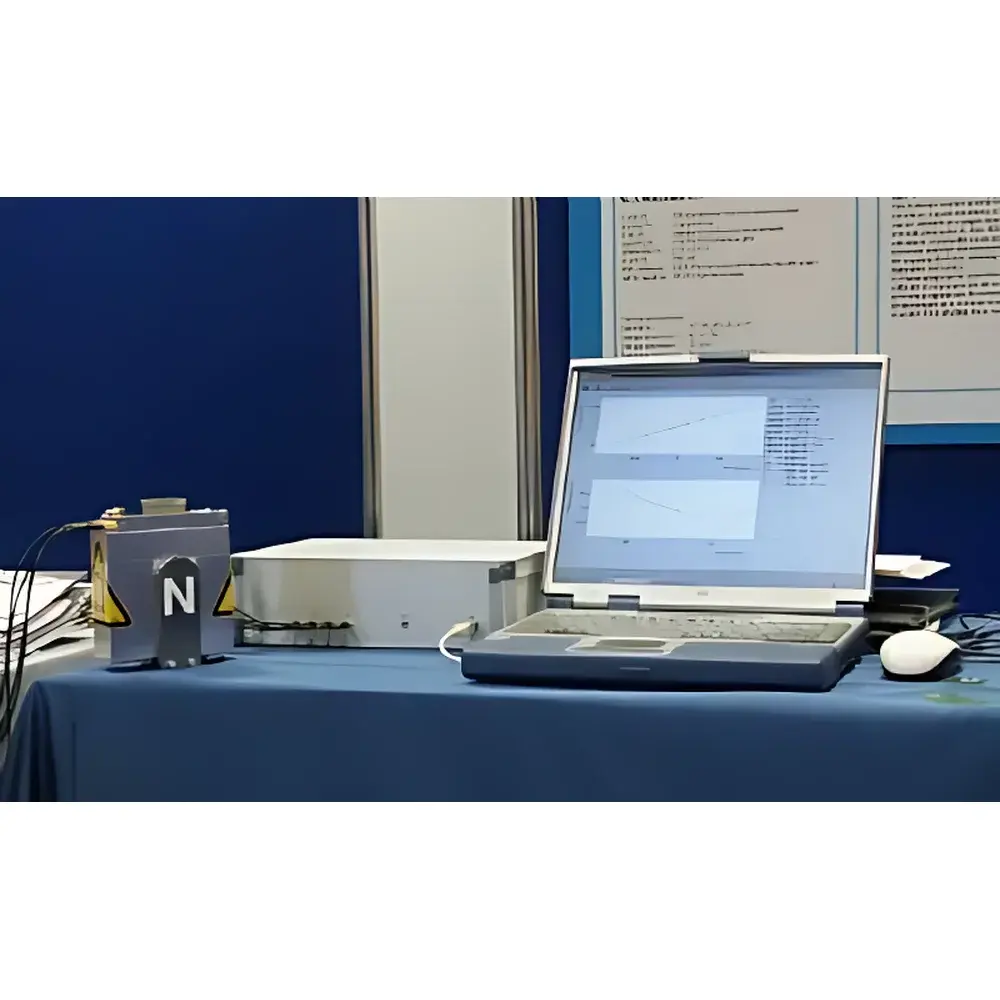
PhysTech RH2035 Hall Effect Measurement System
| Brand | PhysTech |
|---|---|
| Origin | Germany |
| Model | RH2035 |
| Magnetic Field | 0.45 T permanent magnet |
| Field Uniformity | < ±1% |
| Field Drift | < ±0.2% over 10 years |
| Temperature Range | 77 K (liquid nitrogen) or ambient |
| Resistivity Range | 1 µΩ·cm to 10 MΩ·cm |
| Resistance Range | 0.1 mΩ to 10 GΩ |
| Carrier Concentration | 1×10⁷ to 1×10²¹ cm⁻³ |
| Mobility Range | 1×10⁻² to 1×10⁷ cm²/(V·s) |
| Current Source | 1000 pA–10 mA, resolution 2.5 pA (lowest range), accuracy ±2% |
| Voltage Measurement | ±10 V, resolution 1 µV |
Overview
The PhysTech RH2035 Hall Effect Measurement System is a benchtop, microprocessor-controlled instrumentation platform engineered for quantitative characterization of semiconductor thin films and bulk materials. It operates on the classical Hall effect principle—applying a controlled current through a sample while subjecting it to a known, stable perpendicular magnetic field—and measures the resulting transverse Hall voltage and longitudinal resistive voltage. From these primary electrical signals, the system calculates fundamental electronic transport parameters including carrier type (n- or p-type), carrier concentration, Hall mobility, sheet/resistivity, and Hall coefficient. Designed for precision metrology in R&D and quality control environments, the RH2035 supports both room-temperature and cryogenic (77 K) operation using standard liquid nitrogen dewars, enabling reliable thermally dependent transport analysis across technologically relevant semiconductors such as Si, SiGe, SiC, GaAs, InGaAs, InP, and GaN.
Key Features
- Integrated 0.45 T permanent magnet with long-term field stability (< ±0.2% drift over 10 years) and high spatial uniformity (< ±1%)—eliminating need for electromagnet power supplies and cooling infrastructure
- Automated contact check functionality verifying ohmic integrity prior to measurement, reducing false data from non-ideal contacts
- Differential resistivity analysis via full I/V curve acquisition, supporting nonlinear transport assessment and contact resistance deconvolution
- Real-time misalignment voltage compensation and slow drift correction algorithms—particularly effective for wide-bandgap oxides like ZnO exhibiting time-dependent surface states
- Modular hardware architecture with programmable current source (1000 pA–10 mA, 2.5 pA resolution) and dual-path voltage measurement (±10 V, 1 µV resolution), optimized separately for low-current and low-voltage regimes
- Automatic field calibration routine ensuring traceable magnetic flux density input without external gaussmeter dependency
- IEEE-488 (GPIB) and RS-232 interfaces for automated test sequencing and integration into semiconductor lab automation frameworks
- Expandable design compatible with third-party temperature controllers (e.g., closed-cycle cryostats) and alternative magnet systems (e.g., Bio-Rad HL 5200)
Sample Compatibility & Compliance
The RH2035 accommodates standard van der Pauw and Hall bar geometries with four-terminal contact configurations. Its wide dynamic range—carrier concentration from 1×10⁷ to 1×10²¹ cm⁻³ and resistivity from 1 µΩ·cm to 10 MΩ·cm—covers intrinsic, doped, and heavily compensated semiconductors. The system meets essential requirements for ISO/IEC 17025-accredited laboratories performing semiconductor material qualification, including documented measurement uncertainty budgets, calibration traceability to national standards (via NIST-traceable current/voltage references), and configurable audit trails. Software supports user-defined test protocols compliant with ASTM F76, ASTM F84, and SEMI MF1530 standards for Hall effect characterization.
Software & Data Management
The RH2035 is supplied with PhysTech’s dual-tier software suite: a streamlined “Routine Mode” for rapid pass/fail screening and an “Enhanced Mode” supporting advanced scripting, multi-step temperature/magnetic field sweeps, and batch data export in CSV and HDF5 formats. All measurements include timestamped metadata (current, voltage, field, temperature, contact configuration), enabling full GLP/GMP-compliant data archiving. The software implements 21 CFR Part 11–ready features—including electronic signatures, role-based access control, and immutable audit logs—for regulated environments engaged in device process development or qualification under FDA or IEC 62304 guidelines.
Applications
- Process monitoring of epitaxial layers (MOCVD, MBE) for dopant activation uniformity and interface trap density estimation
- Characterization of wide-bandgap power devices (SiC, GaN HEMTs) at cryogenic temperatures to isolate phonon-scattering contributions
- Quality assurance of transparent conductive oxides (ITO, AZO, ZnO) where mobility degradation correlates with grain boundary oxygen vacancy density
- Research on 2D materials (graphene, MoS₂) requiring ultra-low current capability and sub-microvolt voltage resolution
- Calibration reference for secondary measurement techniques such as spreading resistance profiling (SRP) and capacitance–voltage (C–V) analysis
FAQ
What semiconductor materials are supported by the RH2035?
The system is validated for Si, SiGe, SiC, GaAs, InGaAs, InP, GaN, and ZnO—covering both n-type and p-type doping configurations across bulk wafers, epitaxial films, and sputtered/deposited layers.
Can the RH2035 operate below 77 K?
The base configuration supports 77 K (liquid nitrogen) and ambient temperature. Integration with closed-cycle refrigerators or dilution cryostats is possible via its modular temperature controller interface and vacuum-compatible sample stage design.
Is the magnetic field strength adjustable?
No—the RH2035 uses a fixed 0.45 T permanent magnet optimized for signal-to-noise ratio and long-term stability. For variable-field studies, PhysTech offers complementary systems with superconducting or electromagnet options.
How does the system handle non-ohmic contacts?
The built-in automatic contact check evaluates contact linearity and series resistance before initiating Hall measurement; non-ohmic configurations trigger operator alert and optional re-probing guidance.
Does the software support automated compliance reporting?
Yes—preconfigured report templates align with ASTM F76 and SEMI MF1530, including uncertainty calculation per GUM (Guide to the Expression of Uncertainty in Measurement) and export-ready formatting for internal QA review or external certification bodies.



