
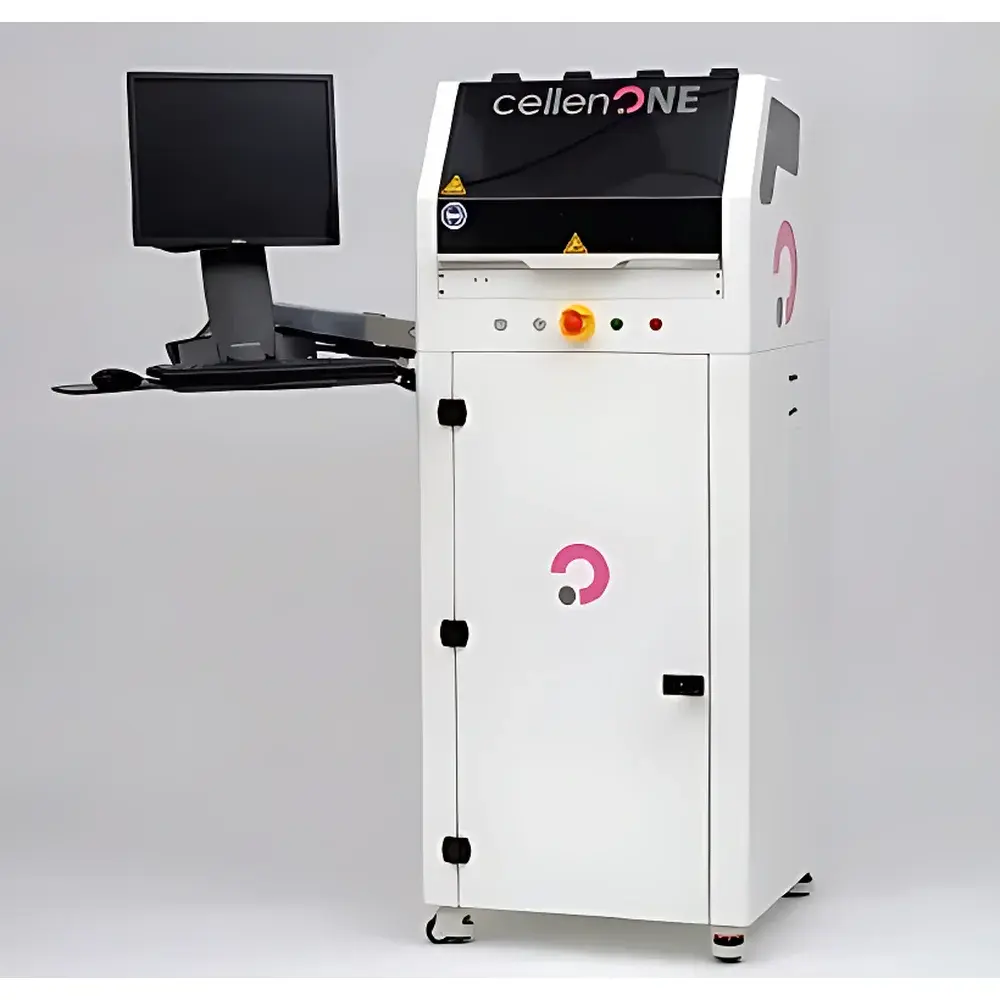
cellenONE f1.4 Automated Single-Cell Isolation System
| Origin | Germany |
|---|---|
| Manufacturer Type | Authorized Distributor |
| Origin Category | Imported |
| Model | f1.4 |
| Detection Channels | 3 |
| Fluorescence Sensitivity | 10,000 cells/s |
| Cell Analysis Speed | 0.2 mL/min |
| Detection Resolution | 200 µm |
| Laser Efficiency | 95% |
| Product Type | Flow Cytometry-Based Single-Cell Isolation Platform |
| Compatible Collection Formats | 96-well, 384-well, 1536-well, and custom microplates |
| Reagent Dispensing Precision | Nanoliter (nL)-level |
| Single-Cell Isolation Accuracy | ≥95% |
| Minimum Input Volume | 5 µL |
| Minimum Viable Cell Input | 50 cells |
| Cell Viability Post-Isolation | >90% (vs. typical FACS: 70–85%) |
Overview
The cellenONE f1.4 Automated Single-Cell Isolation System is an engineered precision platform designed for label-free, non-destructive, and highly reproducible single-cell isolation in demanding life science workflows. Unlike conventional fluorescence-activated cell sorting (FACS) or droplet-based microfluidic systems, the cellenONE employs piezoelectric acoustic dispensing—combined with real-time optical monitoring and deterministic positional mapping—to achieve true single-cell deposition without hydrodynamic shear stress or encapsulation artifacts. This principle ensures minimal mechanical perturbation to sensitive primary cells, stem cells, and fragile immune populations, making it especially suited for applications where post-isolation viability, clonal integrity, and transcriptional fidelity are critical—such as single-cell RNA sequencing (scRNA-seq), monoclonal antibody development, and functional phenotyping.
Key Features
- Piezoelectric acoustic dispensing technology enables gentle, contactless cell ejection with sub-nanoliter reagent dispensing accuracy and negligible shear-induced damage.
- Integrated high-speed optical imaging system continuously monitors nozzle contents at frame rates sufficient to resolve individual cell morphology and position prior to each dispensing event.
- Deterministic single-cell assignment: software maps cell coordinates in real time and triggers dispensing only when spatial criteria confirm isolated cell presence—ensuring ≥95% single-cell deposition efficiency.
- Minimal input requirements: validated for reliable operation with as few as 50 viable cells suspended in 5 µL volume—eliminating pre-amplification or pooling steps required by conventional FACS or 10X Genomics platforms.
- Flexible collection compatibility: supports standard and custom microplate formats including 96-, 384-, and 1536-well plates—enabling seamless integration into HTS, CRISPR screening, and clone expansion pipelines.
- Multi-function capability: performs both single-cell isolation and nanoliter-scale reagent dispensing (e.g., lysis buffer, RT master mix, barcoded primers), reducing library preparation costs and cross-contamination risk in scRNA-seq workflows.
Sample Compatibility & Compliance
The cellenONE f1.4 accommodates a broad range of suspension cell types—including PBMCs, dissociated tumor cells, iPSC-derived neurons, and hybridoma lines—without requiring surface labeling or antibody conjugation. Its open architecture permits direct integration with downstream molecular assays compliant with ISO/IEC 17025 and CLIA guidelines. For regulated environments, audit trails, user access control, and electronic signature support align with FDA 21 CFR Part 11 requirements when paired with validated LIMS or ELN systems. The system meets CE marking standards for in vitro diagnostic (IVD) ancillary equipment and adheres to IEC 61000-6-3 EMC emission limits.
Software & Data Management
The proprietary cellenONE Control Suite provides intuitive workflow configuration, real-time image-based quality control, and automated log generation for every isolation event. All optical frames, dispensing timestamps, coordinate maps, and viability metrics are stored in HDF5 format for traceability and third-party analysis interoperability (e.g., Seurat, Scanpy). Software updates follow a documented change control process, and version history is embedded in exported data packages. Raw image archives may be exported in TIFF or OME-TIFF format to support GLP/GMP-compliant documentation practices.
Applications
- Single-cell transcriptomics library preparation (compatible with 10X Genomics, SMART-seq, and targeted panel workflows).
- Monoclonal antibody discovery: high-fidelity single-B-cell or single-hybridoma isolation followed by immediate culture initiation in 96- or 384-well plates.
- CRISPR screening hit validation: deterministic isolation of edited clones from heterogeneous pools without dilution bias.
- Organoid and primary cell line establishment: recovery of rare progenitor subsets from low-yield tissue digests.
- Nanoliter-scale assay setup: precise allocation of enzymes, inhibitors, or fluorescent probes for dose-response or kinetic studies.
FAQ
Does the cellenONE f1.4 require fluorescent labeling for cell identification?
No—it operates label-free using brightfield and phase-contrast imaging to detect and localize intact cells based on morphological contrast.
Can it isolate single cells directly into PCR tubes or strips?
Yes—custom plate definitions allow mapping to non-standard receptacles, including 0.2-mL PCR tubes and 8-strip formats, provided mechanical alignment is verified.
What is the maximum throughput for single-cell deposition?
At nominal settings, the system achieves up to 0.2 mL/min fluid handling rate; actual cell deposition speed depends on sample concentration and desired purity—typically 100–500 cells/hour with ≥95% singlet confirmation.
Is remote monitoring or unattended operation supported?
Yes—the system supports secure network connectivity for status polling, email alerts, and session resumption after interruption, subject to local IT policy compliance.
How is calibration maintained across long-term use?
Daily automated nozzle health checks and weekly geometric calibration routines are built into the maintenance schedule; all calibration events are logged with operator ID and timestamp.




