
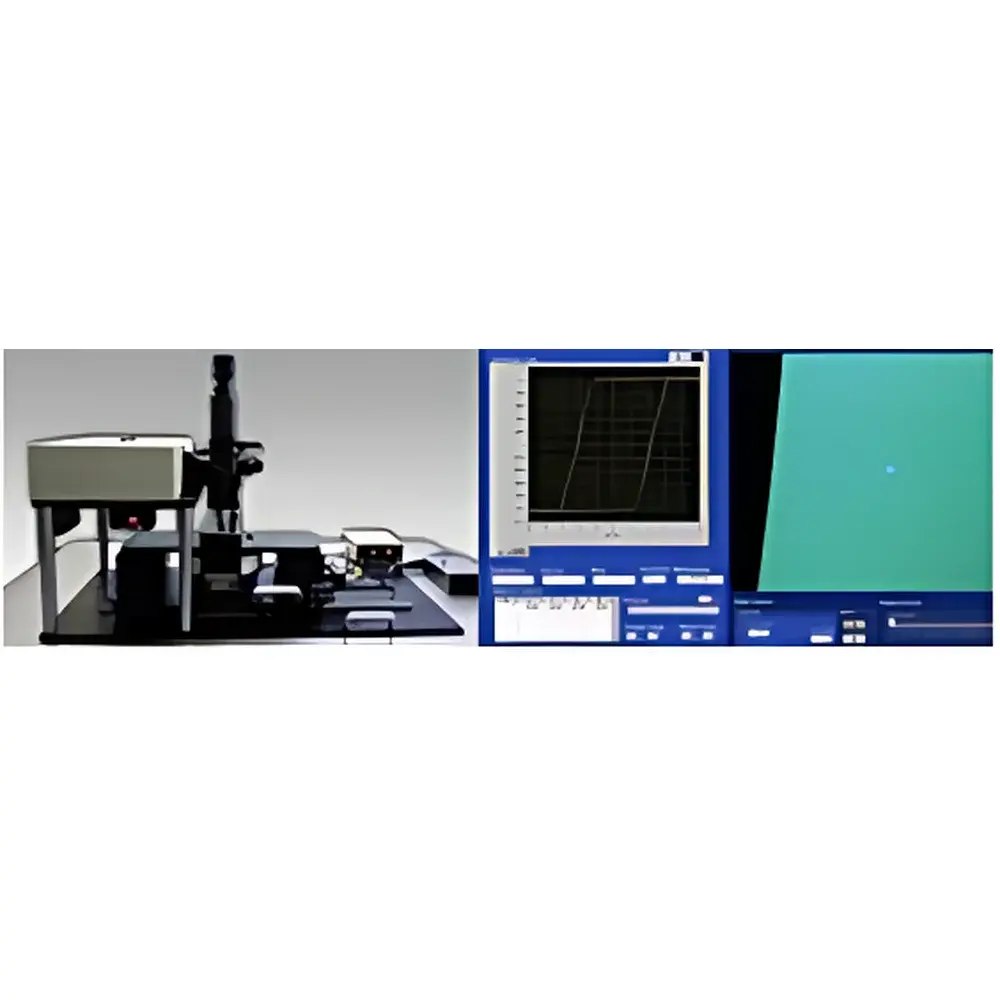
JASCO MOKE-1000 Series Magneto-Optical Kerr Effect (MOKE) Measurement System
| Origin | Japan |
|---|---|
| Supplier Type | Authorized Distributor |
| Import Status | Imported |
| Model | MOKE-1000 Series |
| Pricing | Upon Request |
| Measurement Modes | Polar MOKE, Longitudinal MOKE, Faraday Rotation, Perpendicular Magnetic Anisotropy (PMA) Analysis |
| Light Source | Collimated Diode Laser (635 nm or 785 nm), Optional Hg Lamp for domain imaging |
| Probe Spot Size | 2–5 µm (micro-MOKE), 1 mm (macro-MOKE), 2 mm (Faraday) |
| Spatial Resolution (Domain Imaging) | ≤1 µm (with 50× objective) |
| Maximum Applied Field | ±10 kOe (1 T) standard |
| Field Orientation | In-plane (±10°–100° continuous rotation) and out-of-plane |
| Cryogenic Option | Compatible with variable-temperature cryostats (4 K–300 K) |
| Compliance | ASTM F1529, ISO/IEC 17025-aligned calibration traceability, GLP-compliant data logging |
Overview
The JASCO MOKE-1000 Series is a modular, research-grade magneto-optical Kerr effect (MOKE) measurement system engineered for quantitative, spatially resolved analysis of magnetization dynamics in thin films, multilayers, and nanostructured magnetic materials. Operating on the principle of polarization rotation induced by magnetization-dependent Fresnel reflection at ferromagnetic surfaces, the system enables non-contact, label-free characterization of hysteresis loops (Kerr loops), coercivity, remanence, anisotropy fields, and domain wall motion. Unlike bulk magnetometry techniques, MOKE provides surface-sensitive detection (penetration depth < 10 nm for visible light), making it indispensable for evaluating interfacial magnetism, spin-orbit coupling effects, and exchange bias phenomena in spintronic devices. The platform supports both static and quasi-static field protocols under ambient or controlled environments—including integration with cryostats for low-temperature studies down to 4 K—and is optimized for reproducible measurements compliant with ASTM F1529 (Standard Practice for Magnetic Characterization of Thin Films).
Key Features
- Multi-mode optical configuration: Simultaneous or sequential selection of polar, longitudinal, and transverse MOKE geometries via motorized polarization optics and sample-stage alignment.
- Micro-spot capability: High-numerical-aperture optics deliver diffraction-limited probe spots from 2 µm to 5 µm—enabling spatial mapping of magnetic domains and local hysteresis in patterned microstructures.
- Field-flexible electromagnet: Standard in-plane solenoid (±10 kOe) with optional high-field (±25 kOe) and ultra-low-field (±100 Oe) configurations; precise angular control (–10° to +100°) for perpendicular magnetic anisotropy (PMA) quantification.
- Dual-light-source architecture: Integrated diode laser (635 nm or 785 nm) for high signal-to-noise Kerr loop acquisition; mercury arc lamp for wide-field magnetic domain imaging with real-time CCD capture.
- Modular extensibility: Designed for seamless integration with vacuum chambers, UHV sample transfer stages, and external RF/microwave excitation sources for dynamic MOKE studies.
Sample Compatibility & Compliance
The MOKE-1000 accommodates planar samples up to 25 mm × 25 mm and thicknesses ≤3 mm, including sputtered/perovskite thin films, Co/Pt multilayers, Fe-based amorphous ribbons, and exfoliated 2D magnets (e.g., CrI₃, Fe₃GeTe₂). All optical paths are sealed and vibration-isolated to maintain sub-milliradian polarization stability. Data acquisition adheres to ISO/IEC 17025 principles for measurement uncertainty estimation, with full audit trails for instrument parameters, field calibration coefficients, and environmental logs (temperature, humidity). Optional 21 CFR Part 11-compliant software modules support electronic signatures and role-based access control for regulated QA/QC laboratories.
Software & Data Management
JASCO MOKEControl v4.2 provides deterministic, scriptable control of field ramps, laser modulation, lock-in detection (SR830-compatible), and synchronized image capture. Raw Kerr rotation signals (in mrad) are converted to normalized magnetization (M/Ms) using in situ reference standards. Domain images are processed via FFT-based filtering and vector field reconstruction algorithms. Export formats include HDF5 (for Python/Matlab interoperability), CSV (for statistical analysis), and TIFF (with embedded metadata per MIAME guidelines). All datasets retain timestamped calibration records and are archived in hierarchical directory structures aligned with FAIR (Findable, Accessible, Interoperable, Reusable) data principles.
Applications
- Quantification of perpendicular magnetic anisotropy energy (Ku) and damping parameters (α) in CoFeB/MgO stacks for STT-MRAM development.
- In-situ observation of vortex nucleation and skyrmion lattice evolution under rotating fields in chiral magnets.
- Interface-driven exchange bias determination in IrMn/CoFe bilayers via angular-dependent Kerr loop shifts.
- Thermal stability assessment of nanomagnet arrays via temperature-dependent coercivity mapping (4–300 K).
- Faraday rotation spectroscopy of magneto-optical garnets for integrated photonic isolator design.
FAQ
What is the minimum detectable Kerr rotation angle?
The system achieves 30,000:1).
Can the system perform time-resolved MOKE measurements?
Yes—when coupled with a pulsed laser source (e.g., Ti:sapphire oscillator) and fast photodetector, the platform supports pump-probe MOKE with ~10 ps temporal resolution (requires optional upgrade kit).
Is vacuum compatibility available?
The base system operates in air or dry N₂; vacuum-ready versions (10⁻⁶ mbar) with feedthroughs for electrical biasing and cryo-cooling are available upon specification.
How is field calibration performed?
Each electromagnet is supplied with NIST-traceable Hall probe calibration certificates; field homogeneity (<±0.5% over 1 mm²) is verified using a calibrated fluxgate sensor prior to delivery.
Does the software support automated batch measurement protocols?
Yes—MOKEControl includes Python API bindings and GUI macro recorder for unattended multi-sample sequences, including auto-focus, field sweep, and domain image tiling across predefined grids.



