
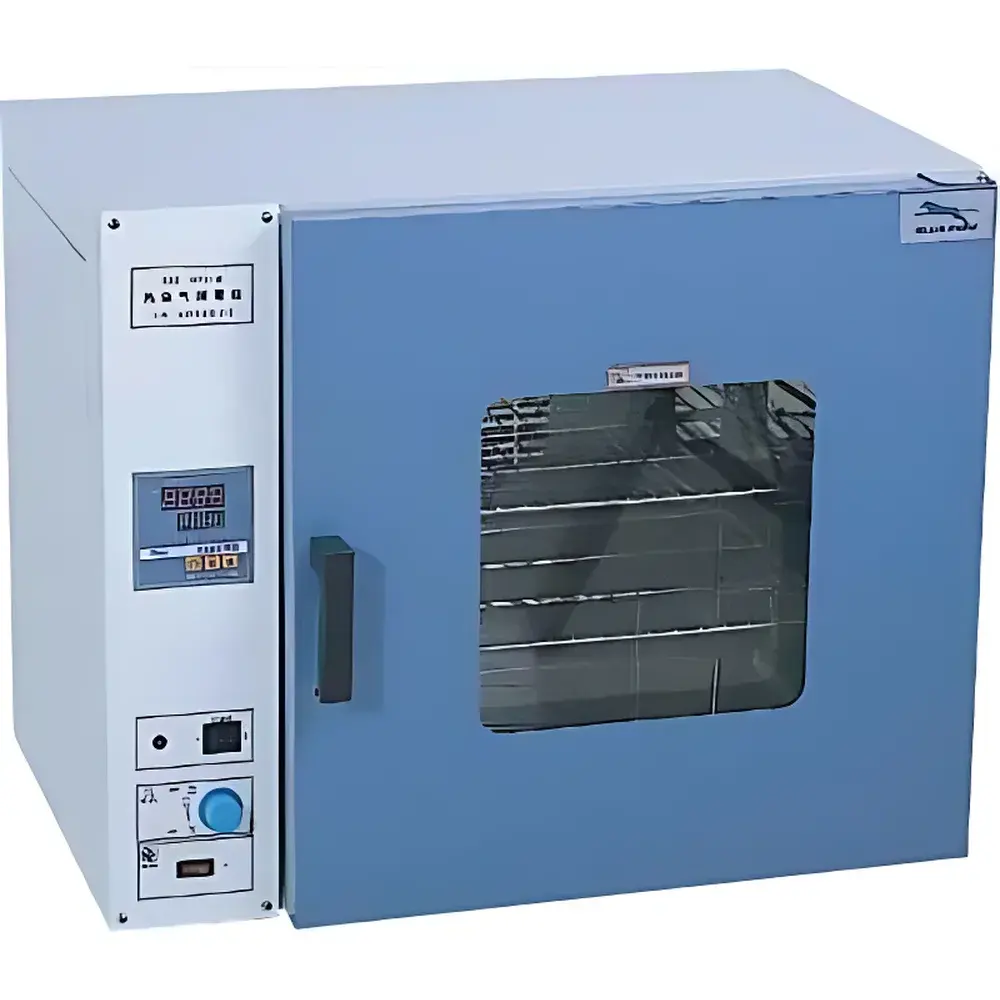
Yiheng GRX Series Hot Air Sterilization Oven
| Brand | Yiheng |
|---|---|
| Origin | Shanghai, China |
| Model Series | GRX |
| Power Input | 600–2450 W |
| Temperature Range | RT+10°C to 200°C or 250°C |
| Temperature Resolution | 0.1°C |
| Temperature Uniformity | ±1°C |
| Chamber Dimensions (W×D×H mm) | 250×260×250 to 600×550×600 |
| Timer Range | 1–9999 min |
| Standard Shelving | 2 adjustable stainless steel shelves |
| Forced Convection | 3-speed programmable fan |
| Safety | Over-temperature cut-off protection |
| Display | LCD microprocessor controller |
Overview
The Yiheng GRX Series Hot Air Sterilization Oven is a precision-engineered dry-heat sterilization system designed for reliable microbial inactivation in research laboratories, pharmaceutical QC facilities, and medical device manufacturing environments. Operating on the principle of dry-heat sterilization—where elevated temperatures induce irreversible oxidative damage to cellular components, protein denaturation, and electrolyte imbalance—the GRX series delivers validated thermal lethality across a controlled temperature range of RT+10°C to 200°C or 250°C. Unlike moist-heat methods, dry heat requires longer exposure times but is uniquely suited for materials incompatible with steam or moisture, including glassware, metal instruments, powders, oils, and anhydrous reagents. Its forced convection architecture ensures rapid, uniform air circulation throughout the chamber, minimizing thermal gradients and enhancing process reproducibility—critical for compliance with ISO 17665-1, EN 554, and USP sterility assurance requirements.
Key Features
- Precision microprocessor-based LCD controller with 0.1°C resolution and ±1°C temperature uniformity across the working chamber.
- Three-speed programmable axial fan enables dynamic airflow optimization—low speed for delicate samples, medium for routine drying, high for accelerated sterilization cycles.
- Robust over-temperature safety cutoff circuit automatically de-energizes heating elements when setpoint deviation exceeds predefined thresholds, protecting both personnel and equipment integrity.
- Double-walled insulated chamber with high-density mineral wool insulation minimizes external surface temperature rise and improves energy efficiency during extended operation.
- Stainless steel interior (SUS304) and reinforced tempered glass door with silicone gasket ensure corrosion resistance, thermal stability, and visual monitoring without compromising seal integrity.
- Programmable timer with 1–9999 minute range supports unattended operation and integration into standardized sterilization protocols—including validation runs requiring dwell time documentation.
Sample Compatibility & Compliance
The GRX series accommodates a broad spectrum of thermally stable laboratory items: borosilicate glassware (vials, pipettes, Petri dishes), stainless steel forceps and scalpels, ceramic crucibles, filter membranes, and non-volatile pharmaceutical excipients. It is explicitly unsuitable for plastics, rubber, solvents, or biological tissues. The oven’s performance aligns with internationally recognized dry-heat sterilization benchmarks: D-value determination at 160°C/120 min or 170°C/60 min per ISO 14937; compatibility with EN 285 Annex C for heat distribution mapping; and support for IQ/OQ/PQ documentation workflows under GMP and GLP frameworks. All units are CE-marked and manufactured in accordance with IEC 61010-1 safety standards for laboratory electrical equipment.
Software & Data Management
While the GRX series operates via embedded firmware without external PC connectivity, its controller supports full audit-trail functionality through non-volatile memory logging of critical parameters—including setpoint, actual chamber temperature, elapsed time, fan speed, and alarm events. Optional RS-485 interface (available on select configurations) enables integration with SCADA systems or centralized lab management platforms for remote monitoring and data archiving compliant with FDA 21 CFR Part 11 requirements (when paired with validated third-party software). Calibration certificates traceable to NIM (National Institute of Metrology, China) are provided upon request, supporting metrological traceability in regulated environments.
Applications
- Sterilization of glass and metal labware prior to aseptic processing in microbiology and cell culture labs.
- Depyrogenation of glass containers used in parenteral drug manufacturing per USP criteria.
- Drying of moisture-sensitive analytical standards, reference materials, and hygroscopic chemicals.
- Heat treatment of filters, gaskets, and packaging components where steam penetration is impractical.
- Validation of dry-heat sterilization cycles using biological indicators (e.g., Geobacillus stearothermophilus spores on aluminum carriers).
- Pre-conditioning of samples prior to gravimetric analysis, ash content determination (AOAC 923.03), or loss-on-drying assays.
FAQ
What is the maximum recommended operating temperature for GRX-series ovens?
The GRX series offers two variants: standard models rated to 200°C and high-temperature models certified for continuous operation up to 250°C. Sustained use above 200°C requires verification of gasket material compatibility and periodic inspection of door seal integrity.
Can the GRX oven be used for depyrogenation of vials in pharmaceutical production?
Yes—provided the cycle is qualified per USP and includes documented heat distribution studies, biological indicator challenges, and load configuration mapping. Depyrogenation typically requires ≥180°C for ≥30 minutes or equivalent Fdry values.
Is the temperature uniformity validated across the entire chamber volume?
Temperature uniformity of ±1°C is specified at the center of the working chamber under static load conditions. For regulatory applications, users must perform in-situ mapping per ISO 14644-3 or EU GMP Annex 15 using calibrated thermocouples placed at defined grid points.
Does the oven support data export for audit purposes?
Standard models retain event logs internally. With optional RS-485 communication and compatible supervisory software, real-time data streaming and CSV export are enabled—facilitating ALCOA+ compliant recordkeeping.
How often should calibration be performed?
Annual calibration against NIST-traceable references is recommended. Additional verification is required after maintenance, relocation, or if out-of-specification results occur during routine temperature mapping.



