
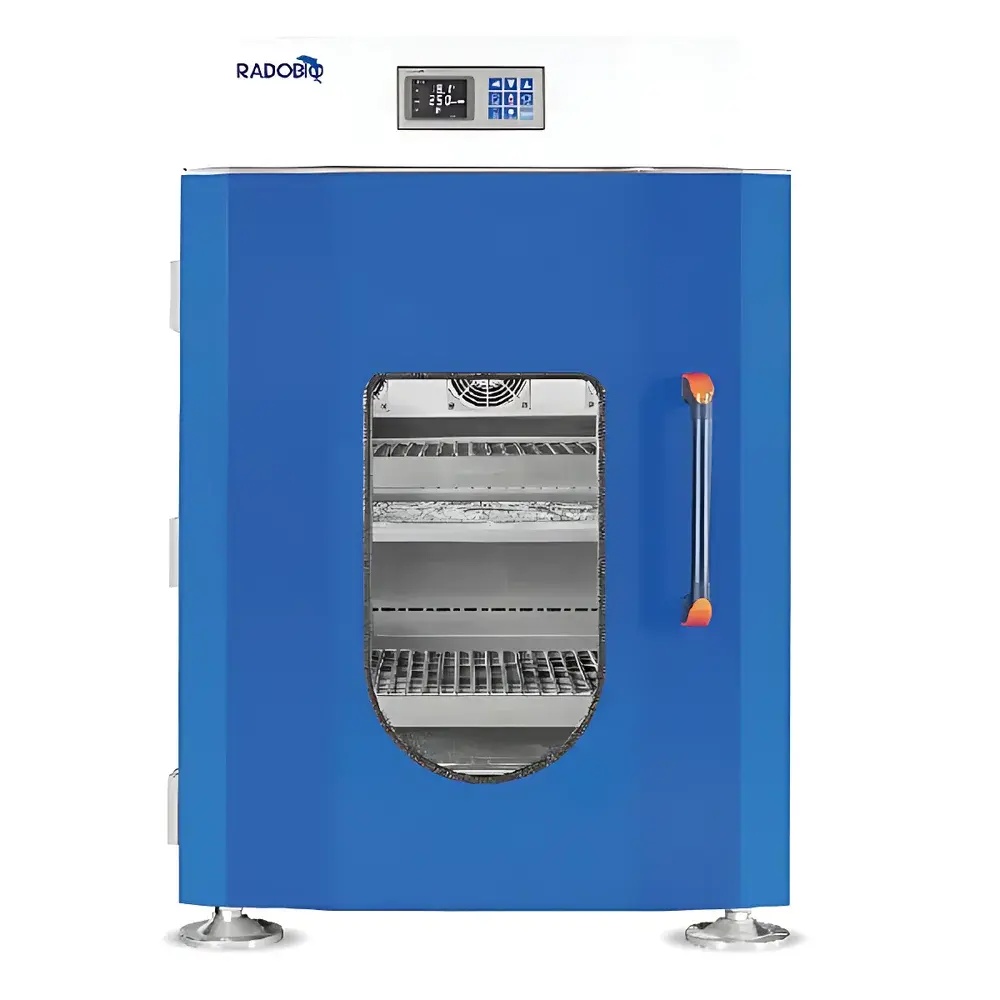
RADOBIO Stab Max Vertical Dual-Layer Full-Temperature Orbital Shaker Incubator
| Brand | RADOBIO |
|---|---|
| Origin | Shanghai, China |
| Model | Stab Max |
| Instrument Type | CO₂-Compatible Full-Temperature Orbital Shaker Incubator |
| Timer Range | 0–999.9 h |
| Oscillation Frequency | 2–300 rpm |
| Amplitude Options | 26 mm or 50 mm (custom amplitudes available) |
| Temperature Range | 4 °C to 60 °C |
| Control Interface | Button-Operated LCD Display |
| Speed Accuracy | ±1 rpm |
| Temperature Setpoint Resolution | 0.1 °C |
| Temperature Uniformity | ±0.5 °C at 37 °C |
| Chamber Volume | 300 L |
| Internal Dimensions (W×D×H) | 638 × 620 × 690 mm |
| External Dimensions (W×D×H) | 710 × 775 × 1080 mm (incl. leveling feet) |
| Max Load Capacity | 35 kg per shelf |
| Power Consumption | 1300 W max |
| Operating Ambient | 5–35 °C |
| Voltage/Frequency | 220–240 V / 50–60 Hz |
| Net Weight | 170 kg |
| Data Logging | 250,000 records (interval: 30 s – 9999 s) |
| Stored Programs | 5 (up to 30 segments each) |
| Illumination | 30 W fluorescent lamp |
| Sterilization | UV-C germicidal lamp (254 nm) |
| Safety Certifications | Compliant with IEC 61010-1 for laboratory equipment |
Overview
The RADOBIO Stab Max Vertical Dual-Layer Full-Temperature Orbital Shaker Incubator is an engineered platform for controlled, scalable microbial, mammalian, and suspension-cell cultivation under precise temperature and agitation conditions. Designed around orbital shaking mechanics—where a circular motion (typically 20–50 mm diameter) induces homogeneous mixing and enhanced gas exchange in liquid cultures—the Stab Max integrates dual independent shelf zones within a single vertical chamber, enabling concurrent or segregated dynamic and static incubation protocols. Its full-temperature range (4 °C to 60 °C), PID-controlled thermal regulation, and CO₂-compatible architecture support applications ranging from low-temperature protein expression to high-yield bioreactor seed train expansion. The unit’s structural integrity, moisture-resistant electronics layout, and externalized drive system ensure operational reliability in humidified or condensing environments typical of long-duration fermentation and cell culture workflows.
Key Features
- Dual-layer modular shelving: Upper and lower shelves operate independently—either both in orbital mode or one oscillating while the other remains static—enabling parallel experiments with differing mechanical stimuli (e.g., shaken E. coli cultures alongside static hybridoma flasks).
- Human-centered vertical design: Optimized height and left-hinged door placement reduce operator bending and improve ergonomics during routine loading/unloading.
- Advanced thermal management: Double-glazed safety glass door with optional anti-fog heating element maintains optical clarity across wide ambient-to-chamber ΔT gradients; internal insulation and heat-dissipating fan design minimize parasitic thermal load.
- UV-C sterilization cycle: Integrated 254 nm germicidal lamp operates during idle periods to suppress airborne and surface-borne contaminants, supporting GLP-aligned environmental control without chemical agents.
- Robust mechanical architecture: All-shelf clamping systems are CNC-machined from solid stainless steel billets—not welded assemblies—eliminating fatigue-induced failure points; polymer-coated clamp arms prevent vial abrasion and operator injury.
- Acoustically optimized drive train: Precision-ground bearings, balanced eccentric mass, and soft-start/soft-stop algorithms ensure vibration isolation even at 300 rpm on dual-loaded shelves, meeting ISO 20483 Class B acoustic limits (<55 dB[A] at 1 m).
- Fail-safe operational logic: Auto-recovery after power interruption preserves setpoints and logs fault events; door-interlocked braking decelerates shelves smoothly upon opening; real-time deviation alerts trigger visual and audible warnings for out-of-spec temperature or speed excursions.
Sample Compatibility & Compliance
The Stab Max accommodates standard laboratory vessels—including Erlenmeyer flasks (25–5000 mL), deep-well plates (96-/384-well), tube racks (15 mL, 50 mL), and custom bioreactor bags—via interchangeable stainless-steel fixtures (spring mesh, fixed clamps, microplate holders). Its IP20-rated enclosure and IEC 61010-1 certification confirm suitability for general laboratory use under normal atmospheric conditions. While not intrinsically rated for CO₂ service, the chamber’s sealed construction and optional gas inlet port (accessory) permit integration into externally regulated CO₂ environments compliant with USP and ISO 13408-1 for cell therapy manufacturing. Temperature uniformity (±0.5 °C at 37 °C) meets ASTM E145-22 Annex A3 requirements for forced-air incubators used in microbiological testing.
Software & Data Management
The button-operated LCD interface supports local parameter entry, real-time monitoring of temperature, speed, elapsed time, and remaining timer duration. All operational data—including setpoints, actual readings, alarms, and door-open events—are timestamped and stored internally (250,000 records). Logging intervals are configurable from 30 seconds to 9999 seconds, enabling granular process documentation aligned with FDA 21 CFR Part 11 principles when paired with optional USB data export (touchscreen upgrade kit). Five programmable protocols—each supporting up to 30 segmented steps—facilitate complex ramp/soak sequences (e.g., cold shock → gradual warming → sustained agitation), critical for recombinant protein folding studies or synchronized algal growth phases.
Applications
- Mammalian cell expansion in serum-free or chemically defined media, where gentle orbital motion (≤120 rpm, 26 mm) enhances nutrient homogeneity without shear damage.
- High-density bacterial fermentation (e.g., Pichia pastoris, Bacillus subtilis) requiring stable 30–37 °C operation with robust thermal recovery after flask insertion.
- Antibiotic susceptibility testing (AST) using broth microdilution, where static upper shelves hold control wells while lower shelves agitate test wells per CLSI M07-A10 guidelines.
- Enzyme kinetics assays involving temperature-sensitive immobilized catalysts, leveraging the unit’s sub-ambient capability (4 °C) and tight thermal stability.
- Bioprocess development for viral vector production, where dual-mode operation allows side-by-side comparison of stirred vs. rocking bioreactor performance under identical environmental conditions.
FAQ
Is the Stab Max certified for use in GMP-regulated environments?
The instrument complies with IEC 61010-1 and includes audit-ready features (event logging, parameter lockout, alarm history), but formal GMP qualification requires site-specific IQ/OQ/PQ execution per user-defined SOPs.
Can the UV lamp be operated while the chamber is in use?
No—UV sterilization is interlocked with door position and active agitation; it only engages during idle periods with the door closed and shelves stationary.
What maintenance is required for long-term reliability?
Annual verification of temperature uniformity and speed calibration is recommended; no lubrication of the drive mechanism is needed due to sealed bearing design.
Does the unit support external CO₂ monitoring or control?
A dedicated CO₂ sensor port and analog output interface are available as factory-installed options, enabling feedback integration with third-party gas controllers.
How is condensation managed during low-temperature operation?
The heated double-glass door option prevents interior fogging; additionally, the chamber’s condensate collection tray (standard) routes moisture to an external drain port for continuous removal.



