
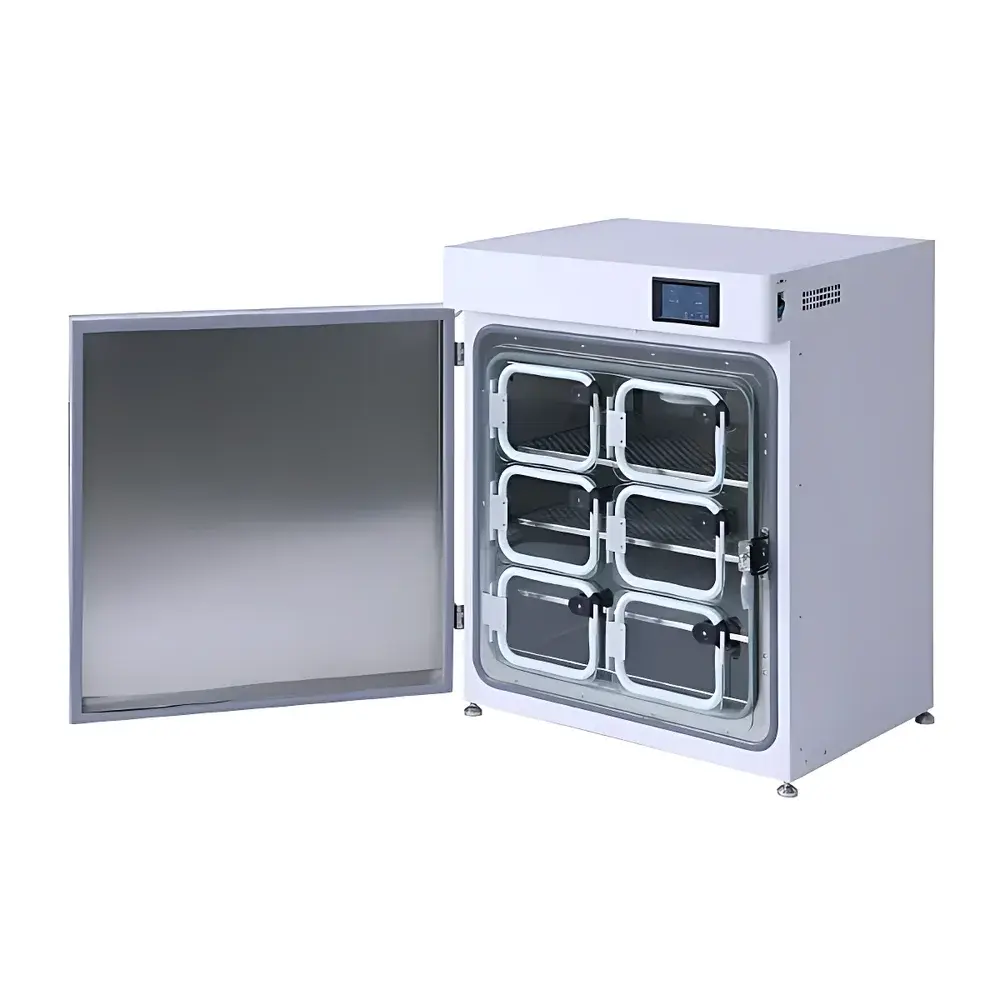
RADOBIO Herocell 240MD Six-Door Infrared CO₂ Incubator with 6-Side Direct Heating and HEPA Filtration
| Brand | RADOBIO |
|---|---|
| Origin | Shanghai, China |
| Model | Herocell 240MD |
| Instrument Type | Air-Jacketed CO₂ Incubator |
| CO₂ Detection | Infrared (IR) Sensor |
| Temperature Control Range & Accuracy | Ambient +4°C to 60°C, ±0.1°C setpoint resolution |
| Temperature Uniformity | ±0.2°C (at 37°C, ambient 25°C, empty chamber) |
| CO₂ Concentration Control Range & Accuracy | 0–20%, ±0.1% setpoint resolution |
| Chamber Capacity | 248 L |
| Internal Dimensions (L×W×H) | 674 × 526 × 675 mm |
| External Dimensions (L×W×H, including base) | 800 × 652 × 1000 mm |
| Heating Method | 6-Side Direct Electric Heating |
| Sterilization | 140°C Dry-Heat Cycle |
| Humidification | Removable 304 Stainless Steel Water Pan (4 L capacity) |
| Air Filtration | Internal HEPA Filter (99.99% @ 0.3 µm), <5 min full chamber air exchange post-door opening |
| Control Interface | 5-inch Capacitive Touch LCD Display with PID Algorithm |
| Data Logging | 250,000 entries, adjustable interval (30 s – 9999 s), USB export, immutable audit trail |
| Power Supply | 220–240 V, 50–60 Hz |
| Weight | 116 kg |
| Door Configuration | Six independent tempered glass inner doors, left-hinged standard (right-hinge optional) |
Overview
The RADOBIO Herocell 240MD is a high-performance, air-jacketed CO₂ incubator engineered for rigorous cell culture applications in academic research laboratories, biopharmaceutical development facilities, and clinical diagnostic settings. It operates on the fundamental principle of maintaining precise, stable physiological conditions—namely temperature (37°C typical), CO₂ concentration (typically 5%), and relative humidity (>95%)—to support optimal mammalian cell proliferation, stem cell expansion, and primary tissue culture. Its 6-side direct heating architecture eliminates thermal gradients by distributing uniform resistive heat across all internal surfaces—floor, ceiling, and four walls—ensuring minimal spatial deviation in temperature distribution. The integrated infrared (IR) CO₂ sensor provides real-time, cross-sensitive compensation for humidity and temperature fluctuations, delivering superior long-term stability compared to thermal conductivity (TC) sensors. This design meets the operational requirements of GLP-compliant workflows and supports adherence to ISO 13485 and FDA 21 CFR Part 11 data integrity standards when paired with validated SOPs.
Key Features
- Six independent tempered glass inner doors minimize environmental perturbation during sample access—reducing average temperature recovery time to ≤5 minutes and CO₂ concentration recovery to ≤5 minutes after a 30-second door opening event.
- 6-side direct electric heating system delivers ±0.2°C temperature uniformity (measured at 37°C, ambient 25°C, empty chamber), verified per ASTM E145-22 Annex A5 methodology for incubator qualification.
- 140°C dry-heat sterilization cycle eliminates bacterial endospores, mycoplasma, fungi, and yeasts from all stainless steel interior surfaces—including corners and seams—without requiring chemical agents or disassembly.
- Internal HEPA filtration (Class H14, EN 1822-1) continuously recirculates and purifies chamber air; full air exchange occurs within 5 minutes post-door closure, significantly reducing airborne particulate and microbial load.
- Removable 304 stainless steel humidification pan (4 L capacity) enables rapid moisture saturation while minimizing condensation formation on upper chamber surfaces—even at 37°C and >95% RH—through optimized airflow dynamics and thermal boundary control.
- Capacitive 5-inch LCD touchscreen interface supports intuitive navigation, real-time parameter visualization (including live trend curves), configurable alarm thresholds (audible/visual), and password-protected user access levels.
Sample Compatibility & Compliance
The Herocell 240MD accommodates standard SBS-format multiwell plates (6–384-well), T-flasks (T25 to T225), Petri dishes, roller bottles, and custom bioreactor inserts. Its polished 304 stainless steel interior—featuring seamless, radius-rounded corners—facilitates complete decontamination and complies with USP requirements for cell therapy equipment surface finish. All materials in contact with the chamber environment are non-leaching and extractables-tested per ISO 10993-12. The incubator’s firmware supports electronic record retention with immutable timestamps and user attribution, satisfying ALCOA+ principles (Attributable, Legible, Contemporaneous, Original, Accurate, Complete, Consistent, Enduring, Available) for regulated environments. Optional IQ/OQ documentation packages are available for GMP-aligned installation and operational qualification.
Software & Data Management
Data logging is performed at user-defined intervals (30 seconds to 9999 seconds), storing up to 250,000 timestamped records internally—including temperature, CO₂, door status, and alarm events. Logged data is exportable via USB 2.0 port in CSV format, retaining original acquisition metadata (e.g., sensor ID, calibration date, firmware version). The system enforces write-once archival behavior: entries cannot be edited or deleted post-acquisition, ensuring forensic traceability. Audit trails capture operator login/logout, parameter changes, sterilization initiation, and alarm acknowledgments—each with ISO 8601 timestamps and hashed user identifiers. Integration with laboratory information management systems (LIMS) is supported via Modbus TCP protocol upon request.
Applications
- Mammalian cell line maintenance (HEK293, CHO, HeLa, iPSCs) under physiologically relevant CO₂ and humidity conditions.
- Stem cell differentiation protocols requiring stringent environmental reproducibility across multi-day timelines.
- Co-culture experiments involving sensitive primary cells where cross-contamination risk must be minimized via compartmentalized access.
- Regulatory-grade bioprocess development, including comparability studies and stability testing per ICH Q5C.
- High-throughput screening (HTS) workflows where frequent plate retrieval necessitates rapid environmental re-stabilization.
- Teaching laboratories requiring robust, low-maintenance platforms compliant with ANSI Z358.1 eyewash and electrical safety standards.
FAQ
What CO₂ supply pressure is recommended for optimal performance?
A regulated inlet pressure of 0.05–0.1 MPa (0.5–1 bar) is required to ensure stable gas flow through the mass-flow controller and avoid pressure-induced fluctuations in CO₂ concentration.
Is the HEPA filter replaceable, and what is its service life?
Yes—the H14-rated HEPA filter is field-replaceable and rated for 12 months of continuous operation under typical lab conditions (ISO Class 7 ambient air); replacement interval should be adjusted based on local particulate load and sterilization frequency.
Does the incubator support remote monitoring or network connectivity?
Standard configuration includes standalone operation only; Ethernet or Wi-Fi modules are available as factory-installed options for integration into centralized facility monitoring systems.
How is temperature uniformity validated during installation qualification?
Uniformity is assessed using a minimum of 9 calibrated PT100 probes placed in a 3×3 grid per ICH Q5A(R2) Annex 2, with acceptance criteria of ±0.2°C deviation from setpoint at steady state.
Can the humidification pan be removed during sterilization cycles?
No—the water pan remains installed during 140°C dry-heat cycles; its 304 stainless steel construction and welded seams are rated for repeated exposure to this temperature without deformation or outgassing.




