
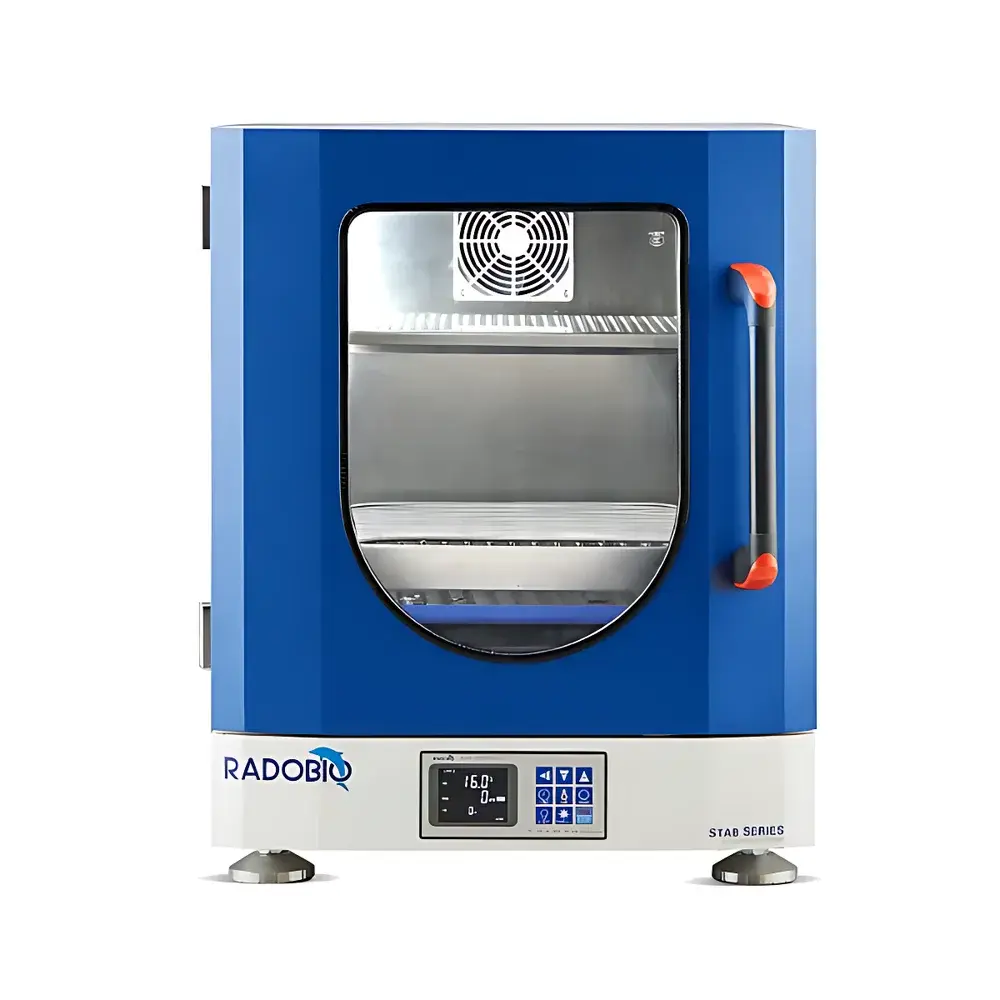
RADOBIO Stab Mini Advanced Temperature-Controlled Orbital Shaker Incubator
| Brand | RADOBIO |
|---|---|
| Origin | Shanghai, China |
| Model | Stab Mini |
| Instrument Type | Stackable Temperature-Controlled Shaker |
| Timer Range | 0–999.9 h |
| Oscillation Amplitude | 25 / 26 / 50 mm (customizable) |
| Temperature Range | 4°C to 60°C |
| Speed Range | 2–300 rpm |
| Speed Accuracy | ±1 rpm |
| Temperature Setting Resolution | 0.1°C |
| Temperature Uniformity | ±0.5°C (empty chamber) |
| Chamber Volume | 110 L |
| Tray Dimensions | 370 × 400 mm |
| Max Load Capacity | 15 kg per shelf |
| Power Consumption | 800 W max |
| Input Voltage | 220–240 V, 50–60 Hz |
| Net Weight | 80 kg |
| External Dimensions (single unit) | 550 × 676 × 700 mm (L×W×H, including base) |
Overview
The RADOBIO Stab Mini Advanced Temperature-Controlled Orbital Shaker Incubator is an engineered solution for precise, scalable, and safe cell culture, microbial growth, and biochemical incubation under controlled agitation and thermal conditions. Designed around orbital shaking mechanics—where platform motion follows a circular path at adjustable speed and amplitude—the system delivers consistent shear stress and oxygen transfer across suspension cultures. Its dual-shelf architecture enables simultaneous dynamic and static cultivation within a single compact footprint: the lower shelf provides regulated orbital oscillation (2–300 rpm), while the upper shelf operates as a stationary incubation zone—ideal for parallel experiments requiring differential mechanical stimulation. The unit integrates PID-based temperature control with active door heating and double-glazed insulated doors to ensure thermal stability (±0.5°C uniformity) across its 110 L chamber, even during prolonged operation at low (4°C) or high (60°C) setpoints. Built for life science laboratories operating under GLP-aligned workflows, the Stab Mini supports reproducible batch cultivation of mammalian cells, bacteria, yeasts, and recombinant expression systems.
Key Features
- Dual-function chamber: Independent lower oscillating tray (26 mm or 50 mm amplitude standard; customizable options available) and upper pull-out static tray—enabling concurrent shaken and non-shaken cultures without cross-interference.
- Space-optimized stackable design: Units can be vertically integrated up to two layers (Stab Mini + Stab Mini-D2); each layer operates autonomously with independent parameter control and real-time monitoring.
- Robust stainless-steel interior: Seamless, radius-cornered 304 stainless steel chamber with IPX4-rated water resistance; all electronics and drive motors mounted externally to prevent moisture ingress and simplify decontamination.
- UV-C germicidal irradiation: Integrated 254 nm UV lamp with programmable off-cycle activation ensures routine sterilization of interior surfaces between runs—compatible with ISO 14644 cleanroom hygiene protocols.
- No-heat waterproof blower system: Maintains uniform air circulation without introducing parasitic thermal load, extending effective ambient temperature range and reducing reliance on compressor-based cooling.
- Fail-safe operational logic: Automatic soft-stop upon door opening; power-loss memory retention with alarm logging; over-temperature/over-speed deviation alerts via audible buzzer and visual LED indicators.
- Ergonomic accessibility: Top-layer working height remains ≤1.0 m when stacked; full-view double-glazed door with anti-fog heating element (optional) ensures uninterrupted visual monitoring during long-term assays.
Sample Compatibility & Compliance
The Stab Mini accommodates standard laboratory vessels—including Erlenmeyer flasks (125–5000 mL), deep-well microplates, test tube racks, and custom bioreactor bags—via interchangeable clamping systems (universal spring mesh, fixed bottle clamps, deep-well plate holders). Its 15 kg per-shelf load capacity and 370 × 400 mm tray surface support high-density configurations compliant with ASTM D4003 for orbital shaker performance validation. All materials in contact with samples meet USP Class VI biocompatibility standards. The device is CE-marked and conforms to IEC 61010-1:2010 for electrical safety in laboratory equipment. Optional USB data export (touchscreen variant) supports audit-ready record keeping aligned with FDA 21 CFR Part 11 requirements for electronic records and signatures.
Software & Data Management
While the base model features an intuitive LCD keypad interface with large-digit display (temperature, speed, timer), the optional touchscreen upgrade adds local data logging (up to 30 days of timestamped parameters), USB 2.0 export capability, and password-protected user profiles. Logged datasets include real-time temperature history, speed deviation traces, door-open events, and alarm triggers—structured in CSV format for direct import into LIMS or statistical analysis platforms (e.g., JMP, GraphPad Prism). Firmware supports remote calibration verification and firmware update via secure USB handshake, ensuring long-term metrological traceability. No cloud connectivity is implemented, preserving data sovereignty in regulated environments.
Applications
- Mammalian cell expansion in serum-free or chemically defined media under low-shear orbital agitation.
- High-yield bacterial fermentation (E. coli, Pseudomonas) with precise DO modulation via speed–temperature coupling.
- Yeast and filamentous fungal cultivation where mycelial dispersion correlates with amplitude selection.
- Antibiotic susceptibility testing (AST) using broth microdilution in shaken vs. static parallel arms.
- Enzyme kinetics studies requiring synchronized agitation and thermal ramping (e.g., thermostable polymerase characterization).
- Bioprocess development at lab scale, serving as a bridge between shake-flask screening and benchtop bioreactors.
FAQ
Can the Stab Mini operate continuously for extended periods (e.g., 7+ days)?
Yes—its sealed motor housing, thermally isolated electronics, and maintenance-free bearing system are rated for unattended operation up to 999.9 hours. Chamber humidity management is optimized for condensation control, even at 4°C setpoints.
Is UV sterilization validated against specific microbial strains?
The 254 nm UV-C source achieves ≥3-log reduction of Bacillus atrophaeus spores (ATCC 9372) and Aspergillus niger (ATCC 16404) under standardized exposure cycles (IEC 62471 photobiological safety classification). Validation reports available upon request.
How does the dual-shelf configuration affect temperature uniformity?
Independent airflow channels and PID-tuned heaters per shelf maintain ±0.5°C uniformity in both zones simultaneously. Thermal crosstalk is mitigated by physical separation and staggered fan duty cycles.
What safety certifications apply to the stacked configuration?
Each unit retains full IEC 61010-1 compliance when stacked. Structural integrity is verified per EN 1021-1 for furniture stability; no additional anchoring is required below 1350 mm total height.
Are custom amplitude options supported beyond 26/50 mm?
Yes—amplitude can be factory-configured from 15 mm to 75 mm in 5 mm increments, subject to mechanical resonance analysis and load-dependent speed derating per ISO 10816 vibration severity guidelines.




