
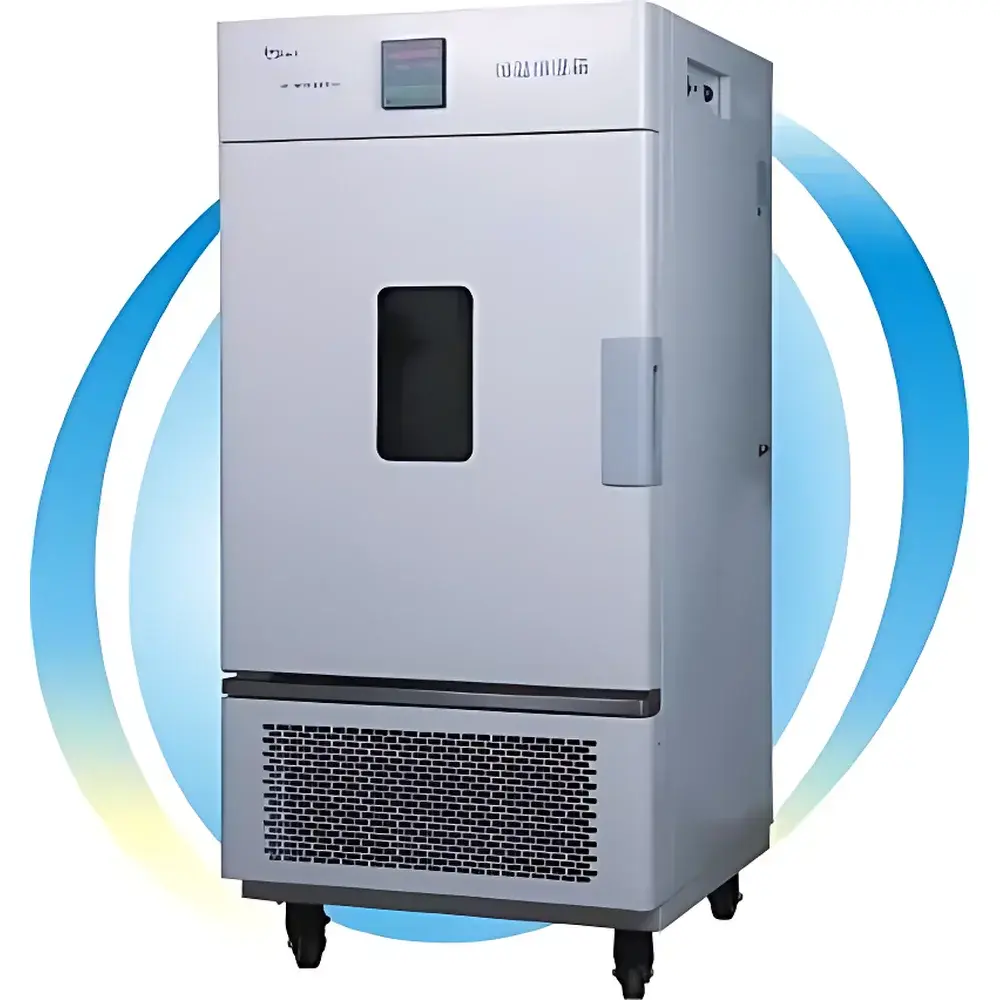
YIHENG LHS Series Temperature and Humidity Controlled Chamber with Balanced Control System
| Brand | YIHENG |
|---|---|
| Model | LHS Series |
| Temperature Range | RT+10–85°C (LHS-50CH/100CH), –10–85°C (LHS-50CL/100CL), –20–85°C (LHS-100CA), –40–85°C (LHS-100CB) |
| Humidity Range | 45–95% RH (standard models), 80–95% RH (high-humidity variants) |
| Temperature Resolution | 0.1°C |
| Temperature Uniformity | ±1.0°C (±0.5°C at high temp, ±1.0°C at low temp) |
| Humidity Accuracy | ±3% RH |
| Power Input | 1650–2000 W |
| Internal Chamber Dimensions (W×D×H) | 500×400×550 mm |
| External Dimensions (W×D×H) | 650×800×1310 mm |
| Standard Shelves | 3 adjustable stainless steel shelves |
| Port | 25 mm diameter access port on left side |
| Compliance | Designed for ISO 17025-aligned environmental validation |
| Software Interface | Optional external chart recorder compatible |
Overview
The YIHENG LHS Series Temperature and Humidity Controlled Chamber with Balanced Control System is an engineered environmental test chamber designed for precise, stable, and reproducible simulation of temperature and humidity conditions in laboratory and industrial quality assurance settings. Utilizing a dual-loop balanced control architecture—separately regulating refrigeration, heating, and humidification subsystems—the chamber achieves high-fidelity environmental replication without overshoot or prolonged recovery times. This architecture ensures minimal thermal inertia and dynamic coupling between temperature and humidity actuation, critical for stability testing per ICH Q1A(R2), USP , and ASTM E145-22 standards. The chamber operates across a broad thermal envelope—from ambient +10°C up to 85°C in standard configurations, down to –40°C in ultra-low-temperature variants—and maintains relative humidity from 45% to 95% RH with ±3% RH accuracy under steady-state conditions. Its mirror-polished stainless-steel interior (AISI 304), radius-corner construction, and removable, height-adjustable shelving support contamination control and cleaning validation requirements common in pharmaceutical stability studies and textile aging protocols.
Key Features
- Balanced dual-loop control system integrating independent PID algorithms for temperature and humidity regulation, minimizing cross-talk and improving setpoint recovery time
- Mirror-finish AISI 304 stainless-steel inner chamber with seamless, radius-corner welds and autoclavable-grade surface finish for ISO Class 5–8 cleanroom compatibility
- Microprocessor-based controller with real-time digital display, programmable ramp-soak profiles, and password-protected parameter lockout
- Dedicated over-temperature safety cutoff circuit—mechanically isolated from the main controller—with independent sensor and relay output for fail-safe interruption
- 25 mm diameter pass-through port on left chamber wall, sealed with silicone gasket and threaded cap, enabling external probe insertion or inline sensor integration without compromising chamber integrity
- Imported key components including Danfoss compressors (for low-temp models), Honeywell humidity sensors, and Omron solid-state relays for long-term operational reliability
- Zero-ozone-depletion-potential (zero-ODP) refrigerant (R134a or R404A depending on model), compliant with EU F-Gas Regulation (EU) No 517/2014 and China’s HCFC Phase-out Management Plan
Sample Compatibility & Compliance
The LHS series accommodates diverse sample geometries and material classes—including sealed vials, blister packs, woven fabric swatches, polymer films, and electronic assemblies—within its 500 × 400 × 550 mm working volume. Adjustable shelf spacing (up to 5 positions) allows vertical configuration optimization for airflow uniformity and thermal mass distribution. All models meet mechanical and electrical safety requirements per IEC 61010-1:2010 and GB 4793.1–2007. When equipped with an optional certified chart recorder (e.g., Sartorius T-Log or Omega OM-DAQPRO), the system supports 21 CFR Part 11-compliant audit trails, including user ID logging, timestamped setpoint changes, and alarm event capture—enabling full traceability in FDA-regulated stability programs. Humidity calibration is traceable to NIM (National Institute of Metrology, China) standards; temperature calibration follows ISO/IEC 17025 procedures using accredited dry-block calibrators.
Software & Data Management
The LHS chamber does not include embedded software or network connectivity. It relies on analog/digital I/O interfaces compatible with third-party data acquisition systems (e.g., LabVIEW, WinCC, or custom SCADA platforms) via 4–20 mA or 0–10 V output signals for temperature and humidity. Optional analog chart recorders provide continuous strip-chart documentation with manual calibration verification points. For digital archiving, users may integrate external USB or RS-485 loggers (e.g., Onset HOBO UX100 series) connected through the left-side port. All recorded data files are generated in CSV or PDF format, supporting metadata tagging for batch, operator, and protocol identification—essential for GLP audits and regulatory submissions.
Applications
- Pharmaceutical stability testing per ICH Q1A–Q1E guidelines, including long-term (25°C/60% RH), accelerated (40°C/75% RH), and intermediate condition studies
- Textile performance evaluation: colorfastness, shrinkage, and tensile strength degradation under cyclic humidity exposure (AATCC TM100, ISO 139)
- Food packaging barrier property validation: moisture vapor transmission rate (MVTR) preconditioning per ASTM F1249
- Electronics component reliability screening: solder joint fatigue assessment under thermal-hygric stress (JEDEC JESD22-A101)
- Biological reagent storage qualification and cold-chain deviation simulation
- Adhesive and coating curing behavior analysis under controlled RH gradients
FAQ
Does the LHS chamber support automated data export to LIMS or ELN systems?
No native integration is provided; however, analog outputs (4–20 mA) or optional RS-485 modules enable connection to external DAQ hardware compatible with LIMS/ELN ingestion workflows.
What is the recalibration interval recommendation for temperature and humidity sensors?
Per ISO/IEC 17025 guidance, annual recalibration is recommended; humidity sensors require quarterly verification using saturated salt solutions (e.g., NaCl, KNO₃) per ISO 4882-2.
Can the LHS-100CB model operate continuously at –40°C with 95% RH?
No. At sub-zero temperatures, condensation control limits practical humidity range to ≤70% RH below 0°C; operation at –40°C is strictly dry-cold mode per design specification.
Is the chamber suitable for sterile applications requiring ISO 14644-1 Class 5 certification?
The chamber itself is not a cleanroom but may be installed within one. Its smooth interior and absence of particle-shedding materials support Class 5 environments when coupled with HEPA-filtered air supply and validated sanitization protocols.
What documentation is supplied for regulatory submissions?
Factory calibration certificates (traceable to national standards), IQ/OQ protocol templates, and electrical safety test reports are provided upon request. Full validation support packages (including PQ execution) are available as a professional service.
Related Products



