
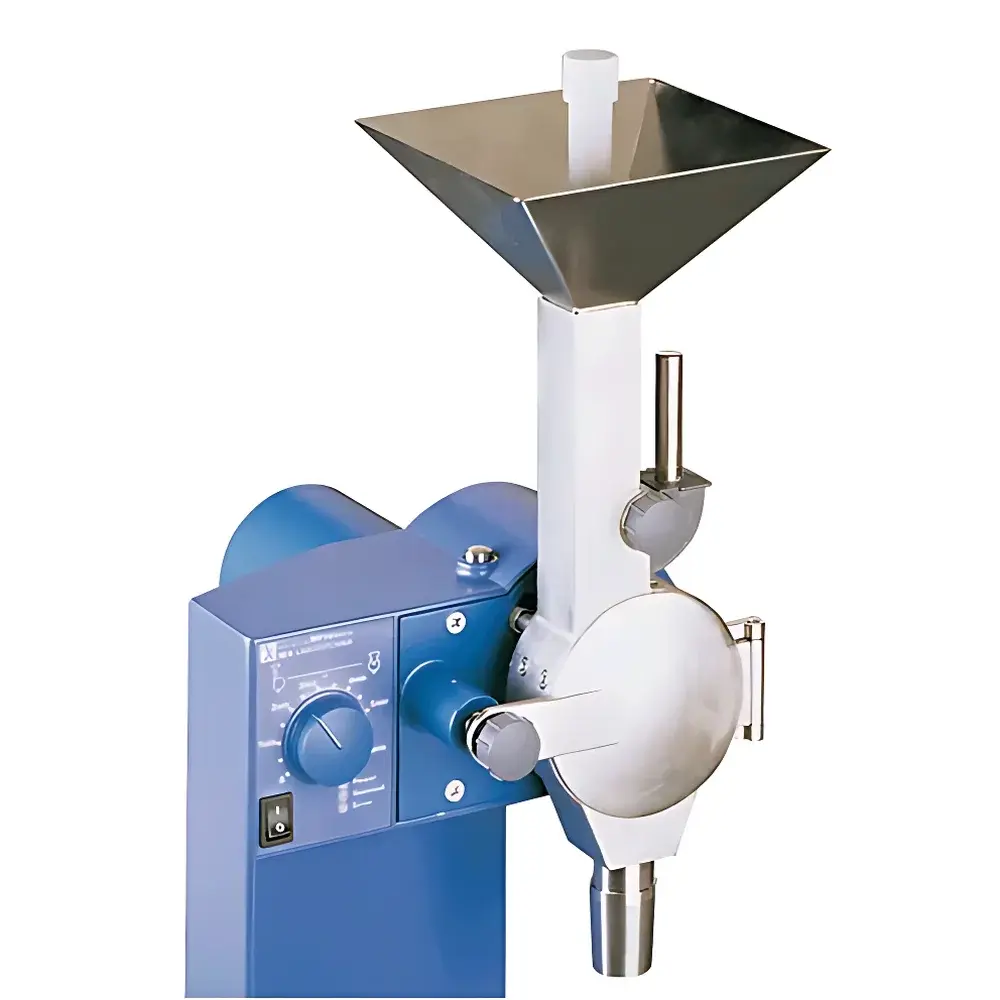
IKA MF10.1 Basic Grinder with Shear Cutting Head
| Brand | IKA |
|---|---|
| Origin | Germany |
| Model | MF10.1 Basic |
| Operating Principle | Inline Shear Grinding |
| Max. Peripheral Speed | 22.5 m/s |
| Max. Feed Particle Size | 15 mm |
| Grinding Chamber Material | Stainless Steel 1.4308 (AISI 304 equivalent) |
| Dry-Ice Cooling Capability | Yes |
| Liquid Nitrogen Cooling | No |
| Dimensions (W × H × D) | 320 × 560 × 300 mm |
| Weight | 2.2 kg |
| Collection Vessel | Standard NS 29 Thread Interface |
| Sieve Compatibility | Interchangeable Sieves (Not Included) |
Overview
The IKA MF10.1 Basic Grinder is a compact, inline shear-type laboratory grinder engineered for reproducible size reduction of soft to moderately tough organic and polymeric materials. Its operating principle relies on high-speed rotor-stator shear forces generated by a precision-machined cutting head rotating at controlled speeds—delivering consistent particle size distribution without thermal degradation when operated under appropriate cooling conditions. Designed for benchtop use in analytical laboratories, quality control environments, and R&D settings, the MF10.1 supports sample preparation workflows requiring rapid, small-batch comminution prior to downstream analysis (e.g., elemental analysis, moisture determination, or spectroscopic characterization). The device operates without integrated water cooling but permits dry-ice-assisted temperature control within the grinding chamber—a critical feature for thermolabile biological matrices such as leaf tissue, fibrous plant matter, or certain polymers.
Key Features
- Inline shear grinding architecture optimized for fibrous and low-density materials including paper, fresh vegetables, cellulose-based substrates, and rigid plastics up to Shore A 90 hardness.
- Stainless steel 1.4308 (equivalent to ASTM A351 CF8 / AISI 304) grinding chamber ensures corrosion resistance, cleanability, and compliance with general laboratory hygiene standards.
- Interchangeable sieve inserts (sold separately) enable customization of final particle size; standard sieve mesh options range from 0.2 mm to 2.0 mm nominal aperture, supporting method-specific granularity requirements.
- NS 29 standardized thread interface allows direct coupling with common laboratory collection vessels—including glass, polypropylene, or stainless-steel containers—ensuring compatibility with existing labware inventories.
- Compact footprint (320 × 560 × 300 mm) and lightweight design (2.2 kg) facilitate integration into fume hoods, glove boxes, or mobile analytical stations without structural reinforcement.
- Dry-ice cooling capability enables sub-ambient operation for heat-sensitive samples; chamber temperature monitoring is recommended via external IR thermometer or thermocouple probe during cryogenic use.
Sample Compatibility & Compliance
The MF10.1 demonstrates reliable performance across a defined material spectrum: non-metallic, non-abrasive, and non-fiberglass-reinforced substances with bulk densities below 1.2 g/cm³ and tensile strength under 35 MPa. It is routinely employed for homogenizing botanical tissues, food-grade packaging materials, pharmaceutical excipients, and recyclable polymer flakes. While not certified for explosion-proof or ATEX environments, its construction meets general-purpose electrical safety requirements per IEC 61010-1:2010. The absence of liquid nitrogen compatibility precludes ultra-low-temperature applications (< −70 °C), and users must verify material compatibility with stainless steel 1.4308 prior to processing halogenated or strongly acidic feedstocks.
Software & Data Management
The MF10.1 Basic operates as a manually controlled standalone unit without embedded microprocessor logic or digital interface. Speed regulation is achieved via mechanical dial adjustment; no firmware, USB connectivity, or data logging functionality is provided. Consequently, it does not support FDA 21 CFR Part 11 electronic record compliance, audit trails, or GLP/GMP traceability features. For regulated environments requiring documentation, users are advised to integrate external timers, calibrated tachometers, and procedural SOPs specifying fixed run durations, ambient temperature thresholds, and post-grinding visual inspection criteria.
Applications
- Preparation of homogeneous reference samples for FTIR, XRF, and combustion-based elemental analysis (e.g., Cl, S, N determination in biomass).
- Routine size reduction of QC test specimens for mechanical property evaluation—particularly where fiber alignment or thermal history must be preserved.
- Standardized comminution of food safety test portions (e.g., ISO 6497:2002-compliant subsampling of cereal grains or dried herbs).
- Processing of biodegradable polymer blends prior to melt flow index testing or differential scanning calorimetry (DSC).
- Supporting environmental labs in preparing heterogeneous waste fractions (e.g., mixed paper-plastic composites) for leaching assays per EN 12457 series protocols.
FAQ
Is the MF10.1 suitable for grinding metal-containing samples?
No—metal particles may damage the shear cutting head and compromise dimensional accuracy of the grinding gap. Only non-metallic, non-abrasive feedstock is recommended.
Are sieve inserts included with the base unit?
No—sieves are optional accessories ordered separately. Available nominal apertures include 0.2, 0.5, 1.0, and 2.0 mm.
Can the unit be operated continuously for extended periods?
Continuous operation beyond 90 seconds per batch is discouraged without intermediate cooling pauses to prevent motor overheating and thermal expansion-induced clearance changes.
What maintenance is required between uses?
Rinse the grinding chamber and cutting head with deionized water or ethanol; air-dry thoroughly. Inspect the shear edge for burrs or deformation before each use; replace cutting head if visible wear exceeds 0.1 mm radial deviation.
Does IKA provide validation documentation for GMP environments?
The MF10.1 Basic is not supplied with IQ/OQ documentation or calibration certificates. Users must perform in-house operational qualification aligned with internal SOPs and ISO/IEC 17025 requirements.



