
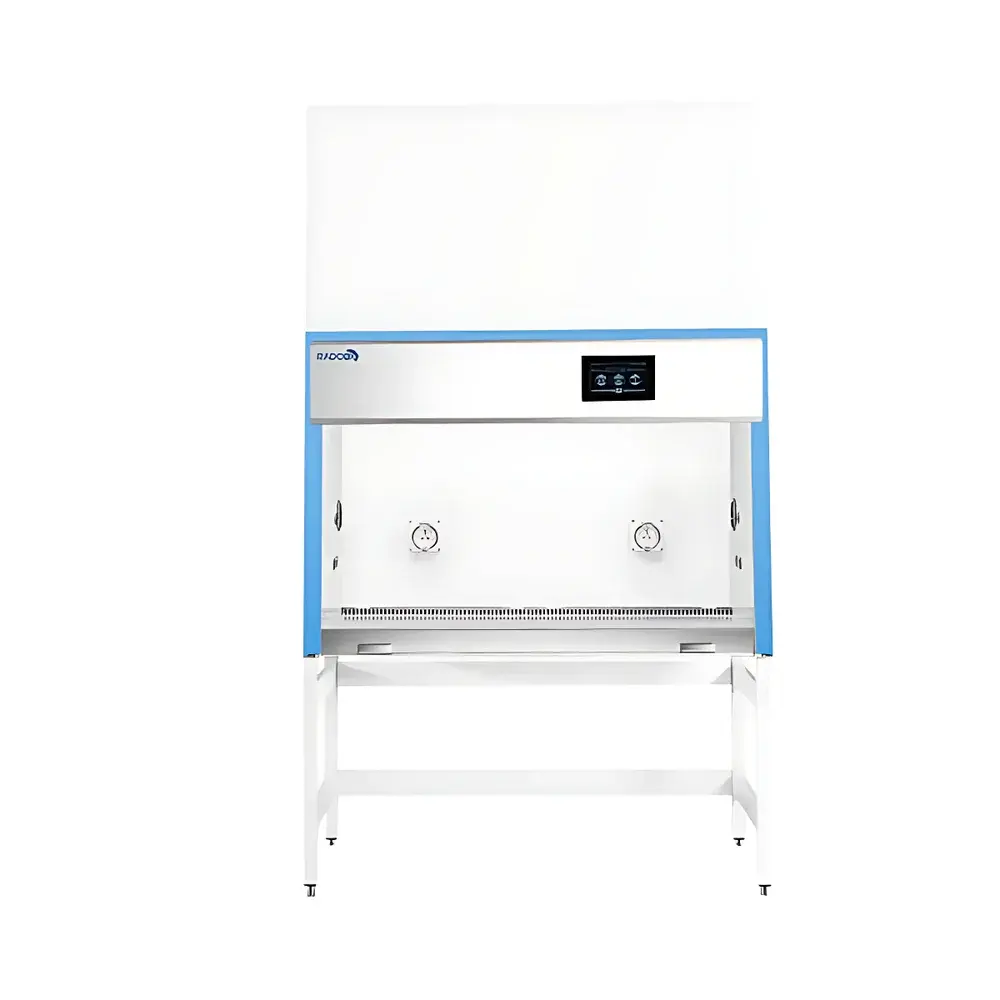
RADOBIO AirSafe 1300A2 Class II Type A2 Biological Safety Cabinet
| Brand | RADOBIO |
|---|---|
| Model | AirSafe 1300A2 |
| Safety Class | Class II, Type A2 |
| External Dimensions (L×W×H) | 1300 × 810 × 2290 mm |
| Internal Dimensions (L×W×H) | 1180 × 580 × 798 mm |
| ULPA Filter Efficiency | ≥99.9995% @ 0.3 µm |
| Downflow Velocity | 0.35 m/s |
| Inflow Velocity | 0.55 m/s |
| Noise Level | <65 dB(A) |
| Vibration at Work Surface Center | ≤5 µm |
| Lighting Illuminance | ≥900 lx |
| UV Lamp | 30 W × 1 |
| Fluorescent Lamp | 18 W × 1 |
| Power Supply | AC 220 V, 1φ, 50 Hz |
| Rated Power (excl. outlet) | 0.33 kW |
| Max. Power (incl. outlet) | 1.65 kW |
| Net Weight | 268 kg |
| Compliance | YY 0569–2011, GB 4793.1, GB/T 18268.1 |
| Air Cleanliness Class | ISO 4 (equivalent to Federal Standard 209E Class 10) |
Overview
The RADOBIO AirSafe 1300A2 is a certified Class II, Type A2 Biological Safety Cabinet engineered for containment of low- to moderate-risk biological agents (BSL-1, BSL-2, and selected BSL-3 applications with appropriate risk assessment). It operates on the principle of inward airflow (inflow) for personnel protection, downward laminar airflow (downflow) for product protection, and recirculation of ~70% of filtered air within the work area—while exhausting ~30% via dedicated ducting or thimble connection to an external exhaust system. This dual-airflow architecture ensures simultaneous protection of operator, sample integrity, and environmental safety in molecular biology, cell culture, microbiology, and pharmaceutical quality control laboratories. Designed and validated per YY 0569–2011—the Chinese national standard aligned with NSF/ANSI 49 and EN 12469—the AirSafe 1300A2 meets ISO 4 (Class 10) cleanroom performance requirements in its work area and incorporates redundant safety mechanisms including real-time airflow monitoring, automatic sash interlock, and fail-safe power recovery.
Key Features
- 7-inch capacitive touchscreen HMI with integrated operational dashboard: displays real-time sash position, fan runtime, ULPA filter remaining life (%), UV lamp status, lighting state, and alarm history—without interface switching.
- Brushless DC constant-volume blower system: delivers stable inflow (0.55 m/s) and downflow (0.35 m/s) velocities across filter loading; reduces energy consumption by up to 60% versus conventional AC motor systems and emits 60% less heat; includes ultra-low-power standby mode (10% nominal power).
- ULPA-grade filtration: dual ULPA filters (supply and exhaust) with ≥99.9995% efficiency at 0.3 µm particle size, low-pressure-drop pleated media, high mechanical strength, and low-boron content to minimize background interference in sensitive assays.
- Leak-proof filter housing technology: proprietary gasketing and structural sealing prevent bypass leakage, ensuring sustained ISO 4 air cleanliness and compliance with containment validation protocols.
- Intelligent sash management: automatic transition to low-speed containment mode upon sash closure; immediate return to full operational state upon reopening—eliminating manual restart and preserving sterile conditions during workflow interruptions.
- Power-fail memory function: restores pre-interruption operating parameters—including sash height, fan speed, lighting, and UV status—upon grid recovery, maintaining audit-trail continuity and personnel safety.
- Ergonomic workstation design: one-piece 304 stainless steel work surface; optimized sash height and tilt angle; integrated handrests; wide working depth (580 mm); front-accessible cleaning position for simplified maintenance.
Sample Compatibility & Compliance
The AirSafe 1300A2 supports routine handling of liquid cultures, tissue samples, primary cells, recombinant nucleic acids, and low-concentration viral vectors under BSL-2 conditions. Its ISO 4-certified work environment ensures compatibility with aseptic techniques required for stem cell expansion, monoclonal antibody production, and diagnostic assay development. Performance validation includes microbial challenge testing per YY 0569: personnel protection ≤10 CFU/plate (impactor) and ≤5 CFU/plate (slit sampler); product protection ≤5 CFU/plate; cross-contamination ≤2 CFU/plate. Structural compliance covers electrical safety (GB 4793.1), EMC (GB/T 18268.1), and biosafety engineering (YY 0569–2011). While not intrinsically compliant with FDA 21 CFR Part 11, its event-log functionality and parameter traceability support GLP/GMP-aligned documentation practices when integrated into validated lab informatics ecosystems.
Software & Data Management
The embedded microcontroller logs all critical events—including sash movement timestamps, filter differential pressure trends, UV exposure duration, alarm triggers (e.g., airflow deviation >±10%, sash out-of-range), and power cycle history. Logs are stored internally for ≥12 months and exportable via USB to CSV format for integration with LIMS or electronic lab notebooks. No cloud connectivity or remote access is implemented, preserving data sovereignty and aligning with institutional IT security policies. Audit trail entries include operator ID (if configured via external authentication), timestamp (ISO 8601), and action type—supporting retrospective review for regulatory inspections under ISO/IEC 17025 or CAP accreditation frameworks.
Applications
- Aseptic preparation of mammalian cell culture media and reagents
- Handling of clinical specimens for PCR-based pathogen detection
- Transfection and lentiviral vector manipulation under BSL-2+ containment
- Quality control testing of sterile pharmaceutical intermediates
- Preparation of CRISPR-Cas9 ribonucleoprotein complexes
- Mycobacterial culture (with supplemental engineering controls)
- Environmental monitoring swab processing in cleanroom gowning rooms
FAQ
What certification standards does the AirSafe 1300A2 meet?
It is tested and verified per YY 0569–2011, which references NSF/ANSI 49 and EN 12469 requirements for Class II Type A2 cabinets. Electrical and EMC compliance follows GB 4793.1 and GB/T 18268.1.
Can this cabinet operate without external ducting?
Yes—when used with a dedicated thimble connection and canopy, it functions in recirculating mode. However, for volatile chemicals or radionuclides, hard-ducted exhaust is mandatory per YY 0569 and institutional biosafety office directives.
How often must the ULPA filters be replaced?
Filter service life depends on ambient particulate load and usage intensity. The HMI displays real-time filter degradation percentage; replacement is recommended when remaining life falls below 10%, typically every 3–5 years under standard lab conditions.
Is the UV lamp germicidal output validated?
UV irradiance at the work surface is calibrated to deliver ≥400 µW/cm² at 1 meter, meeting ISO 15714 for surface decontamination efficacy against common laboratory microbes (e.g., Bacillus subtilis spores) after 15 minutes exposure.
Does the cabinet support integration with building management systems (BMS)?
No native BACnet or Modbus interface is provided. Analog 4–20 mA outputs for airflow and filter pressure are available upon request for third-party SCADA integration.
Related Products



