
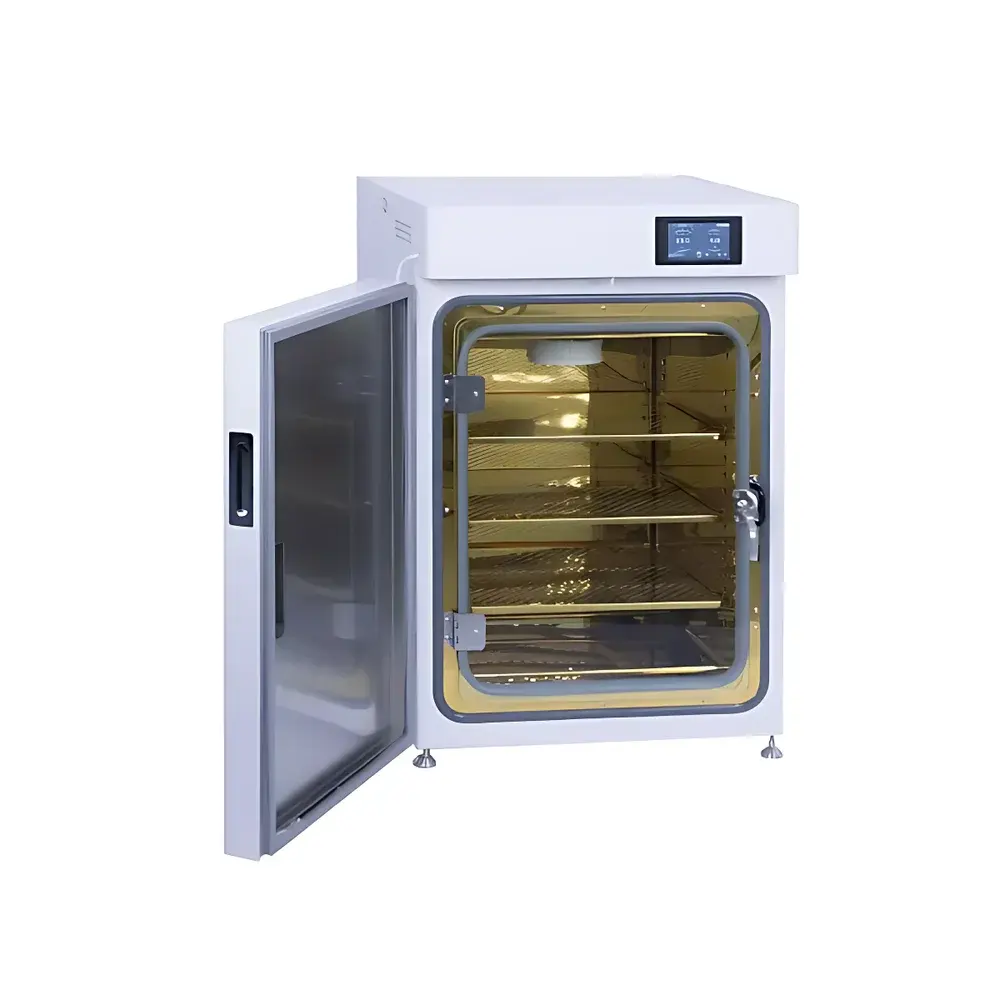
RADOBIO Herocell 180CC Copper-Lined CO₂ Incubator
| Brand | RADOBIO |
|---|---|
| Origin | Shanghai, China |
| Model | Herocell 180CC |
| Instrument Type | Air-Jacketed CO₂ Incubator |
| CO₂ Detection | Infrared (IR) Sensor |
| Temperature Control Range & Accuracy | Ambient +4°C to 60°C, ±0.1°C setpoint resolution |
| Temperature Uniformity | ±0.2°C (at 37°C, empty chamber, ambient 25°C) |
| CO₂ Concentration Control Range & Accuracy | 0–20%, ±0.1% setpoint resolution |
| Chamber Capacity | 185 L |
| Internal Dimensions (L×W×H) | 535 × 526 × 675 mm |
| External Dimensions (L×W×H, including base) | 660 × 652 × 1000 mm |
| Key Configuration | PID temperature control, 6-face direct-heating air jacket, 140°C dry-heat sterilization, HEPA filtration, copper-coated 304 stainless steel interior |
Overview
The RADOBIO Herocell 180CC Copper-Lined CO₂ Incubator is an air-jacketed, microprocessor-controlled incubation system engineered for precision cell culture applications in academic, clinical, and pharmaceutical laboratories. It operates on the principle of stable thermal regulation via six-face direct heating—distributing uniform heat across all internal chamber surfaces—to maintain tight thermal homogeneity essential for sensitive mammalian cell lines, stem cells, and primary cultures. The incubator integrates infrared (IR) CO₂ sensing technology, which provides long-term stability and immunity to cross-sensitivity from humidity or temperature fluctuations—critical during frequent door openings or multi-user environments. Its copper-coated 304 stainless steel chamber leverages the intrinsic antimicrobial properties of elemental copper (per ISO 22196 and ASTM E2149), reducing viable microbial load on contact surfaces without chemical intervention. This design supports GLP-compliant workflows where bioburden control is integral to experimental reproducibility.
Key Features
- Six-face air-jacketed heating architecture delivering ±0.2°C temperature uniformity at 37°C (empty, ambient 25°C), validated per ISO 13408-1 Annex C protocols.
- Copper-coated 304 stainless steel interior with seamless, radius-cornered construction—facilitating mechanical cleaning and minimizing microbial harborage zones.
- 140°C dry-heat sterilization cycle (programmable, time-limited) validated for ≥6-log reduction of bacteria, yeasts, molds, and mycoplasma per EN 14885 and ISO 15883-1 standards.
- Integrated Class II HEPA filtration system (≥99.99% @ 0.3 µm) recirculating chamber air continuously; achieves full air exchange and particle clearance within 5 minutes post-door opening.
- Infrared (IR) CO₂ sensor with automatic baseline correction—immune to drift caused by condensation, pressure variation, or frequent access—ensuring ≤±0.1% CO₂ setpoint accuracy over extended operation.
- Passive humidity maintenance via removable 4 L stainless steel water pan; optimized airflow dynamics prevent cold-spot condensation above samples while sustaining >95% RH at 37°C.
- Capacitive 5-inch LCD touchscreen interface with real-time trend visualization, configurable data logging (30 s–9999 s intervals), and tamper-resistant USB export of up to 250,000 timestamped records.
Sample Compatibility & Compliance
The Herocell 180CC accommodates standard T-flasks (up to 175 cm²), multi-well plates (6–96-well), Petri dishes, roller bottles, and custom culture vessels without airflow obstruction. Its copper-lined chamber complies with ISO 13408-1 (aseptic processing), ISO 5 (cleanroom classification for internal airflow), and USP (cell therapy environmental controls). The system supports FDA 21 CFR Part 11 compliance when paired with RADOBIO’s optional audit-trail-enabled software package (not bundled), enabling electronic signatures, user-level access control, and immutable data archiving. All thermal and gas performance specifications are verified under controlled laboratory conditions per IEC 61010-1 and EN 61326-1 for safety and electromagnetic compatibility.
Software & Data Management
The embedded firmware supports local data acquisition at user-defined intervals (30 seconds to 2.7 hours), storing temperature, CO₂ concentration, and door-open events with millisecond-level timestamps. Historical curves—including deviation alerts and recovery kinetics—are viewable directly on the touch interface. Raw logs export as CSV files via USB-A port; no proprietary software is required for data parsing. Optional cloud connectivity (via RADOBIO’s RadNet™ gateway, sold separately) enables remote monitoring, SMS/email alerting on parameter excursions, and integration into LIMS or ELN platforms through RESTful API endpoints. All stored data conforms to ALCOA+ principles (Attributable, Legible, Contemporaneous, Original, Accurate, Complete, Consistent, Enduring, Available) for regulatory submissions.
Applications
This incubator is routinely deployed in applications requiring stringent environmental fidelity: human induced pluripotent stem cell (iPSC) expansion, CAR-T cell manufacturing under cGMP-aligned conditions, organoid development, primary neuronal culture, and co-culture systems involving stromal and epithelial lineages. Its rapid thermal and gas recovery (<5 min after 30-second door opening at 37°C/5% CO₂) minimizes transient stress on pH-sensitive cultures. The copper surface chemistry also makes it suitable for low-bioburden workflows in biosafety level 2 (BSL-2) containment labs handling fastidious pathogens or antibiotic-resistant isolates where surface decontamination frequency must be reduced.
FAQ
What validation documentation is provided with the Herocell 180CC?
Factory-installed IQ/OQ documentation (in English) is included, covering temperature mapping (9-point grid), CO₂ linearity verification (0–20%), and HEPA filter integrity testing. PQ protocols are customizable per client SOP.
Is the copper coating compliant with FDA or EU food-contact regulations?
While not intended for food contact, the electroless copper plating meets ISO 22196:2011 and JIS Z 2801:2010 antimicrobial efficacy standards and contains no leachable heavy metals above REACH SVHC thresholds.
Can the incubator operate with alternative CO₂ sources such as tankless generators?
Yes—compatible with membrane-based CO₂ generators and compressed gas supplies regulated between 0.05–0.1 MPa (0.5–1 bar); inlet pressure regulator recommended for consistent flow control.
Does the system support password-protected user profiles?
Yes—three-tier access (Operator, Supervisor, Administrator) with configurable permissions for parameter editing, sterilization initiation, and data export.
How often must the HEPA filter be replaced?
Under typical BSL-2 usage (10–15 door openings/day), replacement is recommended every 12 months; filter life is monitored via differential pressure sensor and logged in system diagnostics.
Related Products




