
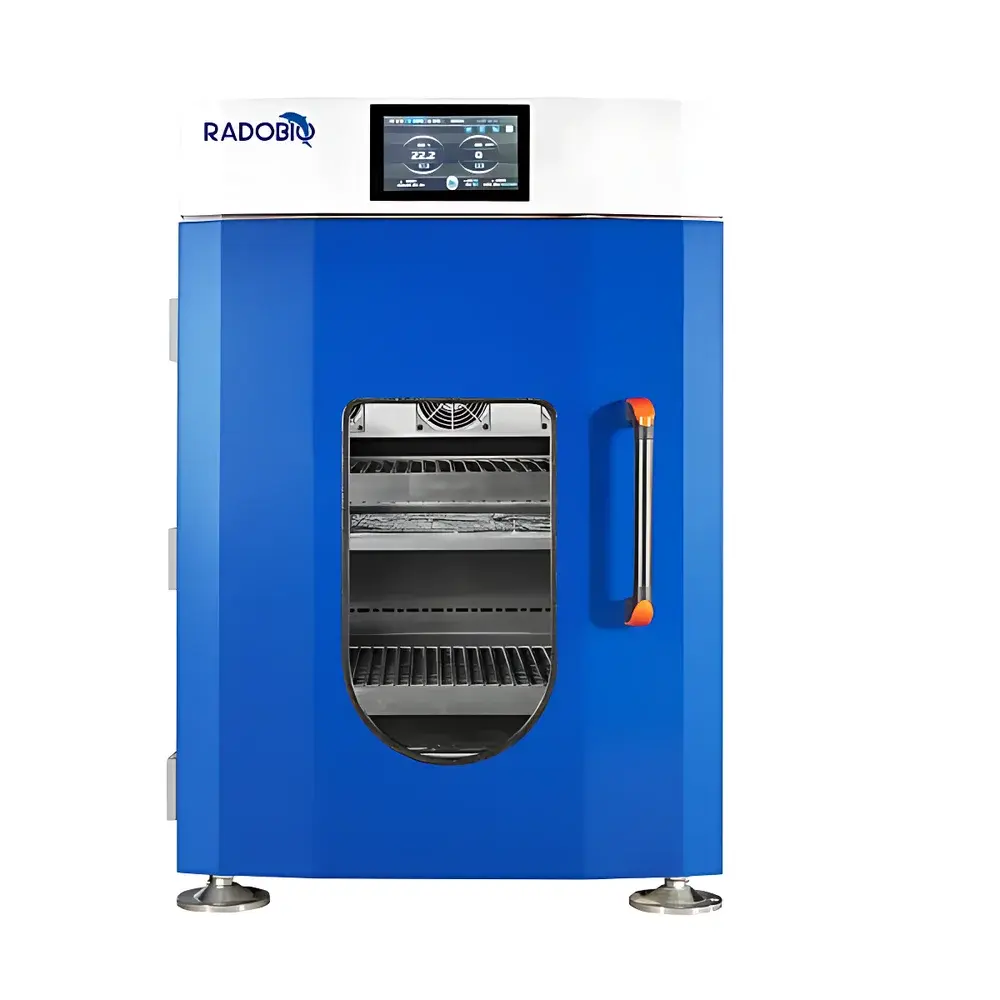
RADOBIO Stab MaxT Vertical Dual-Layer Full-Temperature Orbital Shaker Incubator
| Brand | RADOBIO |
|---|---|
| Origin | Shanghai, China |
| Model | Stab MaxT |
| Instrument Type | Full-Temperature Orbital Shaker Incubator |
| Timer Range | 0–999.9 h |
| Oscillation Amplitude Options | 26 mm / 50 mm (custom amplitudes available) |
| Temperature Range | 4 °C to 60 °C |
| Control Interface | LCD Touchscreen |
| Speed Range (Empty Load) | 2–300 rpm |
| Speed Accuracy | ±1 rpm |
| Temperature Setting Resolution | 0.1 °C |
| Temperature Uniformity | ±0.5 °C at 37 °C |
| Chamber Volume | 300 L |
| Internal Dimensions (L×W×H) | 638 × 620 × 690 mm |
| External Dimensions (L×W×H) | 710 × 775 × 1080 mm |
| Net Weight | 170 kg |
| Max Load per Shelf | 35 kg |
| Shelf Size | 500 × 500 mm |
| Power Consumption | 1300 W |
| Data Storage Capacity | 250,000 records |
| Data Logging Interval | 30 s – 9999 s (configurable) |
| Programmable Protocols | 5 stored protocols, up to 30 segments each |
| UV Sterilization | Integrated UV-C lamp |
| Lighting | 30 W fluorescent tube |
| Safety Features | Auto-braking on door opening, power-loss parameter retention, over-temperature/over-speed alarm, PID-based thermal control |
| Optional Accessories | Retractable light-blocking curtain, heated glass door, USB data export port |
Overview
The RADOBIO Stab MaxT is a vertically oriented, dual-layer full-temperature orbital shaker incubator engineered for precision-controlled microbial, mammalian, and suspension cell culture under dynamically regulated thermal and mechanical conditions. It operates on the principle of orbital shaking—generating uniform circular motion with defined amplitude and frequency—to ensure homogeneous oxygen transfer, nutrient mixing, and shear-sensitive cell suspension without vortex formation or excessive foaming. Unlike horizontal shakers, its vertical architecture optimizes ergonomic access and footprint efficiency in constrained laboratory environments. The dual-shelf configuration supports either simultaneous dual-layer orbital agitation or hybrid operation—orbital motion on the upper shelf and static incubation on the lower—enabling parallel experiments with divergent culture requirements within a single chamber. Its temperature range spans from refrigerated (4 °C) to elevated (60 °C), accommodating psychrophilic, mesophilic, and thermophilic applications, while its PID-driven thermal regulation ensures stability and repeatability across long-duration cultivations.
Key Features
- Dual independent shelves (500 × 500 mm each) with configurable operation modes: dual orbital, upper-orbital/lower-static, or fully static—maximizing experimental flexibility without increasing floor space.
- LCD touchscreen interface with intuitive navigation, large numeric displays, and real-time visualization of temperature, speed, amplitude, and elapsed time—designed for rapid parameter adjustment without operator training.
- Retractable internal light-blocking curtain (optional), installed between double-glazed observation window and outer panel, enabling photophobic cultivation while preserving visual monitoring capability and eliminating manual foil application.
- Double-pane safety glass door with optional door-heating function to suppress condensation during high-humidity or low-ambient-temperature operation—ensuring uninterrupted visual assessment of cultures.
- Integrated UV-C germicidal lamp (254 nm) activated during idle periods to maintain sterility of interior surfaces, compliant with standard biosafety practices for cleanroom-adjacent workflows.
- Monolithic stainless-steel interior with seamless radius corners and IPX4-rated water resistance; all electronics and drive motors housed externally to prevent moisture ingress and simplify decontamination.
- Low-noise bearing system and balanced oscillation mechanism enable stable operation up to 300 rpm—even under dual-shelf load—with vibration isolation exceeding ISO 20484-1 Class A thresholds.
- One-piece CNC-machined stainless-steel clamping fixtures with polymer-coated arms to eliminate pinch hazards, reduce bottle friction, and prevent fixture fatigue failure during extended cycling.
- Heatless waterproof blower system minimizes parasitic thermal load, enhancing temperature homogeneity and extending effective non-refrigerated operating range—reducing compressor duty cycle and energy consumption.
Sample Compatibility & Compliance
The Stab MaxT accommodates a broad spectrum of vessel formats—including Erlenmeyer flasks (25 mL to 5 L), deep-well microplates, test tube racks (15 mL and 50 mL), and custom bioreactor vessels—via interchangeable clamp kits (universal spring mesh, fixed-bottle clamps, deep-well plate holders, and centrifuge-tube adapters). Its 35 kg per-shelf capacity and optimized weight distribution support high-volume fermentation studies while maintaining mechanical integrity. The unit complies with IEC 61010-1:2010 for laboratory equipment safety and meets electromagnetic compatibility requirements per EN 61326-1. While not certified for GLP/GMP production environments out-of-the-box, its programmable logging (250,000 entries), timestamped audit trail, and USB data export capability align with FDA 21 CFR Part 11 readiness when deployed with validated SOPs and access controls.
Software & Data Management
The embedded controller supports up to five user-defined multi-segment protocols (30 segments per protocol), each defining time-varying setpoints for temperature, speed, and amplitude. Data logging occurs at user-configurable intervals (30 s to 9999 s), with all records stamped with date/time and stored internally in non-volatile memory. Optional USB port enables encrypted export of CSV-formatted datasets for traceability, statistical analysis, or integration into LIMS platforms. Alarm events—including door-open interruption, temperature deviation >±2 °C, speed error >±5 rpm, or UV lamp fault—are recorded with timestamps and persist until acknowledged. No cloud connectivity or proprietary software installation is required; raw data files are human-readable and compatible with common spreadsheet and plotting tools.
Applications
- Mammalian cell expansion in serum-free or chemically defined media under controlled O2 transfer rates.
- High-yield recombinant protein expression in E. coli and Pichia pastoris using temperature-shift and induction-synchronized protocols.
- Microbial growth kinetics assays for antibiotic susceptibility testing (AST) and metabolic profiling.
- Enzyme production and purification workflows requiring consistent agitation during induction and harvest phases.
- Algal biomass cultivation under photoperiod-controlled conditions (when paired with external lighting systems).
- Stability studies of biologics and vaccine candidates under accelerated thermal stress regimes (4 °C to 40 °C).
- Environmental microbiology—enrichment and isolation of heterotrophic bacteria from soil or water samples.
FAQ
What is the maximum flask size supported on a single shelf?
Up to five 3 L flasks or four 5 L flasks can be secured per shelf using the standard fixed-bottle clamp kit. Larger vessels require custom fixture engineering.
Does the unit support CO2 control or humidity regulation?
No—this model is designed exclusively for temperature and orbital agitation control. Humidity and CO2 integration are available in the RADOBIO Stab MaxT-CO2 variant.
Can the UV sterilization cycle be scheduled automatically?
Yes—the UV lamp can be programmed to activate during predefined idle windows via the timer function, with configurable duration and frequency.
Is calibration documentation provided with shipment?
A factory calibration certificate (traceable to NIST standards) is included, covering temperature sensor accuracy (±0.3 °C at 37 °C) and speed verification (±1 rpm) at three points across the operational range.
What maintenance intervals are recommended for long-term reliability?
Biannual inspection of belt tension, bearing lubrication status, and UV lamp output intensity is advised. The stainless-steel chamber requires only routine wipe-down with 70% ethanol or sporicidal agents between runs.
Related Products



