
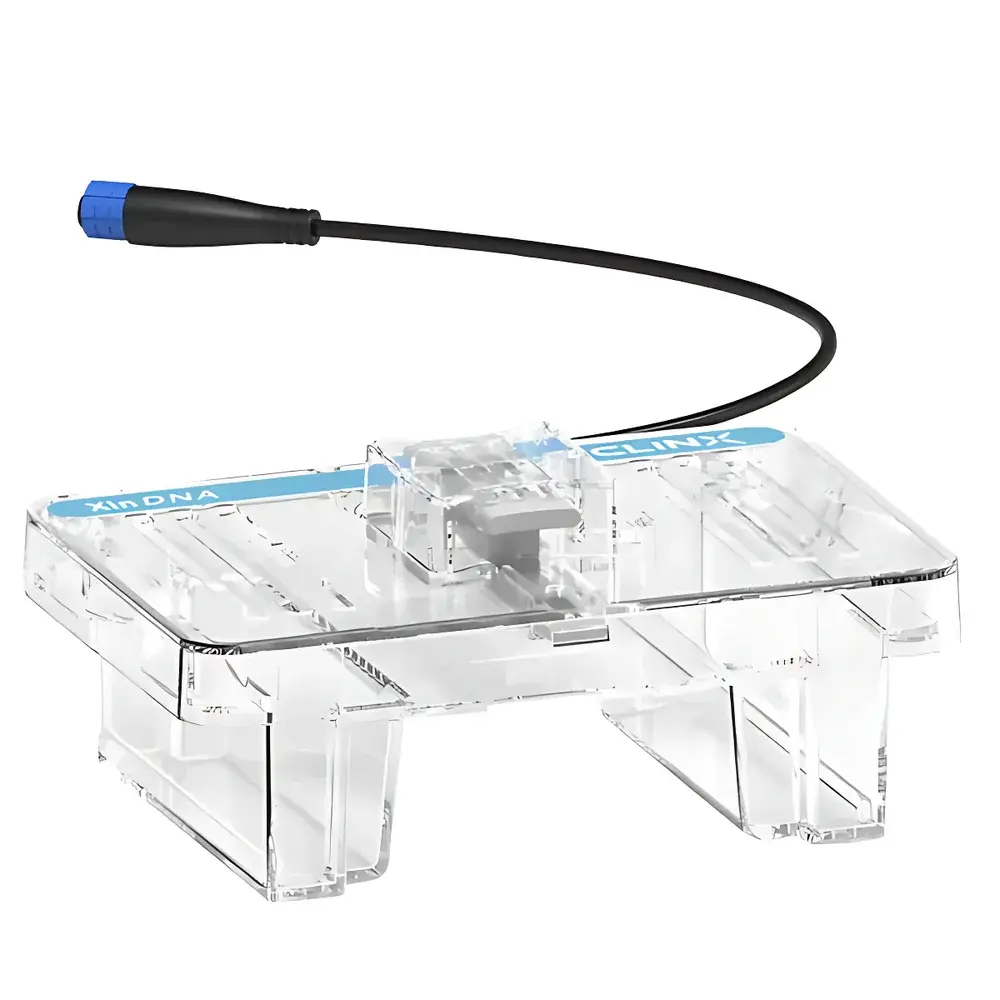
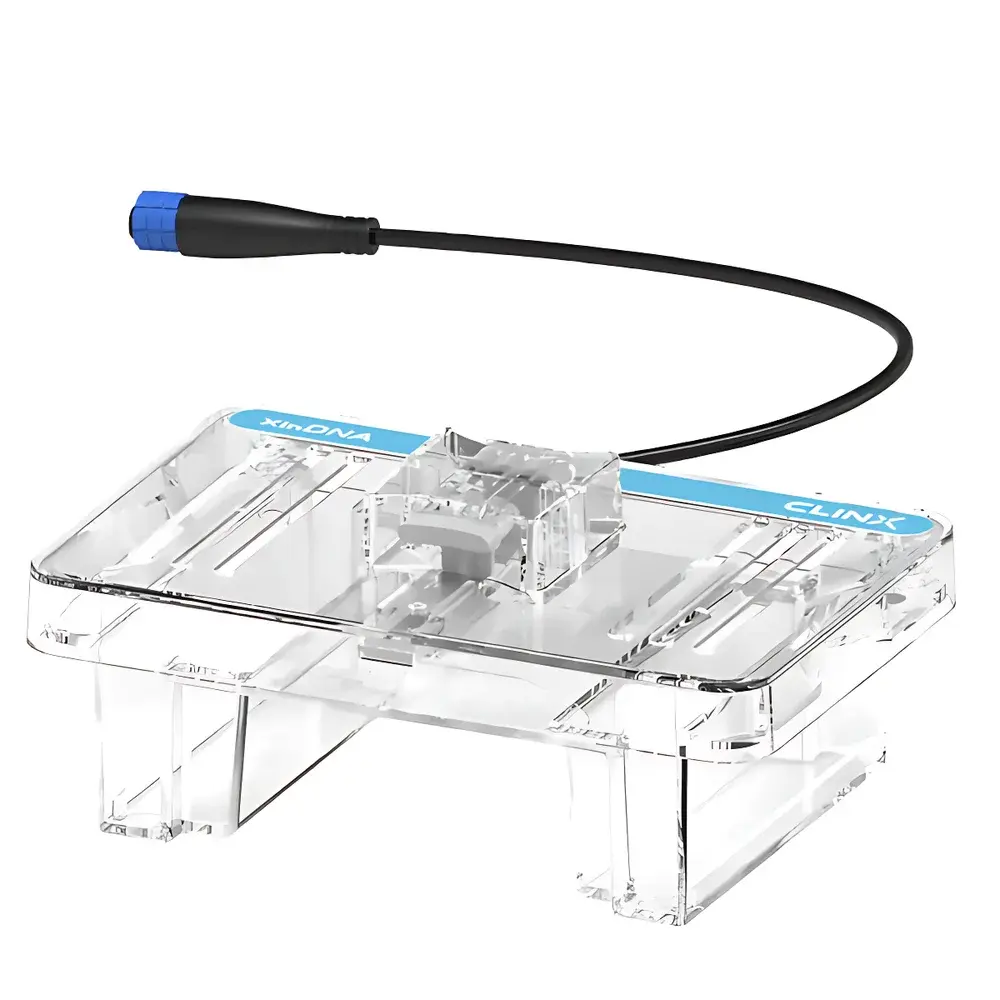
Clix XinDNA Horizontal Electrophoresis System
| Brand | Clix |
|---|---|
| Origin | Shanghai, China |
| Model | XinDNA |
| Instrument Type | Nucleic Acid Electrophoresis Apparatus |
| Gel Tray Dimensions | 125 mm × 125 mm |
| Maximum Buffer Volume | 750 mL |
| Electrode Cross-section | 1.6 mm × 1.0 mm |
| External Dimensions (W×D×H) | 218 mm × 144 mm × 89 mm |
| Comb Options | 0.75 mm (7+7 / 14-tooth |
| Total Comb Count | 9 |
| Electrode Lifetime | >100,000 connection cycles |
| Compliance | GB, IEC 61010-1, EN 61010-1 |
Overview
The Clix XinDNA Horizontal Electrophoresis System is a benchtop nucleic acid electrophoresis apparatus engineered for reproducible DNA and RNA separation in routine molecular biology laboratories. It operates on the principle of horizontal gel electrophoresis—where charged biomolecules migrate through a porous matrix (agarose or polyacrylamide gel) under a direct current electric field. The system’s modular tray design supports four standardized gel formats, enabling flexible experimental planning without compromising field uniformity or thermal stability. Its low-profile architecture minimizes buffer volume requirements while maintaining sufficient electrode-to-gel distance to ensure consistent voltage gradients across variable gel dimensions. Designed for compliance with international safety standards (IEC 61010-1 and EN 61010-1), the XinDNA system integrates seamlessly into GLP-aligned workflows where traceability, operator safety, and electrical reliability are non-negotiable.
Key Features
- Single-hand electrode connection mechanism with gold-plated spring-pin contacts—ensuring stable conductivity and mechanical durability exceeding 100,000 mating cycles.
- Tool-free, snap-fit lid with integrated alignment guides—eliminating misalignment risk during gel loading and enabling rapid setup and cleanup.
- Corrosion-resistant platinum- or stainless-steel electrodes (1.6 mm × 1.0 mm cross-section) mounted on reinforced polymer supports—designed for long-term performance in TAE, TBE, and MOPS buffers without polarization or pitting.
- Optimized buffer chamber geometry—reducing required volume by up to 30% compared to conventional horizontal systems of similar gel capacity, thereby lowering reagent cost and waste generation per run.
- Compact footprint (218 mm × 144 mm × 89 mm) with integrated cable management—ideal for space-constrained biosafety cabinets or shared core facility benches.
Sample Compatibility & Compliance
The XinDNA system accommodates standard agarose gels (0.7–3.0% w/v) and native or denaturing polyacrylamide gels (3–20% T) for applications including PCR product verification, restriction digest analysis, plasmid QC, and small RNA profiling. All gel trays are autoclavable (121 °C, 20 min), supporting strict contamination control protocols. The system complies with IEC 61010-1 for electrical safety in laboratory equipment and meets national GB standards for electromagnetic compatibility and insulation resistance. While not certified for clinical diagnostics under ISO 13485, its construction and documentation support audit readiness for ISO/IEC 17025-accredited testing laboratories performing method validation per CLSI EP05-A3 guidelines.
Software & Data Management
As a standalone electrophoresis platform, the XinDNA requires no proprietary software or drivers. Voltage and current parameters are set externally via compatible DC power supplies (e.g., 0–300 V, 0–500 mA). However, the system is fully interoperable with industry-standard gel documentation systems—including UV transilluminators (302 nm or 365 nm), chemiluminescence imagers, and densitometry platforms compliant with FDA 21 CFR Part 11 when paired with validated acquisition software (e.g., ImageLab, AlphaView SA, or Fiji/ImageJ with audit trail plugins). Raw electrophoretic data (band position, migration distance, relative mobility) can be exported in CSV or TIFF format for integration into LIMS or ELN environments supporting ASTM E2500-18 data integrity frameworks.
Applications
- Routine agarose gel electrophoresis for PCR amplicon sizing and purity assessment.
- High-resolution DNA fragment analysis using low-melt agarose or gradient polyacrylamide gels.
- Plasmid conformation analysis (supercoiled vs. linear vs. nicked) under non-denaturing conditions.
- RNA integrity evaluation (e.g., 28S/18S rRNA ratio) in denaturing MOPS-formaldehyde gels.
- Preparative electrophoresis for excision and extraction of DNA bands prior to cloning or sequencing library preparation.
- Teaching laboratory use—supporting student-led experiments with intuitive ergonomics and robust safety features.
FAQ
What power supply is recommended for optimal performance?
A programmable DC power supply capable of delivering 0–300 V and 0–500 mA with constant voltage or constant current mode is recommended. Output ripple should be ≤0.5% to minimize band smearing.
Can the XinDNA accommodate custom gel molds or comb configurations?
Yes—the tray base features standardized mounting slots compatible with third-party combs meeting DIN 476 A4 footprint alignment. Custom acrylic molds may be used if they maintain ≥2 mm clearance from electrodes and do not obstruct buffer circulation.
Is the system suitable for use with ethidium bromide alternatives such as SYBR Safe or GelRed?
Yes—buffer compatibility has been verified with all common nucleic acid stains, including SYBR Safe, GelRed, GelGreen, and EvaGreen. No leaching or fluorescence quenching was observed after 50 consecutive runs.
How often should electrodes be cleaned or replaced?
Under normal usage (≤5 runs/day), electrodes require no maintenance beyond rinsing with deionized water post-run. Visual inspection every 200 runs is advised; replacement is only necessary if physical deformation or measurable resistance increase (>5% over baseline) is detected.
Does the XinDNA support temperature-controlled electrophoresis?
No—it is a passive, ambient-temperature system. For temperature-sensitive applications (e.g., high-percentage PAGE), users must integrate external cooling plates or circulate chilled buffer via a peristaltic pump connected to the reservoir ports.





