
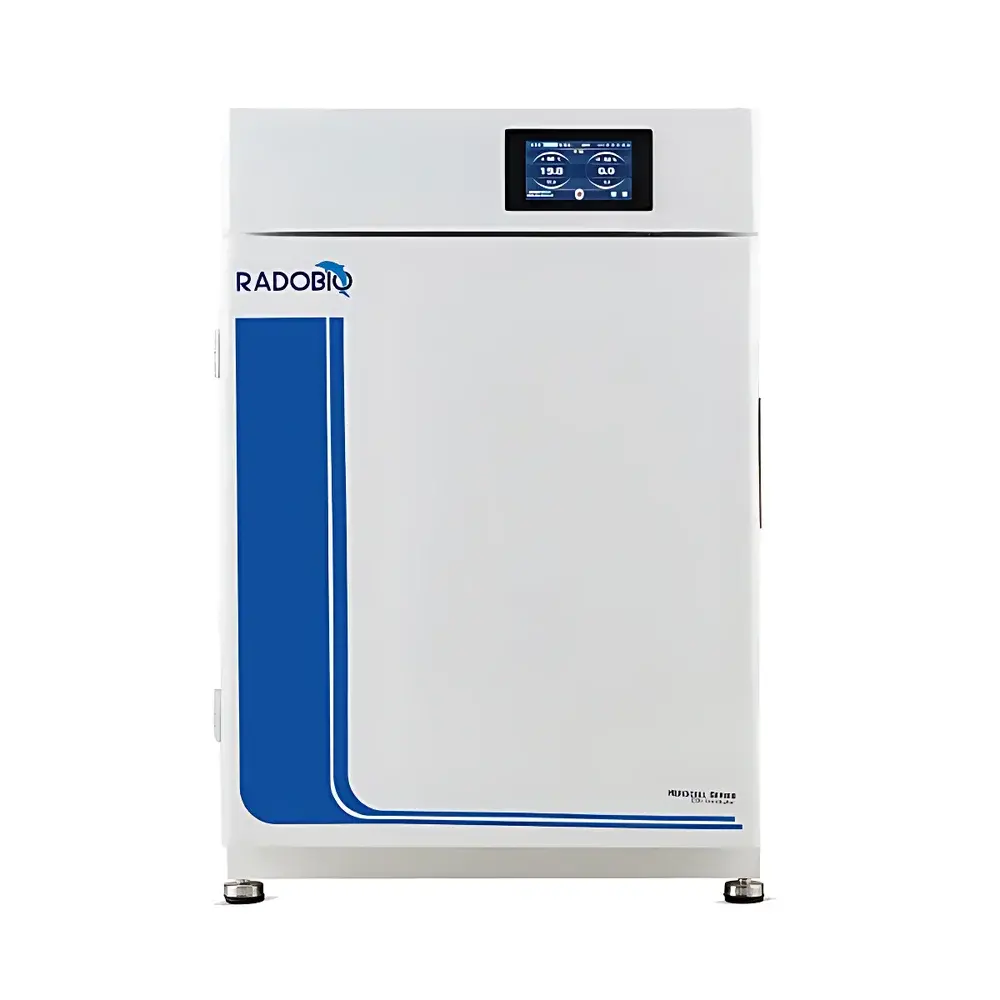
RADOBIO Herocell 80 Carbon Dioxide Incubator
| Brand | RADOBIO |
|---|---|
| Origin | Shanghai, China |
| Manufacturer Type | Authorized Distributor |
| Product Category | Domestic |
| Model | Herocell 80 |
| Instrument Type | Air-jacketed CO₂ Incubator |
| CO₂ Detection | Infrared (IR) Sensor |
| Temperature Control Range & Accuracy | Ambient +4°C to 60°C, ±0.1°C |
| Temperature Uniformity | ±0.2°C (at 25°C ambient, 37°C setpoint, empty chamber) |
| CO₂ Concentration Control Range & Accuracy | 0–20%, ±0.1% |
| Capacity | 85 L |
| Internal Dimensions (L×W×H) | 440 × 400 × 500 mm |
| External Dimensions (L×W×H) | 567 × 528 × 832 mm (including base) |
| Standard Configuration | PID control algorithm, 6-sided direct-heating air jacket, 140°C dry-heat sterilization cycle |
Overview
The RADOBIO Herocell 80 Carbon Dioxide Incubator is an air-jacketed, microprocessor-controlled environmental chamber engineered for precision cell culture applications in academic, clinical, and pharmaceutical laboratories. It operates on the fundamental principle of maintaining a physiologically relevant atmosphere—specifically 5% CO₂, 37°C, and ≥95% relative humidity—to support optimal mammalian cell proliferation, attachment, and metabolic function. The incubator employs a 6-sided direct-heating air jacket architecture to eliminate thermal gradients across the chamber volume, ensuring stable and reproducible temperature distribution without reliance on forced convection alone. Its infrared (IR) CO₂ sensor provides real-time, drift-resistant gas concentration monitoring independent of humidity fluctuations—a critical advantage over thermal conductivity (TC) sensors during frequent door openings or high-humidity operation. Designed for GLP-compliant workflows, the Herocell 80 integrates hardware-level data integrity safeguards, including tamper-proof internal logging and USB-exportable audit trails aligned with FDA 21 CFR Part 11 expectations for electronic records.
Key Features
- 6-sided direct-heating air jacket system delivering ±0.2°C temperature uniformity (measured at 37°C, empty chamber, 25°C ambient), minimizing spatial variability across all shelf positions
- 140°C dry-heat sterilization cycle—fully automated, chamber-wide, and validated to eliminate bacteria, yeasts, molds, and mycoplasma without disassembly or autoclaving of components
- Infrared (IR) CO₂ sensor with ±0.1% full-scale accuracy, insensitive to water vapor interference and stable over extended calibration intervals
- Integrated HEPA filtration system (ISO Class 5 equivalent) recirculating cabin air continuously; achieves >99.99% particle removal ≥0.3 µm and restores sterile conditions within 5 minutes after door opening
- Polished 304 stainless-steel interior with seamless, radius-corner construction and tool-free removable shelves—designed for rapid cleaning, chemical resistance, and low bioburden retention
- Capacitive 5-inch LCD touchscreen interface with graphical real-time trend display, configurable alarm thresholds, and audible/visual alerts for temperature deviation, CO₂ excursion, or door-open duration
- Passive humidity maintenance via 4-L capacity 304 stainless steel water pan; engineered airflow prevents condensation on upper chamber surfaces even at 37°C/95% RH
Sample Compatibility & Compliance
The Herocell 80 accommodates standard tissue culture vessels—including T-flasks (up to T225), multiwell plates (6–96-well), Petri dishes, and roller bottles—within its 85 L working volume. Its stainless-steel interior and non-porous surfaces comply with ISO 14644-1 Class 5 cleanroom requirements when operated with active HEPA filtration. The unit meets IEC 61010-1 safety standards for laboratory equipment and supports regulatory adherence in GMP environments through traceable parameter logging, user-access controls, and immutable historical data storage (250,000 entries). While not certified to ASTM E1907 or USP , its IR-based CO₂ sensing methodology and temperature stability profile align with best practices outlined in ISO 13408-2 (aseptic processing) and CLSI EP23-A (verification of incubator performance).
Software & Data Management
Data acquisition occurs at user-defined intervals (30 s to 9999 s), with all temperature, CO₂, and operational events timestamped and stored internally in non-volatile memory. Historical datasets—including setpoints, deviations, sterilization cycles, and door-open events—are exportable in CSV format via USB 2.0 port, preserving original acquisition time stamps and preventing post-collection modification. The embedded firmware implements write-once logging logic: once recorded, entries cannot be edited or deleted, satisfying ALCOA+ principles (Attributable, Legible, Contemporaneous, Original, Accurate, Complete, Consistent, Enduring, Available) for audit readiness. No proprietary software installation is required for data retrieval; exported files are compatible with common spreadsheet and LIMS platforms.
Applications
The Herocell 80 serves as a primary environment for routine and sensitive cell culture workflows, including primary cell isolation, stem cell expansion, hybridoma maintenance, transfection assays, and 3D organoid development. Its rapid thermal and gaseous recovery (<5 min post 30-sec door opening at 37°C/5% CO₂) makes it suitable for high-frequency access labs conducting co-culture experiments or time-lapse imaging preparations. The 140°C dry-heat cycle enables routine decontamination between cell line passages—particularly valuable for mycoplasma-prone cultures or shared-core facility use. Its compact footprint (567 × 528 × 832 mm) allows integration into biosafety cabinets, glove boxes, or modular lab layouts where space is constrained but environmental fidelity remains non-negotiable.
FAQ
What CO₂ supply pressure is recommended for optimal performance?
A regulated inlet pressure of 0.05–0.1 MPa (0.5–1 bar) is specified to ensure stable gas blending without over-pressurizing the internal mixing manifold.
Does the incubator support humidity monitoring as a standard feature?
Relative humidity is maintained passively via the stainless-steel water pan; digital RH sensing is available only as an optional add-on module.
Can multiple Herocell 80 units be stacked vertically?
Yes—up to two units may be mechanically coupled using the Herocell 80-D2 stacking kit, maintaining independent control and validation per chamber.
Is the 140°C sterilization cycle validated per ISO 14644 or EN 285?
The cycle is manufacturer-validated for microbial reduction efficacy; formal validation against ISO 14644 or EN 285 requires site-specific IQ/OQ protocols performed by qualified personnel.
How frequently must the HEPA filter be replaced?
Filter replacement interval depends on usage intensity and ambient air quality; typical service life is 6–12 months under continuous operation in ISO Class 7 environments.



