
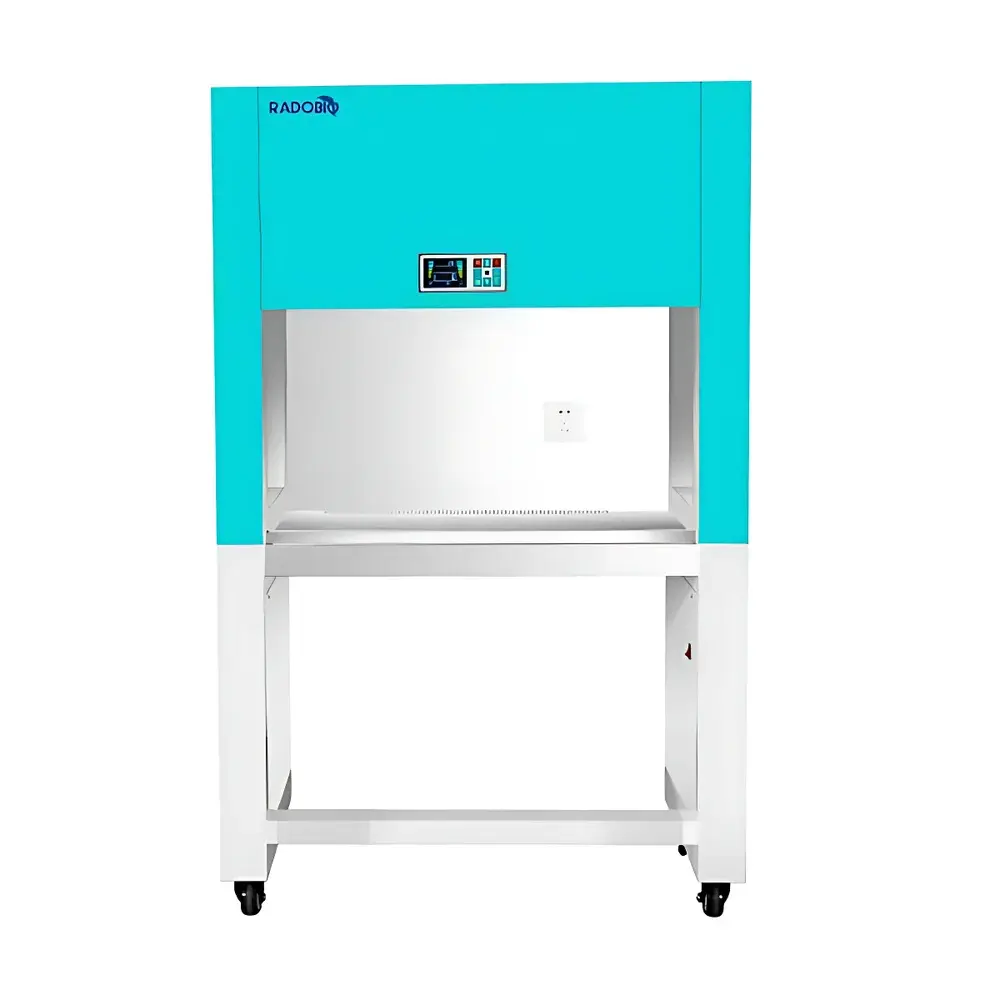
RADOBIO AirGuard1000 Single-Person, Single-Open-Face Clean Bench
| Brand | RADOBIO |
|---|---|
| Origin | Shanghai, China |
| Manufacturer Type | Authorized Distributor |
| Country of Origin | China |
| Model | AirGuard1000 |
| Cleanliness Class | ISO 5 (Class 100) |
| Noise Level | ≤62 dB(A) |
| User Configuration | Single-person, single-open-face |
| Average Air Velocity | 0.3–0.6 m/s |
| Illuminance | ≥300 lx |
| UV Sterilization | Integrated germicidal lamp |
| Power Supply | AC 220 V, 50 Hz |
| Rated Power | 250 W |
| Work Area Dimensions (W×D×H) | 870 × 690 × 520 mm |
| Overall Dimensions (W×D×H) | 1010 × 725 × 1625 mm |
| Net Weight | 130 kg |
| Microbial Contamination | ≤0.5 CFU/plate·hour (Φ90 mm settle plate) |
Overview
The RADOBIO AirGuard1000 is a single-person, single-open-face laminar flow clean bench engineered for reliable personnel and sample protection in non-sterile but particle-controlled environments. It operates on the principle of unidirectional, vertical laminar airflow—generated by a low-turbulence centrifugal blower and conditioned through a certified HEPA filter (EN 1822 H14 or equivalent)—to deliver ISO 5 (Class 100) air quality within the work area. Unlike biological safety cabinets, the AirGuard1000 does not recirculate air nor provide containment for hazardous agents; instead, it establishes a consistent, low-velocity (0.3–0.6 m/s), particle-free airflow barrier across the entire work surface to minimize airborne contamination during routine aseptic procedures. Its design conforms to core performance expectations outlined in ISO 14644-1 for cleanroom classification and aligns with general laboratory best practices for microbiological handling as referenced in ISO 14698-1 (Biocontamination control) and USP (Microbiological control of cleanrooms).
Key Features
- Vertical laminar airflow system with real-time digital monitoring of air velocity, operational time, and ambient temperature via a full-color LCD interface
- Three-step adjustable blower speed control using capacitive touch keys for precise airflow optimization across varying procedural demands
- UV germicidal lamp with programmable scheduling: users may define start/end times for automated sterilization cycles, reducing manual intervention and ensuring consistent decontamination protocols
- Manually operated 5 mm tempered glass sash with infinite-position counterbalanced suspension mechanism—enabling smooth, stable height adjustment and secure hold at any point within its travel range
- Interlocked lighting and UV systems: illumination remains active only when UV emission is disabled, preventing inadvertent exposure during operation
- Monolithic 304 stainless steel work surface—electropolished and seamless—for corrosion resistance, non-porosity, and compliance with cleaning validation requirements under GMP/GLP frameworks
- Pre-filter integrated upstream of the HEPA module to capture coarse particulates (>5 µm), thereby extending HEPA service life and reducing long-term maintenance frequency
- Four swivel casters with locking brakes—facilitating repositioning within shared lab spaces while ensuring stability during active use
- Dedicated dual-outlet power strip with overcurrent protection and automatic cut-off upon main power loss, supporting auxiliary equipment without compromising safety integrity
Sample Compatibility & Compliance
The AirGuard1000 is intended for applications where product sterility must be preserved against environmental particulate and microbial ingress—but where operator protection from biohazards or chemical vapors is not required. It supports routine tasks including media preparation, cell passaging, PCR setup, sterile filtration, and non-hazardous instrument calibration. The unit meets structural and performance benchmarks aligned with ISO 14644-1 (cleanliness classification), IEC 61000-6-3 (EMC emissions), and IEC 61000-6-2 (immunity). While not certified to NSF/ANSI 49 or EN 12469 (which apply to biosafety cabinets), its construction materials—including electrostatically coated cold-rolled steel enclosure and optical-grade side panels—support routine disinfection per CDC-recommended protocols and facilitate visual inspection per ISO 13485 Annex A.3 (cleanroom environmental monitoring).
Software & Data Management
The AirGuard1000 employs embedded firmware—not cloud-connected software—with local data retention limited to runtime logs (e.g., cumulative UV exposure hours, filter usage duration, and blower runtime). All operational parameters—including setpoints and alarm thresholds—are stored in non-volatile memory and survive power interruption. The system provides visual alerts for HEPA filter saturation (based on differential pressure monitoring) and UV lamp end-of-life (via accumulated irradiation time tracking), enabling proactive maintenance scheduling. Audit trails are not generated, as the device lacks user authentication or electronic record capabilities; however, all displayed metrics comply with ALCOA+ principles when manually transcribed into laboratory notebooks or LIMS entries. No FDA 21 CFR Part 11 functionality is implemented, consistent with its classification as Class I general-purpose laboratory equipment.
Applications
- Cell culture setup and subculturing in academic and industrial biotechnology labs
- Aseptic preparation of culture media, reagents, and dilution blanks in food microbiology and pharmaceutical QC laboratories
- Handling of sensitive electronic components requiring particulate-free assembly environments
- Plant tissue culture and seed germination studies in agricultural research facilities
- Pre-analytical sample staging prior to entry into higher-classified cleanrooms or isolators
- Calibration and alignment of optical instruments where ambient dust compromises measurement fidelity
FAQ
Is the AirGuard1000 suitable for working with pathogenic microorganisms?
No. This unit provides product protection only and does not offer personnel or environmental protection against aerosolized biohazards. Use only with Risk Group 1 (RG1) agents or non-infectious materials.
What is the recommended HEPA filter replacement interval?
Filter life depends on ambient air quality and daily usage duration. Under typical lab conditions (8 h/day, ISO 8 background), replacement is advised every 18–24 months—or sooner if differential pressure exceeds 250 Pa or airflow drops below 0.3 m/s.
Can the unit be installed in a room without HVAC supply?
Yes. The AirGuard1000 is self-contained and draws ambient air from the surrounding environment. However, installation in a temperature- and humidity-stable space (20–25°C, 40–60% RH) is recommended to maintain consistent airflow performance and minimize condensation risk.
Does the UV lamp emit ozone?
No. The lamp operates at 254 nm and is housed in a quartz sleeve that blocks ozone-generating wavelengths (<200 nm). No ozone detection is expected during standard operation.
Is calibration traceable to national standards?
Air velocity and illuminance measurements are performed using NIST-traceable handheld sensors during factory acceptance testing. End-users may perform periodic verification using calibrated anemometers and lux meters per ISO/IEC 17025 guidelines.



