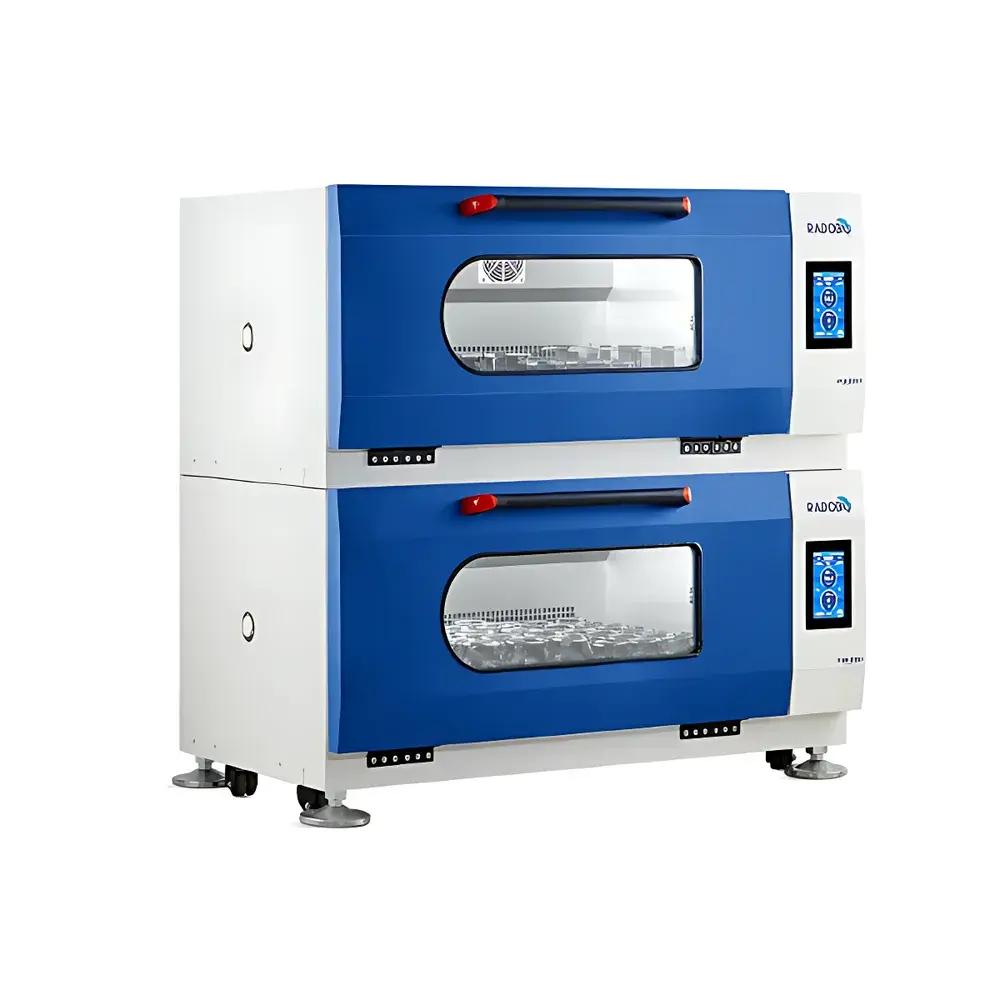
RADOBIO Stab L1T Stackable High-Capacity Full-Temperature Orbital Shaker Incubator
| Brand | RADOBIO |
|---|---|
| Origin | Shanghai, China |
| Model | Stab L1T |
| Instrument Type | Full-Temperature Orbital Shaker Incubator |
| Timer Range | 0–999.9 h |
| Oscillation Amplitude | 26 mm or 50 mm (custom amplitudes available) |
| Temperature Range | 4 °C to 60 °C |
| Display | 7-inch vertical LCD touch screen |
| Control Precision | ±0.1 °C temperature setting, ±1 rpm speed control |
| Uniformity | ±0.5 °C at 37 °C |
| Chamber Volume | 450 L |
| Max Load per Deck | 50 kg |
| Deck Dimensions | 520 × 880 mm |
| Internal Dimensions | 1050 × 730 × 595 mm (L×W×H) |
| Power Consumption | 1400 W max |
| Data Storage | 250,000 records (configurable logging interval: 30 s – 9999 s) |
| Programs | 5 stored, up to 30 segments per program |
| Safety Features | Door-activated soft-stop/soft-start, auto-restart after power failure with event log, over-temp/over-speed alarm, UV sterilization module |
| Construction | Seamless brushed 304 stainless steel interior, double-glazed tempered glass door with optional anti-fog heating |
| Noise Level | <55 dB(A) at full load and 300 rpm |
| Stackable Configuration | Single unit (Stab L1T), dual-stack (Stab L1T-2), or upper-layer add-on (Stab L1T-D2) |
Overview
The RADOBIO Stab L1T Stackable High-Capacity Full-Temperature Orbital Shaker Incubator is an engineered solution for scalable, reproducible microbial, mammalian, and bioprocess cultivation under tightly controlled thermal and mechanical conditions. Designed around the principles of orbital shaking—where a circular motion induces homogeneous suspension and gas exchange in liquid cultures—the system integrates precise PID-based temperature regulation (4 °C to 60 °C), digitally stabilized rotational actuation (2–300 rpm), and modular physical architecture to support evolving laboratory throughput requirements. Unlike conventional shaker incubators limited by fixed footprint or single-tier operation, the Stab L1T employs a mechanically decoupled stacking interface that allows two independently controlled units to be vertically integrated without compromising thermal stability, vibration isolation, or operational autonomy. Its sealed stainless-steel chamber (450 L volume), combined with a waterproof external drive assembly and IP54-rated electronics housing, ensures long-term reliability in high-humidity environments typical of extended fermentation or cell expansion workflows.
Key Features
- 7-inch vertical LCD touchscreen interface with intuitive icon-driven navigation—no specialized training required for parameter adjustment, multi-segment program creation, or real-time curve visualization.
- Stackable dual-unit configuration (Stab L1T-2): Each layer operates as a fully independent incubation zone with separate temperature, speed, timing, and alarm settings—enabling parallel experiments under divergent conditions.
- Double-glazed tempered safety glass door with optional anti-fog heating element—maintains optical clarity during low-temperature operation and prevents condensation-induced obscuration of culture monitoring.
- UV-C germicidal lamp (254 nm) integrated into the ceiling panel—automatically activated during idle periods to suppress airborne and surface-borne microbial contaminants, supporting ISO 14644-compliant cleanroom-adjacent workflows.
- Seamless 304 stainless steel interior with radius-rounded corners and sloped floor drainage—compatible with autoclave-grade disinfectants, ethanol, hydrogen peroxide vapor, and validated cleaning protocols per EU GMP Annex 1 and USP <1058>.
- Patented low-heat, waterproof centrifugal blower—minimizes parasitic thermal load on the chamber, enabling tighter temperature uniformity (±0.5 °C at 37 °C) and expanded passive temperature range without compressor activation.
- Tool-free, pull-out anodized aluminum deck (8 mm thick, brushed chrome finish)—optimized for rapid loading/unloading of large-volume vessels (up to 5 L Erlenmeyer flasks) in constrained benchtop spaces.
- Integrated safety architecture: soft-stop/soft-start upon door opening/closing; auto-recovery with fault logging after power interruption; real-time deviation alarms (visual + audible) for temperature, speed, or timer anomalies.
Sample Compatibility & Compliance
The Stab L1T accommodates standard and custom vessel formats—including 125 mL to 5000 mL conical flasks, deep-well microplates, roller bottles, and tube racks—via interchangeable clamping systems (universal spring mesh, fixed bottle clamps, deep-well plate holders). All contact surfaces are non-porous and chemically resistant, meeting ASTM F2529-20 standards for material compatibility with common bioprocessing solvents and sterilants. The system supports GLP/GMP-aligned documentation through USB data export (CSV format), configurable logging intervals (30 s–9999 s), and 250,000-point internal memory with timestamped audit trails. While not pre-certified to FDA 21 CFR Part 11, its deterministic control logic, parameter lockout options, and immutable event logs provide a foundational framework for validation under ICH Q5D, USP <1043>, and ISO 13485 quality management systems.
Software & Data Management
No proprietary software installation is required. All operational parameters—including setpoints, real-time sensor values (temperature, RPM, elapsed time), and historical trend curves—are managed locally via the embedded Linux-based controller. Data export occurs via front-panel USB-A port; files include metadata headers (instrument ID, operator tag, start/end timestamps) and conform to comma-separated value (CSV) structure for direct import into MATLAB, Python pandas, or LIMS platforms such as LabWare or Thermo Fisher SampleManager. Logging intervals, retention policies, and alarm thresholds are user-configurable. The system retains last-run parameters across power cycles and stores up to five complete multi-segment programs—each supporting up to thirty discrete steps with independent temperature, speed, and duration definitions.
Applications
- High-density seed train expansion for CHO, HEK293, and insect cell lines in serum-free or chemically defined media.
- Aerobic bacterial fermentation (e.g., E. coli, Bacillus subtilis) requiring precise oxygen transfer rates and thermal consistency across batch scales.
- Yeast propagation and metabolic studies where oscillatory shear stress must remain within physiologically relevant ranges (0.5–5 Pa).
- Environmental microbiology assays involving soil slurry enrichment or wastewater biofilm development under variable temperature regimes.
- Biopolymer synthesis (e.g., alginate, xanthan gum) where viscosity-dependent mixing efficiency directly impacts product yield and molecular weight distribution.
- Long-term stability testing of biologics formulations under ICH Q1A(R3) accelerated storage conditions (e.g., 40 °C/75% RH simulated via controlled chamber environment).
FAQ
Can the Stab L1T operate at 4 °C while maintaining humidity control?
Yes—the refrigeration system is rated for continuous operation down to 4 °C. Humidity is not actively regulated, but the sealed chamber and low-heat blower minimize internal condensation; optional door heating further mitigates fogging.
Is UV sterilization validated against specific microbial strains?
The 254 nm UV-C source delivers ≥100 µW/cm² irradiance at 10 cm distance. While RADOBIO does not provide third-party microbial log-reduction reports, users may perform in-house validation per ISO 15714 using Bacillus atrophaeus spores or Aspergillus niger conidia.
What electrical infrastructure is required for dual-stack operation?
Each Stab L1T unit requires a dedicated 16 A / 230 V circuit. When stacked as Stab L1T-2, both units must be connected to separate circuits to prevent overload and ensure independent restart behavior after power loss.
Does the system support remote monitoring or network integration?
No Ethernet or Wi-Fi interface is included. Remote access requires external industrial IoT gateways (e.g., Siemens Desigo CC, Ignition SCADA) interfacing via Modbus RTU over RS-485 (optional add-on port).
How is mechanical balance maintained during high-speed operation with asymmetric loads?
The oscillation mechanism uses dynamically balanced eccentric shafts and self-aligning angular contact bearings. Combined with a rigid 304 SS chassis and isolated mounting feet, this design achieves <55 dB(A) noise emission even at 300 rpm with 50 kg off-center mass.